Detailed Record
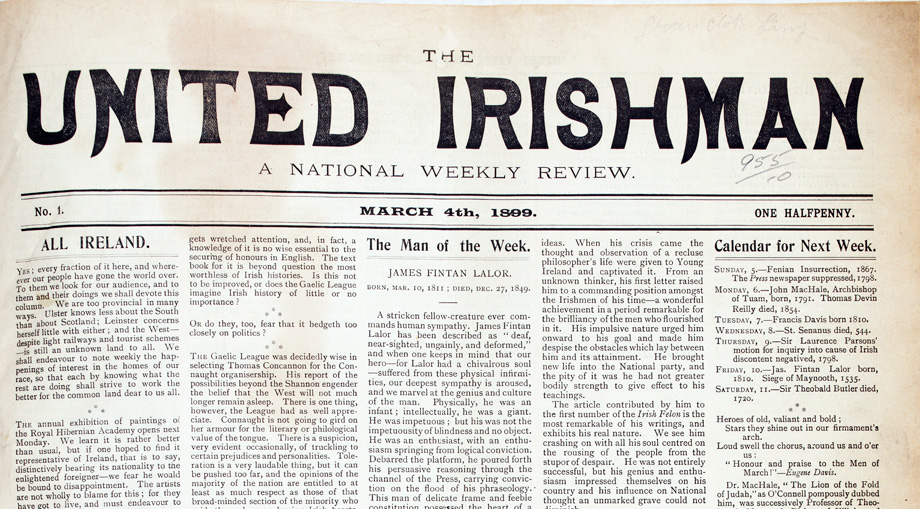
United Irishman, The;
vol 1 no 1, 04 Mar 1899 - vol 16 no 372, 14 Apr 1906

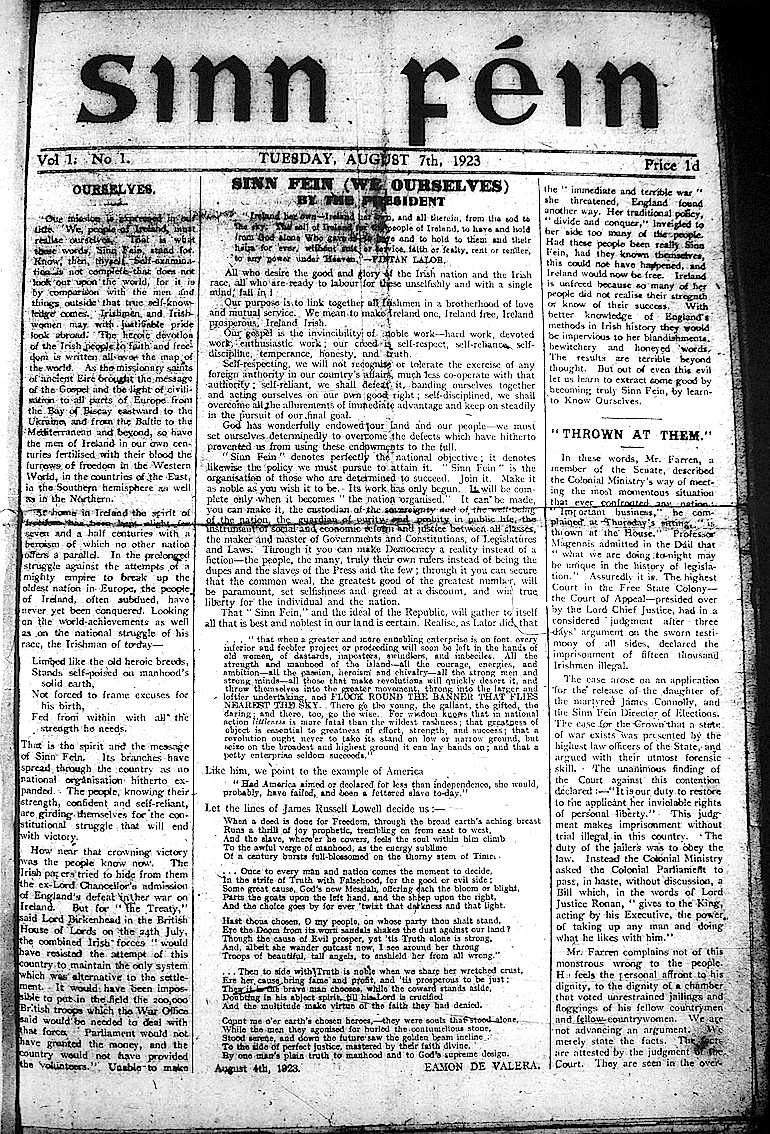
then: Sinn Fein. no 1, 05 May 1906 - no 240, Jun 1925
then: United Irishman, The. no 1(2s), Aug 1923 - no 40, Jun 1925
then: United Irishman, The. no 1(2s), Aug 1923 - no 40, Jun 1925
Dublin,Dublin
Editor:
John F. Fowler
Arthur Griffith (Mar 1899 - 1906)
William Rooney (assistant ed, 1899-1901.)
Arthur Griffith (Mar 1899 - 1906)
William Rooney (assistant ed, 1899-1901.)
Proprietor:
Arthur Griffith (founder)1899-1906)
Publisher:
Sinn Fein Co (1906-1914)
Printer:
Newth and Co Devereux (1913 - 1914)
Bernard Doyle (1899)
P.C.D. Warren (1901-1904)
Bernard Doyle (1899)
P.C.D. Warren (1901-1904)
Contributors:
William Bulfin
Joseph Campbell
Roger Casement
Padraic Colum
James Connolly
John Eglinton
Frank Fay
Oliver St. John Gogarty
Maude Gonne
Arthur Griffith
Douglas Hyde
Edward Martyn
Alice Milligan (c.1906)
Austin Molloy (ill.)
George Moore
P.S. O’Rahilly, The [Michael Joseph] O'Hegarty
Seamus O'Kelly
Seamus O'Sullivan
Padraig [Patrick] Pearse
T.W. Rolleston
George Russell (pseudo AE)
Fred Ryan
James Stephens (c.1906)
Katharine Tynan
Jack B. Yeats
William Butler Yeats
Joseph Campbell
Roger Casement
Padraic Colum
James Connolly
John Eglinton
Frank Fay
Oliver St. John Gogarty
Maude Gonne
Arthur Griffith
Douglas Hyde
Edward Martyn
Alice Milligan (c.1906)
Austin Molloy (ill.)
George Moore
P.S. O’Rahilly, The [Michael Joseph] O'Hegarty
Seamus O'Kelly
Seamus O'Sullivan
Padraig [Patrick] Pearse
T.W. Rolleston
George Russell (pseudo AE)
Fred Ryan
James Stephens (c.1906)
Katharine Tynan
Jack B. Yeats
William Butler Yeats
Size:
49cm; 64cm (1906); 4pp (Mar-Jun 1899); 8pp (Jul 1899-Apr 1906)
Price:
1/2d (1899); 1d (1900); 1d (1906); 1/2d (daily 1909)
Circulation:
500/wk (1899)
Frequency:
weekly (1899); daily (1906 [1909?]); weekly (1906)
Illustration:
political cartoons
Departments:
calendars foreign notes, local news, letters to editor, poetry, advertising, nationalist articles, [Irish] Gaelic league, articles in [Irish] Gaelic, art, music & drama, national calendar, short stories, all Ireland, man of the week, calendar for next week
Orientation:
nationalist; pro-Boer (1899-1902); Irish-Ireland; pro-women’s rights
Merges:
absorbed The Shan van Vocht (1899)
Sources:
"Austin Molloy (1886-1961)." Irish Comics Wiki.; Brown, The Press in Ireland.; Clune, "Seamus O'Kelly," p.146.; COPAC; Harmon, Study of Anglo-Irish Literature, p.144.; Leerssen, Remembrance and Imagination; NLI; O'Broin, Revolutionary Underground, pp.110, 130.; Ward, Imagining Alternative Irelands.
Histories:
Glandon, Virginia. Arthur Griffith and the Advanced-Nationalist Press- Ireland, 1900-1922. Bern, Switzerland: Peter Lang US, 1985.; Hewitt, "Press and the Law" p.153.; Kelly, "Ideological Dilemmas of Sinn Féin," p.150.; Kenny, "Arthur Griffith's editorships".; Maume, "Parnellite Politics and the Origins of Independent Newspapers".; McCracken, Donal P. "This Lonely Propagandist." nli.ie/blog, 20 Apr 2012.; O’Riordan, Tomás. "Arthur Griffith." Multitext Project in Irish History. multitext.ucc.ie; Douglas et al, Drawing Conclusions, 1998. pp.147; Meehan, Clara. "The Prose of Logic." Irish Journalism Before Independence, pp.186-199.; Sidman, "Parnell to Modern Ireland," p.330.; Steele, "Editing out factionalism" pp.128-129.; Strachan, Nally. Advertising, Literature and Print Culture, 2012.; Tymoczko, The Irish Ulysses. pp.229-237; "United Irishman." wikipedia.org
Comments:
The journal became a daily from 1906 but may have returned to a weekly format. Also in 1906, the United Irishman collapsed under a libel suit and was restarted as Sinn Fein, until its suppression from Dec. 1914 to July 1923. A daily edition may have been published from Aug 1909-Jan 1910, although one library catalogue says it was weekly from 1906 to 1914. The journal was reissued as a weekly in a new series consisting of three volumes from Aug 1923-Jun 1925.
In Sinn Fein's first issue, Griffith related his new paper's intent: "The policy which Sinn Fein is born to advocate needs no lengthy exposition...Its essential is faith...a nation's faith in itself. It is because England has disarmed this country, because she has impoverished it, because she is strong that we write 'humbug' to the policy of trusting in England's sense of justice" (Quoted in Glandon, 41).
Sidman writes that "although this newspaper drew upon the Fenians for its title, it relied upon the [Irish] Gaelic League and slogans such as 'Buy Irish' for its strength. More so by far than the [Irish] Gaelic League, however, Sinn Fein stressed the importance of patriotism" (330).
Strachan and Nally note Griffith's pride in the fact that Sinn Fein was "the only journal in Ireland entitled to use the Irish Trade Mark [of the Irish Industrial Development Association];" it was entirely made in Ireland, "using, indeed, Irish ink" (46).
O'Broin calls Sinn Fein "the organ of the National Council [which had originally been] formed to organise protests against the visit of King Edward VII" (130). Yeats contributed an essay called "Ireland and the Arts" in 1901, and Where there is nothing : a play in five acts as a supplement to the United Irishman in 1902.
There were government attempts to suppress the paper. Hewitt explains that "in the late 1880s, Irish newspaper proprietors were imprisoned under the Coersion Act merely for reporting meetings of the suppressed National League, and [later] shopkeepers for selling the United Irishman" (153).
Leerssen explains that a conflict between Yeats and Griffith played out in part through pages of the United Irishman. However, Kelly explains that the paper was originally enthusiastic about Yeats's Irish National Theatre (151).
"The United Irishman, and its successor, Sinn Fein, depended heavily upon financial supporters who condoned its strong separatist approach to nationalist politics, one that diverged from the scrupulously non-sectarian editorial voice of the Shan Van Vocht" (Steele 129).
The paper had a significant impact on James Joyce. "In addition to many series of political articles, [it] carried regular features meant to inculcate in its readers an Irish patriotic history, to expose them to pre-Christian Irish myth and to acquaint them with some principal texts of early Irish literature; the journal also attempted to familiarize its readers with contemporary nationalist Anglo-Irish literature through its reviews and notices" (Tymoczko 232). It "also reported on speeches about Irish literature and culture" (235), and included "transcripts of lectures on early Irish topics... and discussions of placelore" (236).
Griffith published a series of articles in the United Irishman. These articles became The Resurrection of Hungary, which was claimed to sell 25,000 in twenty-four hours, which was an Irish record (Kelly 150).
The United Irishman was "woefully under-financed" according to Padraic Colum and Griffith and Rooney wrote some of the early numbers entirely (reproduced in Kenny 19).
Meehan notes that "[Jonathan] Swift was invariably quoted next to the masthead... of Sinn Fein.
Kenny: "no sooner had the struggling United Irishman gone than Griffith 'cheerfully rebaptised it under the still more appropriate name of Sinn Fein'. One of Griffith's first campaigns in this new weekly publication was for the voting system of proportional representation" (22).
In Sinn Fein's first issue, Griffith related his new paper's intent: "The policy which Sinn Fein is born to advocate needs no lengthy exposition...Its essential is faith...a nation's faith in itself. It is because England has disarmed this country, because she has impoverished it, because she is strong that we write 'humbug' to the policy of trusting in England's sense of justice" (Quoted in Glandon, 41).
Sidman writes that "although this newspaper drew upon the Fenians for its title, it relied upon the [Irish] Gaelic League and slogans such as 'Buy Irish' for its strength. More so by far than the [Irish] Gaelic League, however, Sinn Fein stressed the importance of patriotism" (330).
Strachan and Nally note Griffith's pride in the fact that Sinn Fein was "the only journal in Ireland entitled to use the Irish Trade Mark [of the Irish Industrial Development Association];" it was entirely made in Ireland, "using, indeed, Irish ink" (46).
O'Broin calls Sinn Fein "the organ of the National Council [which had originally been] formed to organise protests against the visit of King Edward VII" (130). Yeats contributed an essay called "Ireland and the Arts" in 1901, and Where there is nothing : a play in five acts as a supplement to the United Irishman in 1902.
There were government attempts to suppress the paper. Hewitt explains that "in the late 1880s, Irish newspaper proprietors were imprisoned under the Coersion Act merely for reporting meetings of the suppressed National League, and [later] shopkeepers for selling the United Irishman" (153).
Leerssen explains that a conflict between Yeats and Griffith played out in part through pages of the United Irishman. However, Kelly explains that the paper was originally enthusiastic about Yeats's Irish National Theatre (151).
"The United Irishman, and its successor, Sinn Fein, depended heavily upon financial supporters who condoned its strong separatist approach to nationalist politics, one that diverged from the scrupulously non-sectarian editorial voice of the Shan Van Vocht" (Steele 129).
The paper had a significant impact on James Joyce. "In addition to many series of political articles, [it] carried regular features meant to inculcate in its readers an Irish patriotic history, to expose them to pre-Christian Irish myth and to acquaint them with some principal texts of early Irish literature; the journal also attempted to familiarize its readers with contemporary nationalist Anglo-Irish literature through its reviews and notices" (Tymoczko 232). It "also reported on speeches about Irish literature and culture" (235), and included "transcripts of lectures on early Irish topics... and discussions of placelore" (236).
Griffith published a series of articles in the United Irishman. These articles became The Resurrection of Hungary, which was claimed to sell 25,000 in twenty-four hours, which was an Irish record (Kelly 150).
The United Irishman was "woefully under-financed" according to Padraic Colum and Griffith and Rooney wrote some of the early numbers entirely (reproduced in Kenny 19).
Meehan notes that "[Jonathan] Swift was invariably quoted next to the masthead... of Sinn Fein.
Kenny: "no sooner had the struggling United Irishman gone than Griffith 'cheerfully rebaptised it under the still more appropriate name of Sinn Fein'. One of Griffith's first campaigns in this new weekly publication was for the voting system of proportional representation" (22).
Location:
LO/N38 A (Jan 1900, 1903-1906, 1906-1914; microfilm: 1899-1906, 1909-1910, 1923); DB/N-1 nos 1-17; vol 2:18-4:96 (1899-1900); DB/U-1 A (microfilm: 20 Apr 1901-10 May 1902, 17 May 1902-20 Dec 1902, 1909-1910, ns 15 Feb 1923- 24 Nov 1923); MA/U-1 A (Mar 1899-Oct 1900, Dec 1901 to Dec 1902); LV/U-1 A (microfilm: 1906-1914); ED/N-1 A (1906-1914, 1923-1925); DB/N-1 F vol 1:1-17, 2:18-4:96 (04 Mar-24 Jun 1899, 01 July 1899-29 Dec 1900); N.America: NN, NjP, see Worldcat.org for more

downloaded from nli.ie/blog
downloaded from nli.ie/blog
downloaded from nli.ie/blog