Detailed Record
Dublin University Magazine, The;
vol 1 no 1, Jan 1833 - vol 90 no 1041, Dec 1877

then: University Magazine, The; a literary and philosophic review. vol 1 no 1 [ns], Jan 1878 - vol 1 no 2 [ns], Christmas 1880
Dublin,Dublin
Editor:
Charles F. Adams (Jul 1869 - May 1873)
Percy Boyd (1846)
Cheyne Brady (Nov 1856 - Jun 1861)
Isaac Butt (Aug 1834 - Nov 1838)
Keningale Cook (Jul 1877 - Dec 1880)
J.S. Crone (1869?)
Durham Dunlop (Jan 1856 - Oct 1856, Jun 1873 - Jun 1877)
S.M. Ellis (1869?)
Sheridan Le Fanu (Jul 1861 - Jun 1869)
Charles James Lever (Apr 1842 - 1845)
James McGlashan [M'Glashan] (Dec 1838 - Mar 1842, Jun 1845)
J.A. Scott (sub-editor)
Charles Stuart Stanford (Rev., pseudonym Anthony Poplar Jan 1833 - Aug 1834)
Digby Pilot Starkey
John Francis Waller (Jul 1845 - Dec 1853; 1869-1877)
James Wills (1838 - Mar 1842)
Percy Boyd (1846)
Cheyne Brady (Nov 1856 - Jun 1861)
Isaac Butt (Aug 1834 - Nov 1838)
Keningale Cook (Jul 1877 - Dec 1880)
J.S. Crone (1869?)
Durham Dunlop (Jan 1856 - Oct 1856, Jun 1873 - Jun 1877)
S.M. Ellis (1869?)
Sheridan Le Fanu (Jul 1861 - Jun 1869)
Charles James Lever (Apr 1842 - 1845)
James McGlashan [M'Glashan] (Dec 1838 - Mar 1842, Jun 1845)
J.A. Scott (sub-editor)
Charles Stuart Stanford (Rev., pseudonym Anthony Poplar Jan 1833 - Aug 1834)
Digby Pilot Starkey
John Francis Waller (Jul 1845 - Dec 1853; 1869-1877)
James Wills (1838 - Mar 1842)
Proprietor:
Charles F. Adams (Apr 1870 - May 1873)
Cheyne Brady (Nov 1856 - Jan 1861)
William Archer Butler (Jan 1833 - Jun 1833)
Isaac Butt (Jan 1833 - Jun 1833)
Keningale Cook (1872, May 1877 - 1880)
Curry & McGlashan (Jul 1833-)
Durham Dunlop (Jun 1873 - Nov or Dec 1876)
Hurst and Blackett (Jan 1856 - Mar 1856)
Sheridan Le Fanu (Jul 1861 - Jun 1870)
Samuel Lover
James M'Glashan (Jul 1833 - Dec 1855)
Digby Pilot Starkey (Jan - Oct 1856?)
Cheyne Brady (Nov 1856 - Jan 1861)
William Archer Butler (Jan 1833 - Jun 1833)
Isaac Butt (Jan 1833 - Jun 1833)
Keningale Cook (1872, May 1877 - 1880)
Curry & McGlashan (Jul 1833-)
Durham Dunlop (Jun 1873 - Nov or Dec 1876)
Hurst and Blackett (Jan 1856 - Mar 1856)
Sheridan Le Fanu (Jul 1861 - Jun 1870)
Samuel Lover
James M'Glashan (Jul 1833 - Dec 1855)
Digby Pilot Starkey (Jan - Oct 1856?)
Publisher:
Alex Thom and Sons (Dublin Jun 1858 - Jan 1860)
William Curry (Dublin 1833-1842)
George Herbert (Dublin Oct 1861 - Dec 1875)
Smith and Co Hodges (Dublin Apr 1856-May 1858)
James M'Glashan (Dublin 1842- Dec 1855)
M'Glashan and Gill (Dublin Jan 1856-Jun 1877)
W. Ridings (Dublin Jan 1876 - Jun 1877)
William Robertson (Feb 1860 - Jun 1861)
Simpkin and Marshall (London 1833)
W.M.S. Orr and Co
William Curry Jr and Co (Dublin Jan 1833 - Mar 1846)
William H. Smith and Son (Dublin Jul 1861-Sep 1861)
William Curry (Dublin 1833-1842)
George Herbert (Dublin Oct 1861 - Dec 1875)
Smith and Co Hodges (Dublin Apr 1856-May 1858)
James M'Glashan (Dublin 1842- Dec 1855)
M'Glashan and Gill (Dublin Jan 1856-Jun 1877)
W. Ridings (Dublin Jan 1876 - Jun 1877)
William Robertson (Feb 1860 - Jun 1861)
Simpkin and Marshall (London 1833)
W.M.S. Orr and Co
William Curry Jr and Co (Dublin Jan 1833 - Mar 1846)
William H. Smith and Son (Dublin Jul 1861-Sep 1861)
Printer:
Alexander Thom and Sons (1859)
Edward Bull (1846)
John S. Folds (1833)
National Press Agency (1878)
F. Philip (1880)
Woodfall and Kinder (1876, 1877)
Edward Bull (1846)
John S. Folds (1833)
National Press Agency (1878)
F. Philip (1880)
Woodfall and Kinder (1876, 1877)
Contributors:
William Allingham
John Anster
J.T. Ball
Michael Banim
Michael J. Barry
Percy Body
George Brittaine
R.S. Brooke
Stopford A. Brooke
Rhoda Broughton
Mary Anne Browne
Arabella Buckley
Selina Bunbury
William Archer Butler
Isaac Butt
William Carleton
John William Cole
Mortimer Collins (1864)
Samuel George Cotton
Dinah Maria Mulock Craik
Aubrey De Vere
Maria Frances Dickson
Emma Dobbins
F.D. Dwyer
Samuel Ferguson (Sir)
Henry Ferris
Percy Fitzgerald
Elizabeth Gaskell
Catherine Gore
Samuel Carter (Mrs.) Hall (pseud Anna Maria Hall)
William Rowan Hamilton
Samuel Hayman
Felicia Hemans
James Hogg
Margaret Hutton
T.H. Huxley
Thomas Caulfield Irwin
G.P.R. James
William Johnston
Patrick Kennedy
Sheridan Le Fanu (1838 - 1873)
Charles Lever (Harry Lorrequer, pseudo.)
Mountifort Longfield
James Clarence Mangan
Harriet Martineau
Denis Florence M'Carthy
W.J. McCormack
Robert J. McGhee
Standish James O'Grady
Mortimer O'Sullivan
Samuel O'Sullivan (Rev.)
George Petrie
Anne Robertson (1864)
Harry Rowley
Marmion W. Savage (after 1824)
John Scoffern
J.A. Scott
John Scouler
Speranza (pseud. Jane Wilde)
D.P. Starkey
William Cooke Taylor
A.G. Trent (see Richard Garnett)
Anthony Trollope
Eliot Warburton
Jane Francesca Wilde (Lady)
Oscar Wilde (1877)
William Wilde (Sir)
James Wills
John George Wood
John Anster
J.T. Ball
Michael Banim
Michael J. Barry
Percy Body
George Brittaine
R.S. Brooke
Stopford A. Brooke
Rhoda Broughton
Mary Anne Browne
Arabella Buckley
Selina Bunbury
William Archer Butler
Isaac Butt
William Carleton
John William Cole
Mortimer Collins (1864)
Samuel George Cotton
Dinah Maria Mulock Craik
Aubrey De Vere
Maria Frances Dickson
Emma Dobbins
F.D. Dwyer
Samuel Ferguson (Sir)
Henry Ferris
Percy Fitzgerald
Elizabeth Gaskell
Catherine Gore
Samuel Carter (Mrs.) Hall (pseud Anna Maria Hall)
William Rowan Hamilton
Samuel Hayman
Felicia Hemans
James Hogg
Margaret Hutton
T.H. Huxley
Thomas Caulfield Irwin
G.P.R. James
William Johnston
Patrick Kennedy
Sheridan Le Fanu (1838 - 1873)
Charles Lever (Harry Lorrequer, pseudo.)
Mountifort Longfield
James Clarence Mangan
Harriet Martineau
Denis Florence M'Carthy
W.J. McCormack
Robert J. McGhee
Standish James O'Grady
Mortimer O'Sullivan
Samuel O'Sullivan (Rev.)
George Petrie
Anne Robertson (1864)
Harry Rowley
Marmion W. Savage (after 1824)
John Scoffern
J.A. Scott
John Scouler
Speranza (pseud. Jane Wilde)
D.P. Starkey
William Cooke Taylor
A.G. Trent (see Richard Garnett)
Anthony Trollope
Eliot Warburton
Jane Francesca Wilde (Lady)
Oscar Wilde (1877)
William Wilde (Sir)
James Wills
John George Wood
Names:
Cecil Francis Alexander (Mrs.)
John Anster (founder 1833)
John Stanyan Bigg
Isaac Butt (founder 1833)
William Henry Dennie
Samuel Ferguson (founder 1833)
Richard Garnett
Robert Gilfillan
Thomas Chandler Haliburton
Barbara Hemphill
John K. Ingram
Robert Shelton MacKenzie
Theodore Martin (Sir)
William Hamilton Maxwell
John Fisher Murray
Eugene O'Curry
Caesar Otway (founder 1833)
Robert Hogarth Patterson
Charles Anderson Read
Charles Stuart Stanford (founder)
Frederic G. Stephens
W.F. Wakeman
John E. Walsh
Robert Walsh
Bartholomew Warburton
William Butler Yeats
John Anster (founder 1833)
John Stanyan Bigg
Isaac Butt (founder 1833)
William Henry Dennie
Samuel Ferguson (founder 1833)
Richard Garnett
Robert Gilfillan
Thomas Chandler Haliburton
Barbara Hemphill
John K. Ingram
Robert Shelton MacKenzie
Theodore Martin (Sir)
William Hamilton Maxwell
John Fisher Murray
Eugene O'Curry
Caesar Otway (founder 1833)
Robert Hogarth Patterson
Charles Anderson Read
Charles Stuart Stanford (founder)
Frederic G. Stephens
W.F. Wakeman
John E. Walsh
Robert Walsh
Bartholomew Warburton
William Butler Yeats
Size:
16pp adv (1843 - 1844); 22cm, 120pp; 23cm
Price:
2s6d (1860)
Circulation:
4,000/m; 2,500 (Jan 1841); 3,500 and 4,000 (1843 - 1844); 3,000 (1860); 2,000 (1870); 40,000/y
Frequency:
monthly; quarterly (1880)
Illustration:
plates: engravings, sketches; plates: photographs (1876)
Issued by:
Dublin University
Indexing:
index/vol; T of C/issue; T of C/vol; vol 1-55, Manuscript Index, compiled by Mr. Haig, librarian of Kings Inns Library c.1880; W.F. Poole, Index to Periodical Literature, vol 1, index vol 1-55, (1833-1860); R.F. Hayes, Periodical Sources for the History of Irish Civilization (1833-1880); See IBL 6:6 (1915), pp. 103-4; Sadleir, Michael. "Dublin University Magazine"; Wellesley Index
Departments:
notes on new books (1860), the month's calendar, the month's chronicle (1861); literature, politics, poetry, notices, reviews, University intelligence, our portrait gallery, stories (1876); literary notices (1877); current literature, contemporary portraits, spirit of the universities (1878); current literature (1880); archaeology, university intelligence, learned societies, critical notices, fiction, poetry, the editor's omnibus, gallery of illustrious Irishmen, serial fiction, our portrait gallery, studies in Scottish literature, stories, lays of the saintly, Irish and university affairs, church
Orientation:
conservative (1864); Irish Tory; Protestant; Unionist; anti-Nationalist; Anti-Catholic (1836)
Sources:
Adams, James, Eli. A History of Victorian Literature. Blackwell Publishing, 2009.; Boyle, Thomas F. in Sullivan, British Literary Magazines, pp.119-123.; Brown, Stephen J. Ireland in Fiction. Dublin: Maunsell, 1919.; Cahalan, Irish Novel: A Critical History, p.47.; Clyde, Irish Literary Magazines.; COPAC; Curran, Eileen M. "The Wellesley Index: Additions and Corrections" In VPR 34:4 (Winter 2001): 324-358.; DNB i, 1037; ii, 481-82; ix, 387; v, 818-819; vii, 1231; viii, 927-29; x, 1320; xii, 605-6; xiii, 137-38, 1294; xiv, 1239; xv, 497-98; xx, 673-74, 681-82, 751-52; xxii, 31; xxiv, 79-82, 339-42, 575-78; xxv, 405-6, xxvi, 793-94.; Ellegard, Alvar. The Readership of the Periodical Press in Mid-Victorian Britain. Goteborg: Goteborgs Universitets Arsskrift. 63:3 (1957). Reprinted VPN 13 (Sep 1971): 3-22.; Hagan, Sun and Wind, p.ix.; Hayley, Voice of Nineteenth-Century Ireland.; Harmon, Study of Anglo-Irish Literature, p.137, p.144.; Henson et al. Culture and Science; IBL 5:3 Oct. 1913, p. 50.; IBL 10 (1919), pp.75-79.; IBL 25:3 (1937), pp. 61-2.; Jones, L.A. An Index to Legal Periodical Literature. Boston, 1888.; Kelleher, "Prose writing and drama in English".; Kerr, Famine Ireland 1846-1852, p.201.; Lightman, Bernard. Victorian Popularizers of Science. Chicago and London: The University of Chicago Press, 2007. p.298. Print; Madden Cat 1138; McKenna, Irish Literature, 1800-1875.; O'Neill, Patrick. "The Reception of German Literature in Ireland 1750-1850. Studia Hibernica. No 16, 1976. p.122-139.; Onslow, Barbara. "Sensationalising Science: Braddon's Marketing of Science in Belgravia" in VPR 35:2 (Summer 2002): 160-177.; J. Power, "Irish Literary Periodicals".; Sadleir, Michael. "Dublin University Magazine: Its History, Contents and Biography," in Bibliographical Society of Ireland, 5 (1933-1934), pp. 59-81; Sutherland Longman Companion to Victorian Fiction.; Uffelman, 1992.; White's The English Literary Journal to 1900.
Histories:
Adelman, Communities of Science in Ireland.; Benson, Charles. "The Dublin Book Trade." Oxford History of the Irish Book. vol 4. 25-46.; Brown, Terence. The Irish Times: 150 Years of Influence. Bloomsbury Publishing: 2015.; "Bunbury, Selina." DNB.; Chuto, Jacques. "Mangan and the 'Irys Herfner': Articles in the Dublin Magazine." HERMATHENA 3 (Spring 1971): 55-58.; Cusack, "Cultural Transfer in the Dublin University Magazine." Popular Revenants, 2012. pp.87-104.; Curran, Eileen [now ed. Gary Simons]. The Curran Index: Additions, Corrections, and Expansions of The Wellesley Index to Victorian Periodicals.; Hall, Dialogues in the Margin.; Hall, Wayne E. "The Dublin University Magazine and Isaac Butt, 1834-1838." VPR 20.2 (Summer 1987): 43-56.; Hall, W. "The first year of the Dublin University Magazine (1833-Spr.1889)." E-I 22.4 (1987): 26-35.; Hall, "A Tory Periodical in a Time of Famine" in Gribben (ed.) The Great Famine and the Irish Diaspora in America, 1999.; Hansson, Heidi. "Varieties of Religious Publishing." Oxford History of the Irish Book. Vol 4. 305-322.; Husni, S.A. "Incorrect reference to William Allingham". N&Q 30 (1983): 296-8.; Holzapfel, R.P. "Mangan's Poetry in the Dublin University Magazine." HERMATHENA 105 (1967):40-54; IBL 10 (Apr-May 1919): 75-79.; Kinane, History of the Dublin University Press, 1994.; Long Room, 14-15 (Autumn 1976-Summer 1977), Friends of the Library, Trinity College Dublin, 1977.; Krans, Irish Life in Irish Fiction, 1903. pp.60-64.; Marley, Michael Davitt, p.94.; Mitchell's Newspaper Press Directory 1864.; McHugh and Harmon, Anglo-Irish Literature.; McMahon, Global Dimensions of Irish Identity, p.140.; Murphy, "British Association meeting of 1857".; Murphy, Ireland: a social, cultural and literary history.; Radford, Andrew. Victorian Sensation Fiction. Palgrave Macmillan, 2009, p.1-171.; Rashid, S. "Political Economy in the Dublin University Magazine, 1833-40," Longroom (1976-1977): 16-19.; Sadleir, Michael. "Dublin University Magazine: its History, Contents and Bibliography". The Bibliographical Society of Ireland 5.4 (1938).; Skilton, Anthony Trollope.; Tilley, Elizabeth. "Charting Cultures in the Dublin University Magazine." Ireland in the Nineteenth Century Regional Identity. Ed. Leon Litvack and Glenn Hooper. Portland: Four Court Press, 2000. pp. 58-66.; Tilley, Elizabeth. "Dublin University Magazine." DNCJ. pp.183-184.; Tilley, Elizabeth. "Le Fanu." DNCJ. p.355; Tilley, Elizabeth. "Periodicals." Oxford History of the Irish Book. vol 4. 144-172.; Uffelman, p.45.; VPR 17:3, p.112; Wall, Sign of Doctor Hay.; Wellesley Index to Victorian Periodicals (vol 4), pp.193-370.; 18:3, p.100; 18:4, pp.154, 156; 20:2, pp.43-46.
Comments:
Rivaled the British monthly and quarterly reviews distributed in Ireland (Benson and Fitzpatrick, 141). The paper was distributed by Simpkin and Marshall in London, and by W. Blackwood in Edinburgh. It was "to be conducted on Tory principles," and claimed to be "the best of existing Irish periodical publications, ably written; contains reviews, tales, poetry and biographical sketches."
Kelleher writes that it was founded "by a group of young Trinity College Tories, including Isaac Butt, Caesar Otway, Samuel Ferguson and John Anster" (453).
The paper was distributed widely, but it was mainly published in Dublin. It may have been published in London for a time. The places that it circulated include: Aberdeen, Durham, New York, Paris, St. Andrews, Edinburgh, Melbourne, Manchester, Birmingham, Cambridge, Glasgow, Liverpool, and Oxford.
The magazine aimed to "'kindle, and fan into flame, the enthusiasm of virtue, the devotedness of honour, the steadfast firmness to integrity, and by these excellent lights, we should shew the populace the error and folly in their mad career'" (Hall, Dialogues 2-3). Hall also notes that Charles Stuart Stanford was the magazine's inaugural editor (Dialogues 52).
In 1859 the editor of The Harp, a minor periodical rival, conceded that "The first magazine in Ireland is the Dublin University [Magazine]. With a large highly educated reading public, peculiarly liberal in supporting a congenial literature, and fully alive to its importance, aided by a large proportion of the upper-class Catholics, the University Magazine is, of course, all that might be expected" (Brown 4).
Cahalan has high praise for DUM: "While the Nation was avowedly nationalist, the Dublin University Magazine established itself as an Irish forum yet was linked ideologically to English culture, if often critical of British political developments, and was strongly anti-Catholic in its editorial sentiments. Even though it saw itself as a "British" periodical, the Dublin University Magazine became unquestionably the most important periodical for Irish fiction writers and contributed more to the survival of the Irish novel than any other nineteenth-century publication" (47).
It was called "'the supreme archive of Irish Victorian experience, especially that of the protestant (and oddly, protestant southern) middle classes'" (Kelleher 453).
However, Murphy explains that, in some instances, "traditional intellectuals in such settings as the Ordnance Survey and the Dublin University Magazine had produced 'organic' results, asisting the very nationalist movement they had sought to resist" (141).
At its height, it circulated 40000 copies monthly throughout the UK. Over time, it "became rather denationalised and characterless" until Sheridan le Fanu's editorship. Its overall success, compared to a long line of preceding magazine failures, was because "it appealed both to the new national spirit in Ireland, and to the growing anthropological-sociological interest of the general British reader...[DUM] sees its own success as a symbol of Ireland's regeneration" (Hayley 35-36).
Clyde calls this "superlative by any measure, be it circulation, longevity or impact on the wider culture. For contemporaries, it had additional significance, in that it was seen as the starting pistol for a new era in Irish culture" (95). Clyde also says the Lever's own contributions were a great strength as well as a great weakness because it alienated or angered many prominent contributors such as William Carleton (96).
William Carleton's contributions were a boon for the magazine. Of note, Black Prophet was an astute and timely novel. As McHugh and Harmon explain, "this novel, which used his experiences of famines in 1817 and 1822, was prophetic about the magnitude of the contemporary disaster, appearing during its worst year, Black '47" (95).
Benson: "Of the purely commercial undertakings the Dublin University Magazine (1833-77) was the most distinguished. By the early 1840s it was selling 4000 copies a month" (38).
Hansson says that William Curry "was one of the most important publishers in the period, issuing numerous works of all kinds from about 1826" when he started W. Curry, Jun., & Co. He is most known for publishing the Dublin University Magazine (316).
"McGlashan, managing director of Curry & Co., who published the magazine, soon gained control over this, and became a power in the literary world of Dublin" (125).
In 1836 and throughout the 1830s, the DUM expressed extreme anti-Catholic sentiments, particularly against the Catholic priesthood (Hall, Dialogues, 55).
Contributors included Lover, Lever, Isaac Butt, Carleton, Mangan, Ferguson. Articles on Irish historical, economic, and archaeological subjects were offered. The magazine was established by Isaac Butt and other students, each contributing 10 pounds. Over 500 writers contributed to the magazine during its lifetime.
For an extended list of contributors, consult the Curran Index.
Six sketches were republished in volume form under the wordy title, "The Irish Police Officer, Comprising the Identification and Other Tales, Founded Upon Remarkable Trials in Ireland," by Robert Curtis, London, 1861.
Also, in vol 4 (1836), p. 161, Madden copies a page from William Curry's ledger publisher 1833) which shows the contributions of Sir Samuel Ferguson from August 1833 to June 1837, and the fees he received. Hurst and Blackett bought Dublin University Magazine for L7S0 on 01 Jan 1856. John Edward Walsh (1816-69), LLD, M.P. for Dublin University, Attorney-General, and Master of the Rolls, was a frequent contributor. Mr. Haig's manuscript index is located in the library of the Royal Irish Academy.
The magazine's critics included Charles Gavan Duffy, Thomas Davis, and William Carleton. However, even they recognized that the magazine "'alone maintained the reputation of Irish genius...though it was more habitually libelous of the Irish people than the Times'" (Tilley, "Periodicals" 157).
Lever was also employed by Curry and McGlashan, so he did not have autonomy over the paper, but he also didn't have a stake in its future. LeFanu, as an owner, was more concerned with his reputation. As such, there is a distinct difference in tone between the 1840s and the 1860s, and the number of authors/contributors decreased significantly under LeFanu. Whereas Society for the Extinction of Slave Trade and for the Civilization of Africa Lever was 'boisterous' and satirical, LeFanu was more reserved and protective (Tilley, "Periodicals" 155-159).
Lever was paid 1,200 pounds annually to edit the paper (Murphy 84).
The fourth volume under the magazine's alternate title appeared around 1879. The issues of vol 91-95 are equivalent to vol 1-5 2s. The issue of vol 96 is equivalent to quarterly series one. Michael Sadleir gives editorial succession in his lecture to the Bibliographical Society of Ireland.
"The Dublin University Magazines' swift success in Ireland M'Glashan gambled on becoming its proprietor in just six months was due not only to the talent and literary enthusiasm of the founders, a combination which had hitherto failed journalistic in Ireland, but to Reform's energizing political challenge to Tory principles and to the group's educational and social credentials. In 1856 when the magazine lost its Irish proprietor and publisher and was briefly owned and published in London, advertisements by London publishers fell off. They did not reappear in numbers until 1861, when, under LeFanu, the DUM became once more 'a genuinely Irish product'....Thomas Davis, the founder with Gavan Duffy in the forties of the 'Young Irelander's' radically nationalist weekly The Nation, acknowledged retrospectively that 'the Dublin University Magazine alone maintained the reputation of Irish genius' even though 'it was more habitually libelous of the Irish people than the Times’ " (Wellesley Index, v.4).
"An ambitious magazine of the Blackwood type, it was decidedly an organ of opinion as well as a vehicle of fiction. It appealed to middle to upper class readers of good education, politically liberal-conservative, and orthodox in religious matters" (Ellegard, pp.18-19). Founded in part by Samuel Lover. Printed Lever's "The Confessions Of Harry Lorrequer" in 1839, which was a hit. "The Confessions Of Harry Lorrequer" was later republished by Curry in Dickensian monthly parts with illustrations by Phiz. Harry Lorrequer was Lever's pseudonym.
The novel began accidentally with a successful short magazine tale of garrison life in Cork. Also published LeFanu's "Maud Ruthyn and Uncle Silas, a Tale of Bartram-Haugh" (shortened to "Uncle Silas" upon subsequent publication by Bentley) in 1864. "Uncle Silas" is often considered the best ghost story of the period. Bartholomew Elliott George Warburton contributed articles through Charles Lever. The novel Arthur O'Leary was serialised from January to December of 1843. Lever, the author, personally claimed to detest his work. The subtitle indicates its random conception. Cometh Up as a Flower appeared in abridged form. This was one of Rhoda Broughton's early and slightly scandalous romances. Volume 1 at the Bodleian Library contains several facsimiles of signed photographs including Matthew Arnold.
O'Neill explains that Lever had a profound interest in German lifestyles, and as such Dublin University Magazine "devoted an average of sixty-five pages annually to German literature" for twenty years.
The magazine influenced most later century writers, most notably W.B. Yeats.
Reviewer Terence de Vere White called Isaac Butt's editorship "represented the 'highest peak of excellence' in the DUM's long career" (Hall, Dialogues, 85). "Throughout the greater part of its career it contained all that was best in Anglo-Irish literature, apart from Catholic and from nationalist literature" (Brown 338). Sir S. Ferguson's Hibernian Nights first appeared in this magazine. Once it became The University Magazine in 1877, Brown says that it "ceased to be distinctively Irish."
Alternatively, John McBride writes that 1852 was the beginning of the DUM's decline: "'the emotional and intellectual commitment to a sense of communal identity which characterizes the earlier period is never again matched'" (Hall, Dialogues, 139).
Hayley writes that "[DUM] makes no secret of its politics or religion, but despite this it seems to be able to catch the confident new voice of a general Irish self. It looked to Europe as well as to Ireland for its subjects, but it was probably precisely its 'Irish' quality that helped to make its mark in Britain" (Hayley 35-36).'br" "The DUM has become synonymous with conservatism, with unionism, with an ethnographic attitude towards Ireland's Catholic population." The magazine had eleven editors and ten proprietors in its lifetime. "It was consciously modeled on the English Fraser's and Blackwood's magazines" (Tilley).
Early on, it tried to distinguish itself from Trinity College, with editor Isaac Butt going so far as to write: "[We have] more popular, and far more important objects...to send forth to the world [than] a chronicle of scientific intelligence, or a register of academic proceedings. We desire that there should be nothing in our pages to distinguish us as a University Magazine" (Tilley).
"The Contents of the magazine can similarly be seen as commodities, as they sell an idea of Ireland and Irishness that helps construct an identity for the imagined reader who is either English or Anglo-Irish." "There is always, throughout the life of the DUM, an assumption of basic allegiance to empire, and a similar assumption (perhaps less obvious) of intellectual superiority, if not material prosperity, over the average Catholic Irishman; but this position in itself involves a further instability as the nineteenth century progresses- an assumption of difference and power that is harder and harder to maintain" (Tilley).
Tilley: LeFanu sold his part of the magazine in 1869 ("LeFanu and the Irish Periodical"). The journal was not embraced by all on campus. A group who wanted to avoid the controversy of the DUM started the Dublin University Review (1833-1834). After the Dublin University Review failed "these 'seceders' may have 'transferred their allegiances back to the DUM'" (Hall, Dialogues 36).
Kelleher writes that it was founded "by a group of young Trinity College Tories, including Isaac Butt, Caesar Otway, Samuel Ferguson and John Anster" (453).
The paper was distributed widely, but it was mainly published in Dublin. It may have been published in London for a time. The places that it circulated include: Aberdeen, Durham, New York, Paris, St. Andrews, Edinburgh, Melbourne, Manchester, Birmingham, Cambridge, Glasgow, Liverpool, and Oxford.
The magazine aimed to "'kindle, and fan into flame, the enthusiasm of virtue, the devotedness of honour, the steadfast firmness to integrity, and by these excellent lights, we should shew the populace the error and folly in their mad career'" (Hall, Dialogues 2-3). Hall also notes that Charles Stuart Stanford was the magazine's inaugural editor (Dialogues 52).
In 1859 the editor of The Harp, a minor periodical rival, conceded that "The first magazine in Ireland is the Dublin University [Magazine]. With a large highly educated reading public, peculiarly liberal in supporting a congenial literature, and fully alive to its importance, aided by a large proportion of the upper-class Catholics, the University Magazine is, of course, all that might be expected" (Brown 4).
Cahalan has high praise for DUM: "While the Nation was avowedly nationalist, the Dublin University Magazine established itself as an Irish forum yet was linked ideologically to English culture, if often critical of British political developments, and was strongly anti-Catholic in its editorial sentiments. Even though it saw itself as a "British" periodical, the Dublin University Magazine became unquestionably the most important periodical for Irish fiction writers and contributed more to the survival of the Irish novel than any other nineteenth-century publication" (47).
It was called "'the supreme archive of Irish Victorian experience, especially that of the protestant (and oddly, protestant southern) middle classes'" (Kelleher 453).
However, Murphy explains that, in some instances, "traditional intellectuals in such settings as the Ordnance Survey and the Dublin University Magazine had produced 'organic' results, asisting the very nationalist movement they had sought to resist" (141).
At its height, it circulated 40000 copies monthly throughout the UK. Over time, it "became rather denationalised and characterless" until Sheridan le Fanu's editorship. Its overall success, compared to a long line of preceding magazine failures, was because "it appealed both to the new national spirit in Ireland, and to the growing anthropological-sociological interest of the general British reader...[DUM] sees its own success as a symbol of Ireland's regeneration" (Hayley 35-36).
Clyde calls this "superlative by any measure, be it circulation, longevity or impact on the wider culture. For contemporaries, it had additional significance, in that it was seen as the starting pistol for a new era in Irish culture" (95). Clyde also says the Lever's own contributions were a great strength as well as a great weakness because it alienated or angered many prominent contributors such as William Carleton (96).
William Carleton's contributions were a boon for the magazine. Of note, Black Prophet was an astute and timely novel. As McHugh and Harmon explain, "this novel, which used his experiences of famines in 1817 and 1822, was prophetic about the magnitude of the contemporary disaster, appearing during its worst year, Black '47" (95).
Benson: "Of the purely commercial undertakings the Dublin University Magazine (1833-77) was the most distinguished. By the early 1840s it was selling 4000 copies a month" (38).
Hansson says that William Curry "was one of the most important publishers in the period, issuing numerous works of all kinds from about 1826" when he started W. Curry, Jun., & Co. He is most known for publishing the Dublin University Magazine (316).
"McGlashan, managing director of Curry & Co., who published the magazine, soon gained control over this, and became a power in the literary world of Dublin" (125).
In 1836 and throughout the 1830s, the DUM expressed extreme anti-Catholic sentiments, particularly against the Catholic priesthood (Hall, Dialogues, 55).
Contributors included Lover, Lever, Isaac Butt, Carleton, Mangan, Ferguson. Articles on Irish historical, economic, and archaeological subjects were offered. The magazine was established by Isaac Butt and other students, each contributing 10 pounds. Over 500 writers contributed to the magazine during its lifetime.
For an extended list of contributors, consult the Curran Index.
Six sketches were republished in volume form under the wordy title, "The Irish Police Officer, Comprising the Identification and Other Tales, Founded Upon Remarkable Trials in Ireland," by Robert Curtis, London, 1861.
Also, in vol 4 (1836), p. 161, Madden copies a page from William Curry's ledger publisher 1833) which shows the contributions of Sir Samuel Ferguson from August 1833 to June 1837, and the fees he received. Hurst and Blackett bought Dublin University Magazine for L7S0 on 01 Jan 1856. John Edward Walsh (1816-69), LLD, M.P. for Dublin University, Attorney-General, and Master of the Rolls, was a frequent contributor. Mr. Haig's manuscript index is located in the library of the Royal Irish Academy.
The magazine's critics included Charles Gavan Duffy, Thomas Davis, and William Carleton. However, even they recognized that the magazine "'alone maintained the reputation of Irish genius...though it was more habitually libelous of the Irish people than the Times'" (Tilley, "Periodicals" 157).
Lever was also employed by Curry and McGlashan, so he did not have autonomy over the paper, but he also didn't have a stake in its future. LeFanu, as an owner, was more concerned with his reputation. As such, there is a distinct difference in tone between the 1840s and the 1860s, and the number of authors/contributors decreased significantly under LeFanu. Whereas Society for the Extinction of Slave Trade and for the Civilization of Africa Lever was 'boisterous' and satirical, LeFanu was more reserved and protective (Tilley, "Periodicals" 155-159).
Lever was paid 1,200 pounds annually to edit the paper (Murphy 84).
The fourth volume under the magazine's alternate title appeared around 1879. The issues of vol 91-95 are equivalent to vol 1-5 2s. The issue of vol 96 is equivalent to quarterly series one. Michael Sadleir gives editorial succession in his lecture to the Bibliographical Society of Ireland.
"The Dublin University Magazines' swift success in Ireland M'Glashan gambled on becoming its proprietor in just six months was due not only to the talent and literary enthusiasm of the founders, a combination which had hitherto failed journalistic in Ireland, but to Reform's energizing political challenge to Tory principles and to the group's educational and social credentials. In 1856 when the magazine lost its Irish proprietor and publisher and was briefly owned and published in London, advertisements by London publishers fell off. They did not reappear in numbers until 1861, when, under LeFanu, the DUM became once more 'a genuinely Irish product'....Thomas Davis, the founder with Gavan Duffy in the forties of the 'Young Irelander's' radically nationalist weekly The Nation, acknowledged retrospectively that 'the Dublin University Magazine alone maintained the reputation of Irish genius' even though 'it was more habitually libelous of the Irish people than the Times’ " (Wellesley Index, v.4).
"An ambitious magazine of the Blackwood type, it was decidedly an organ of opinion as well as a vehicle of fiction. It appealed to middle to upper class readers of good education, politically liberal-conservative, and orthodox in religious matters" (Ellegard, pp.18-19). Founded in part by Samuel Lover. Printed Lever's "The Confessions Of Harry Lorrequer" in 1839, which was a hit. "The Confessions Of Harry Lorrequer" was later republished by Curry in Dickensian monthly parts with illustrations by Phiz. Harry Lorrequer was Lever's pseudonym.
The novel began accidentally with a successful short magazine tale of garrison life in Cork. Also published LeFanu's "Maud Ruthyn and Uncle Silas, a Tale of Bartram-Haugh" (shortened to "Uncle Silas" upon subsequent publication by Bentley) in 1864. "Uncle Silas" is often considered the best ghost story of the period. Bartholomew Elliott George Warburton contributed articles through Charles Lever. The novel Arthur O'Leary was serialised from January to December of 1843. Lever, the author, personally claimed to detest his work. The subtitle indicates its random conception. Cometh Up as a Flower appeared in abridged form. This was one of Rhoda Broughton's early and slightly scandalous romances. Volume 1 at the Bodleian Library contains several facsimiles of signed photographs including Matthew Arnold.
O'Neill explains that Lever had a profound interest in German lifestyles, and as such Dublin University Magazine "devoted an average of sixty-five pages annually to German literature" for twenty years.
The magazine influenced most later century writers, most notably W.B. Yeats.
Reviewer Terence de Vere White called Isaac Butt's editorship "represented the 'highest peak of excellence' in the DUM's long career" (Hall, Dialogues, 85). "Throughout the greater part of its career it contained all that was best in Anglo-Irish literature, apart from Catholic and from nationalist literature" (Brown 338). Sir S. Ferguson's Hibernian Nights first appeared in this magazine. Once it became The University Magazine in 1877, Brown says that it "ceased to be distinctively Irish."
Alternatively, John McBride writes that 1852 was the beginning of the DUM's decline: "'the emotional and intellectual commitment to a sense of communal identity which characterizes the earlier period is never again matched'" (Hall, Dialogues, 139).
Hayley writes that "[DUM] makes no secret of its politics or religion, but despite this it seems to be able to catch the confident new voice of a general Irish self. It looked to Europe as well as to Ireland for its subjects, but it was probably precisely its 'Irish' quality that helped to make its mark in Britain" (Hayley 35-36).'br" "The DUM has become synonymous with conservatism, with unionism, with an ethnographic attitude towards Ireland's Catholic population." The magazine had eleven editors and ten proprietors in its lifetime. "It was consciously modeled on the English Fraser's and Blackwood's magazines" (Tilley).
Early on, it tried to distinguish itself from Trinity College, with editor Isaac Butt going so far as to write: "[We have] more popular, and far more important objects...to send forth to the world [than] a chronicle of scientific intelligence, or a register of academic proceedings. We desire that there should be nothing in our pages to distinguish us as a University Magazine" (Tilley).
"The Contents of the magazine can similarly be seen as commodities, as they sell an idea of Ireland and Irishness that helps construct an identity for the imagined reader who is either English or Anglo-Irish." "There is always, throughout the life of the DUM, an assumption of basic allegiance to empire, and a similar assumption (perhaps less obvious) of intellectual superiority, if not material prosperity, over the average Catholic Irishman; but this position in itself involves a further instability as the nineteenth century progresses- an assumption of difference and power that is harder and harder to maintain" (Tilley).
Tilley: LeFanu sold his part of the magazine in 1869 ("LeFanu and the Irish Periodical"). The journal was not embraced by all on campus. A group who wanted to avoid the controversy of the DUM started the Dublin University Review (1833-1834). After the Dublin University Review failed "these 'seceders' may have 'transferred their allegiances back to the DUM'" (Hall, Dialogues 36).
Location:
complete runs: CA/U-1 A; QZ/P-1 (1878-1880); partial runs: XY/N-1 1:1-vol 4 (Jan 1878-Dec 1879); OX/U-1 A (1878-1880); N.America: see Fulton; ULS 2&3; Ulster Folk Museumcomplete runs: CA/U-1 A; partial runs: XY/N-1 1:1-vol 4 (Jan 1878-Dec 1879); OX/U-1 A (1837-1880); AD/U-1 A (1833-1880); LO/N-01 A (1833-1877); LO/U-3; ED/N-1 A (1833-1880); LO/U-1 G (1833-1867); ED/U-1 A (1833-1880); MA/U-1 A (1845-1869, 1878-1880); BR/U-1 A (1833-1880); GL/U-1 A (1833-1880); CV/U-1 A; NO/U-1 A; SA/U-1 A (1878-1880); N.America: see Fulton; ULS 2&3; BL/U-2 (Jan 1833-Dec 1877); Fermanagh Lib vol 24, 32 (1844, 1848); BL/S-7 (1833-1877); DB/U-1 (1833-1877); DB/N-1 F (1833-1880); DB/S-2; DB/S-1; DB/U-2; Ulster Folk Museum; full text available at at proquest and Hathitrust (1833), archive.org (1833, 1843-1851, 1855,1864, 1866, 1872, 1876, 1880)
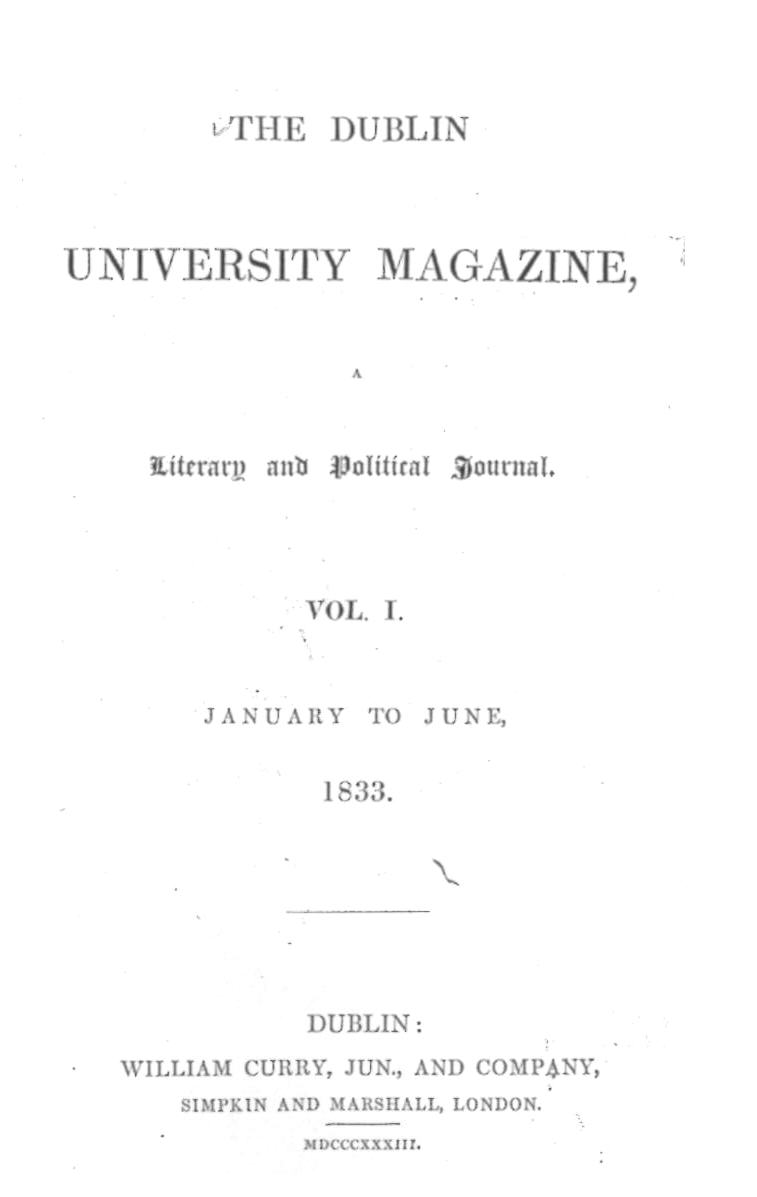
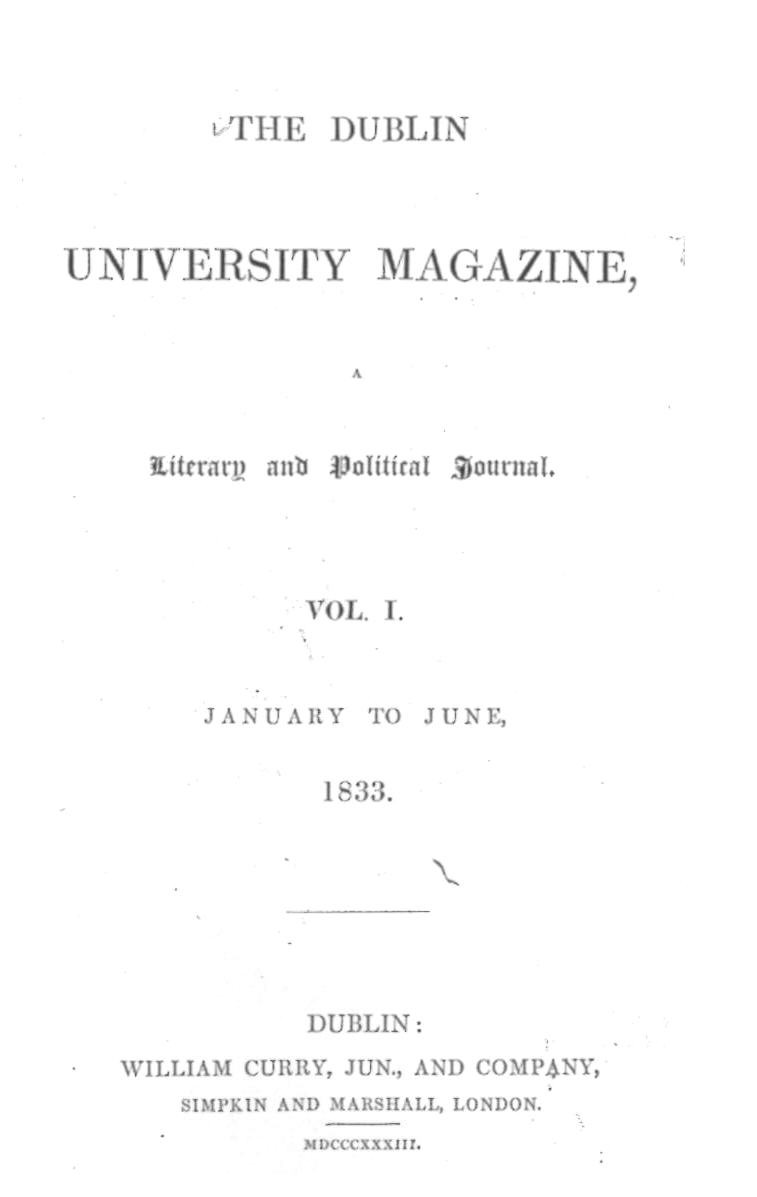
Reproduced by permission, Cambridge University Library
Reproduced by permission, Ulster Folk Museum
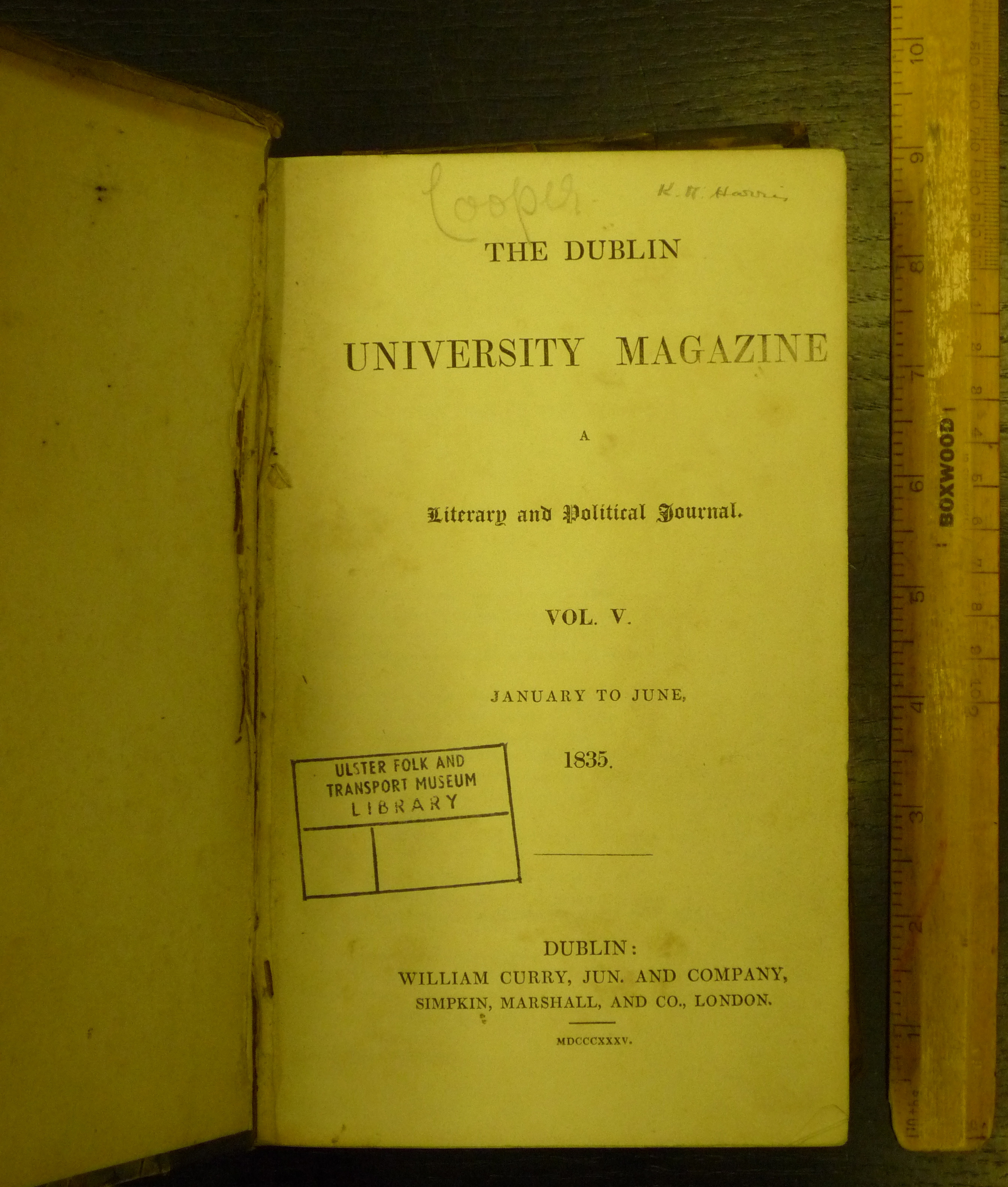
Reproduced by permission, Ulster Folk Museum