Detailed Record
Good Words;
vol 1 no 1, Jan 1860 - vol 47, Apr 1906

then: Good Words and Sunday Magazine. vol 1, 05 May 1906 - vol 10, 08 Apr 1911
Edinburgh,Edinburghshire
Editor:
Hartley Aspden (co-editor 1906 - 1907)
David Macleod (Rev. Jul 1872 - 1874)
Donald Macleod (Jul 1872 - Apr 1906, co-editor 1906 - 1907)
Norman Macleod (Rev.) 1860 - Jun 1872d.)
David Macleod (Rev. Jul 1872 - 1874)
Donald Macleod (Jul 1872 - Apr 1906, co-editor 1906 - 1907)
Norman Macleod (Rev.) 1860 - Jun 1872d.)
Proprietor:
Amalgamated Press (1905+)
Harmsworth (1905 - 1911)
Norman Macleod
Alexander Strahan (1860 - 1905)
Harmsworth (1905 - 1911)
Norman Macleod
Alexander Strahan (1860 - 1905)
Publisher:
Alexander Strahan and Co (Edinburgh 1860 - 1904)
Wm. Bremnen [Bremner?] (Manchester)
Hutcheson Campbell (Glasgow)
E. Marlborough and Co (London 1859)
Isbister and Co Ltd (London)
William Robertson (Dublin)
Sampson & Low (London)
Sampson Low, Son and Co (London)
Wm. Bremnen [Bremner?] (Manchester)
Hutcheson Campbell (Glasgow)
E. Marlborough and Co (London 1859)
Isbister and Co Ltd (London)
William Robertson (Dublin)
Sampson & Low (London)
Sampson Low, Son and Co (London)
Printer:
Ballantyne, Hanson and Co (Jan 1895 - Dec 1899)
Thomas Constable (1860)
J.S. Virtue and Co (Jan 1890 - Dec 1894)
Thomas Constable (1860)
J.S. Virtue and Co (Jan 1890 - Dec 1894)
Contributors:
Cecil Aldin (ill.)
Henry Alford
Henry Hugh Armstead (ill. 1861 - 1862)
Robert Barnes (ill. 1865)
J.M. Barrie
Mathilda Betham-Edwards
Matilda Betham-Edwards
William Black (1878)
Blaikie (Prof.)
John Brown (Dr.)
Elizabeth Barrett Browning
John Buchan
Robert Buchanan
Edward Burne-Jones (ill. 1862 - 1863)
Douglas Campbell
John Collier (ill.)
Walter Crane (ill. 1863)
E.G. Dalziel (ill. 1871)
Thomas Dalziel (ill.)
Austin Dobson
George Louis Palmella Busson Du Maurier (ill. 1861, 1872)
Amelia Blandford Edwards
Mary Ellen Edwards (pseudonym M.E.E. ill. 1866)
George Eliot
S. Luke Fildes (ill. 1867+)
F.A. Fraser (ill. 1869)
J.A. Froude
H. Furniss
Isabella Fyvie
Archibald Geikie
George Gissing
William Gladstone
Thomas Graham (ill. 1861 - 1863, 1868, 1878)
Paul Gray (ill. 1865)
Dora Greenwell (poetry)
Thomas Guthrie (D.D.)
J.W. Hales
William Hanna
Thomas Hardy
Hubert Herkomer (ill.)
John Hollingshead
Arthur Hopkins (ill. 1873, 1875)
Arthur Boyd Houghton (ill. 1862 - 1863, 1866 - 1868, 1871 - 1872)
Mary Howitt (1885)
Arthur Hughes (ill. 1864, 1869 - 1872)
William Holman Hunt (ill. 1862)
John Hunter
R.H. Hutton
Thomas Henry Huxley
Jean Ingelow (1875)
J.B. (Mrs. Blackburn ill.)
Bennet George Johns (Rev.)
Charles Samuel Keene (ill. 1862)
Charles Kingsley
D. Knowles
Matthew James Lawless (ill. 1862, 1864)
Cecil Lawson (ill.)
John Lawson (ill. 1867)
Eliza Lynn Linton
Andrew Long
John Malcolm Ludlow
Edna Lyell
George MacDonald (1867)
Fiona MacLeod
J. Mahoney (ill. 1872)
John McTaggart (ill.)
Frederick McWhirter (ill.)
G. Meredith
John Everett Millais (ill. 1862 - 1864, 1878, 1882)
William Morris
Thomas Morten (ill. 1861 - 1863)
Horace Moule
Dinah Mulock Craik
John William North (ill. 1863, 1866)
Margaret Oliphant
William Quiller Orchardson (ill. 1860, 1861, 1878)
Bessie Parkes-Belloc
James Payn
John James Stewart Perowne (Rev.)
John Pettie (ill. 1861 - 1864, 1878)
Eden Phillpotts
George John Pinwell (ill. 1863 - 1864, 1866 - 1868, 1870 - 1871, 1875)
Edward Hayes Plumptre
Dante Gabriel Rossetti (ill.)
Richard Rowe
Frederick Sandys (ill. 1862 - 1863)
Katherine Saunders
William Small (ill. 1866 - 1869)
Walter C. Smith
Simeon Solomon (ill. 1862)
A.P. Stanley
W. Fleming Stevenson (Rev.)
Marcus Stone (ill.)
Alexander Strahan
Annie Swan
Isaac Taylor
John Tenniel (Sir) ill. 1862 - 1864)
Lord Alfred Tennyson
William Makepeace Thackeray
Joseph Thomson (1880 - 1889)
Anthony Trollope
John Tulloch
Charles Turner
Frederick Walker (ill. 1861 - 1862, 1864, 1867)
John Dawson Watson (ill. 1861 - 1863)
Augusta Webster
Richard Whately
James McNeill Whistler (ill. 1862)
Alfred Whitman
Samuel Wilberforce
Ellen Wood
John George Wood
Stephen Yorke (Mary Linskill 1840 - 1891)
Henry Alford
Henry Hugh Armstead (ill. 1861 - 1862)
Robert Barnes (ill. 1865)
J.M. Barrie
Mathilda Betham-Edwards
Matilda Betham-Edwards
William Black (1878)
Blaikie (Prof.)
John Brown (Dr.)
Elizabeth Barrett Browning
John Buchan
Robert Buchanan
Edward Burne-Jones (ill. 1862 - 1863)
Douglas Campbell
John Collier (ill.)
Walter Crane (ill. 1863)
E.G. Dalziel (ill. 1871)
Thomas Dalziel (ill.)
Austin Dobson
George Louis Palmella Busson Du Maurier (ill. 1861, 1872)
Amelia Blandford Edwards
Mary Ellen Edwards (pseudonym M.E.E. ill. 1866)
George Eliot
S. Luke Fildes (ill. 1867+)
F.A. Fraser (ill. 1869)
J.A. Froude
H. Furniss
Isabella Fyvie
Archibald Geikie
George Gissing
William Gladstone
Thomas Graham (ill. 1861 - 1863, 1868, 1878)
Paul Gray (ill. 1865)
Dora Greenwell (poetry)
Thomas Guthrie (D.D.)
J.W. Hales
William Hanna
Thomas Hardy
Hubert Herkomer (ill.)
John Hollingshead
Arthur Hopkins (ill. 1873, 1875)
Arthur Boyd Houghton (ill. 1862 - 1863, 1866 - 1868, 1871 - 1872)
Mary Howitt (1885)
Arthur Hughes (ill. 1864, 1869 - 1872)
William Holman Hunt (ill. 1862)
John Hunter
R.H. Hutton
Thomas Henry Huxley
Jean Ingelow (1875)
J.B. (Mrs. Blackburn ill.)
Bennet George Johns (Rev.)
Charles Samuel Keene (ill. 1862)
Charles Kingsley
D. Knowles
Matthew James Lawless (ill. 1862, 1864)
Cecil Lawson (ill.)
John Lawson (ill. 1867)
Eliza Lynn Linton
Andrew Long
John Malcolm Ludlow
Edna Lyell
George MacDonald (1867)
Fiona MacLeod
J. Mahoney (ill. 1872)
John McTaggart (ill.)
Frederick McWhirter (ill.)
G. Meredith
John Everett Millais (ill. 1862 - 1864, 1878, 1882)
William Morris
Thomas Morten (ill. 1861 - 1863)
Horace Moule
Dinah Mulock Craik
John William North (ill. 1863, 1866)
Margaret Oliphant
William Quiller Orchardson (ill. 1860, 1861, 1878)
Bessie Parkes-Belloc
James Payn
John James Stewart Perowne (Rev.)
John Pettie (ill. 1861 - 1864, 1878)
Eden Phillpotts
George John Pinwell (ill. 1863 - 1864, 1866 - 1868, 1870 - 1871, 1875)
Edward Hayes Plumptre
Dante Gabriel Rossetti (ill.)
Richard Rowe
Frederick Sandys (ill. 1862 - 1863)
Katherine Saunders
William Small (ill. 1866 - 1869)
Walter C. Smith
Simeon Solomon (ill. 1862)
A.P. Stanley
W. Fleming Stevenson (Rev.)
Marcus Stone (ill.)
Alexander Strahan
Annie Swan
Isaac Taylor
John Tenniel (Sir) ill. 1862 - 1864)
Lord Alfred Tennyson
William Makepeace Thackeray
Joseph Thomson (1880 - 1889)
Anthony Trollope
John Tulloch
Charles Turner
Frederick Walker (ill. 1861 - 1862, 1864, 1867)
John Dawson Watson (ill. 1861 - 1863)
Augusta Webster
Richard Whately
James McNeill Whistler (ill. 1862)
Alfred Whitman
Samuel Wilberforce
Ellen Wood
John George Wood
Stephen Yorke (Mary Linskill 1840 - 1891)
Names:
Blackburn (Mrs.)
Mary Linskill
Mary Linskill
Size:
26cm, 8pp/w (1860); 16pp (1860-1861); 609pp+/vol?; 64pp (1860); 72pp/mo (Jan 1861)
Price:
3 1/2d/w, 6d/m (1860); 1d (1860, 1865, 1870, May 1906); 1s; 3d/m; ½d/wk
Circulation:
30,000 (no 1, 1860); 160,000/m (1864); 70,000 (1865); 80,000 (1870); 80,000-130,000/no (1860s-1870s); 125,000; 15,000
Frequency:
weekly (Jan 1860-Dec 1860), 05 May 1906 - 08 Ap 1911); monthly (Jan 1861 - Apr 1906)
Illustration:
drawings, full page illustrations, wood engravings
Indexing:
index/vol; index general/poetry/illustrations /vol (1860); index of authors/vol (1900); Jones, Index to Legal Periodical Literature
Departments:
stories, articles, meditations on heaven, good words for every day in the year, God's glory in the heavens, serial fiction, missionary sketches, natural history, female criminals, girls' athletics, religion, protecting child performers, philanthropy, short essays, educating the blind, athletics, prisoners' aid societies, poetry, hymns, religion, Christianity, Church of Scotland, religious poetry
Orientation:
Protestant; evangelical, Church of Scotland
Merges:
merged in The Sunday Magazine to form Good Words and Sunday Magazine; merged in The Sunday Companion (c. 1911); merged with The Christian Guest
Sources:
"The Magazines For May." The Times Review no 1: p.11.; 7:2s (Nov 1905): 78.; DNB viii, p.823-825, 1184-1185; xix, p.742-745.; Poole's Index to Periodicals 1860-1904.; Altholz, Josef L. "Nineteenth-Century Religious Magazines with Literary Contents" in Sullivan, British Literary Magazines, vol 3. Appendix H.; Cooper, Dictionary of Contemporaries.; Couper. SNQ 5:2s (Oct 1903): 56; Ellegard, Alvar. The Readership of the Periodical Press in Mid-Victorian Britain. Goteborg: Goteborgs Universitets Arsskrift. 63:3 (1957); Jones, L.A. An Index to Legal Periodical Literature. Boston, 1888.; Mitchell. Newspaper Press Directory.; Reprinted VPN no 13 (Sep 1971): 3-22.; Moody, Davitt and Irish Revolution, p.508.; Srebrnik, Alexander Strahan Victorian Publisher.; Sutherland Longman Companion to Victorian Fiction.; Nash, “Elopement and the Nautical Novel”. p.53; Tye, Periodicals of the Nineties.; Uffelman, 1992.; advertisement in The Galashiels Record (27 Jun 1860).; Mitchell, “Ephemeral Journalism”: 81-92.; Varty, Anne. Children and Theatre In Victorian Britain 'All Work, No Play'. Palgrave Macmillan, 2008, p.1-250; Ledbetter, Kathryn British Victorian Women's Periodicals: Beauty, Civilization, and Poetry. Palgrave Macmillan, 2009, p.1-207;
Lightman, Bernard. Victorian Popularizers of Science. Chicago and London: The University of Chicago Press, 2007. p.297. Print.; Rigg, Patricia. Julia Augusta Webster. Madison: Fairleigh Dickinson University Press, 2009, p.250.; Peterson, Linda H. Becoming a Woman of Letters. Princeton University Press, 2009, p.250; Mitchell's Newspaper Press Directory; Couper, SNQ 5:2s (Oct 1903), p.56; Couper, SNQ 7:2s (Nov 1905), p.78; advertisement in The Galashiels Record (27 Jun 1860)
Histories:
VPR 13:3, p.106; 14:2, p.79; 14:3, p.132; 15:1, p.3; 19:2, p.43, 44, 46, 47, 48; 19:4, p.122-23.; Altholz, Religious Press in Britain.; Altick, Richard D. "Nineteenth-Century English Periodicals." The Newberry Library Bulletin 9 [2s] (May 1952): 255-73.; Altick, English Common Reader.; Coleman, Remembering the Past, pp.107-108.; Cooke, Illustrated Periodicals of the 1860s.; Delafield, "Marketing Celebrity."; De Maré, E. The Victorian woodblock illustrators. 1980.; Elwin, Malcolm. Victorian Wallflowers: A Panoramic Survey of the Popular Literary Periodicals. New York: Kennikat Press, 1934; Finkelstein, "Periodicals in Scotland" pp.191-192.; Goldman, Paul, and Brian Taylor. eds. Retrospective Adventures, Forrest Reid: Author and Collector. Aldershot, England: Scolar Press, 1998.; Goldman, Victorian Illustration and the High Victorians.; Harris, Michael and Alan Lee. eds. The Press in English Society. London: Associated University Presses, 1986.; Houghton, Walter E. “Victorian Periodical Literature and the Articulate Classes.” VS 22 (1979): 389-412.; Knight, "Periodicals and Religion" p.362.; Kooistra, The Illustrated Gift Book and Victorian Visual Culture.; Kooistra, "Wood Engraved Borders in Strahan's Family Magazines".; Ledbetter, Tennyson and Victorian Periodicals.; Maidment, "Illustration" p.106.; Maidment, "Literary Career of Mary Howitt".; Meadows, A.J. "Access to the Results of Scientific Research: Developments in Victorian Britain." Development of Science Publishing in Europe. Ed. A.J. Meadows. New York: Elsevier Science Publishers, 1980. 43-62.; Mitchell, S. "Victorian periodicals at the MVSA." VPR 13 (1980): 106-107.; Mitchell, Sally in Sullivan, British Literary Magazines, vol 3, pp.145-149.; Muir, Victorian Illustrated Books.; Reid, 58 British Artists.; Shattock, "Literature and the Expansion of the Press".; Shattock, Joanne and Michael Wolff. eds. The Victorian Periodical Press: Soundings and Samplings. Toronto: University of Toronto Press, 1982.; Smith, Sydney. Donald Macleod of Glasgow: A Memoir and a Study. London, 1926.; Stewart, Progressives and Radicals.; Strahan, Alexander. "Norman Macleod". Contemporary Review 20 (1872): 291-306.; Uffelman p.50.; reprinted 1966.; Radford, Andrew. Victorian Sensation Fiction. Palgrave Macmillan, 2009, p.1-171; Ehnes, Caley. "Religion, Readership, and the Periodical Press: The Place of Poetry in Good Words." VPR. Toronto: University of Toronto Press, 45:4, Winter 2012, pp.466-487; Delafield, Catherine. "Marketing Celebrity: Norman Macleod, Dinah Mulock Craik, and John Everett Millais in Alexander Strahan’s Good Words." VPR. Toronto: University of Toronto Press, 46:2, Summer 2013, pp.255-278
Comments:
A Catholic enterprise for all Christians. This journal tried to combine the secular and the sacred and received much opposition in some places because of its method of dealing with this. "A decidedly religious magazine, of some intellectual pretensions, and not relying chiefly on fiction for its vogue, it appealed to the lower to upper middle classes of fair educational standard" (Ellegard 21-22).
Good Words "reached a phenomenal circulation in the latter half of the century" (Altick 263).
It was "directed at a non-denominational audience of devout middle-class readers across the English-speaking world" (Kooistra, "Wood Engraved" 380).
Finkelstein explains that it achieved this large circulation of over 150,000 despite facing great competition from periodicals like the Cornhill Magazine, which began around the same time (105).
At a rather low level readership, this was one of the most popular weekly periodicals that included an appreciable mention of science. It was basically a religious publication. The science was regarded as an intellectual stiffener, rather than as of the essential constituents of the periodical demanded by the readership (Meadows, A.J.; p.55).
Altholz writes that this was one of the best magazines of its time. It "ventured to include serialized novels by well-known writers" (Religious Press 13).
It "offered aesthetically ambitious plates to complement the poetry, articles, and serialized fiction" that it published (Maidment 106).
Good Words "capitalised on the popularity of the family periodical, using the genre to promote Christian thought and practices through poetry, prose, and biblical readings" (Ehnes 466)).
"Contains several interesting papers, amongst which are 'Recent Speculations on Primeval Man,' by the Duke of Argyle. It is the third essay, and treats of the antiquity of man. We think it a great pity that the duke should waste his valuable time in petty quarrels and squabbles in the House of Lords. He shines in the press, but utterly fails in the arena of politics. The present series of papers are highly interesting and valuable, and do great credit to the writer. Some of the 'Characteristics of the Papacy,' by the Dean of Westminster, will interest those who are unacquainted with papal elections, customs, dresses, &c….It is certainly something new to be told that the chief of Popery is a mass of primitive Protestantism. Such information will cheer the hearts of those who regard him at present in anything by a favourable light; but the Dean of Westminster says it is so, and, of course, it must be so....[This magazine] keeps its ground well" ("The Magazines for May" The Times Review, no 1, p.11). "Understanding the 'distinctively Christian spirit' of Good Words during its most prosperous era helps to define mid-Victorian religious sentiment....In Good Words they printed optimistic articles on social questions that promoted practical philanthropy; among the specific objectives were care for the children of female criminals; education for the blind; athletics for girls; prisoner's aid societies; protection of child performers; and the provision of medical women to work in India....The page of Good Words index mid-cult taste at a level comparable to the Saturday Evening Post in the United States in the first half of the twentieth century" (Mitchell, Sally in Sullivan)....Good Words was decidedly religious in feeling and contained some splendid illustrations by Millais, Sandys, Holman Hunt and Burne-Jones among others. Though not strictly an art magazine, the standard of illustration was very high" (Collins, p.199).
"Even though Strahan went out of his way to make Good Words and his other periodicals acceptable to English readers by including contributions from as many Anglican writers as possible, Anglican ministers fretted that Good Words was conducted, after all, by Presbyterians (Srebrnik, p.4).
In 1905 when Amalgamated Press bought Good Words, it "became a tabloid-size weekly paper. This new Good Words was a far cry from the original. It eschewed sermons and weighty devotional essays, relying instead on third-rate serialized fiction" (Srebrnik, 201).
Strahan, the publisher, asked the Dalziels to look after Good Words's illustration; in other words, to act as art editors (Reid, p.100). Small has many drawings in Good Words, mostly before 1869. Graham doesn't seem to have any drawings outside of this periodical. Keene has only a single drawing in Good Words. Millais has no drawings in the first two volumes, but he has many drawings beginning with volume 3 (1862). Mahoney gave most of his best work to The Sunday Magazine and to Good Words. Most of Thomas Morten's work was done for magazines, notably Good Words. Published Linskill's (under her 'Yorke' pseudonym) Tales Of the North Riding in 1871. Serialised J.M. Barrie's The Little Minister in January-December 1891. Serialised The Trumpet Major and Robert His Brother written by Thomas Hardy and illustrated by John Collier from January 1880 - December 1880. Miss Edwards published a novel in serial form called Debenham's Vow in 1870. Pinwell drew on wood for the publication (Cooper, Thompson; p.769). Contained well written articles by public figures and writers (Harris and Lee, p. 128).
The periodical "played an important part in transforming the genre of the religious periodical into a popular literary product" (Ehnes 467). In its first three volumes, the periodical " uses devotional poetry and the pious editorial voice of Norman Macleod to define its market both in terms of its readership and its religious/literary purpose" (470). It was "half the price of the periodical’s closest competitors, making it affordable for a broader segment of the middle class. It was moral literature for all" (471).
Macleod wanted to publish a novel by Trollope serially, but Trollope resisted Macleod's entreaty's. Eventually, Trollope submitted Rachel Ray, but there were some moral things in the novel to which Macleod objected. The novel was ultimately rejected (Mitchell in Sullivan 147).
Motto: "Good words are worth much and cost little" George Herbert.
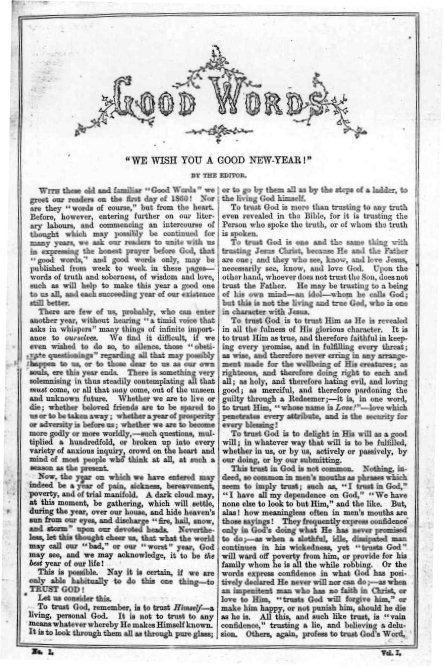
Preface: Words of truth and soberness, of wisdom and love [will be published]. "'We wish you a good new year!' With these old and familiar Good Words we greet our readers on the first day of 1860! Nor are they 'words of course,' but from the heart. Before, however, entering further on our literary labours, and commencing an intercourse of thought which may possibly be continued for many years, we ask our readers to unite with us in expressing the honest prayer before God, that 'good words,' and good words only, may be published from week to week in these pages words of truth and soberness, of wisdom and love, such as will help to make this year a good one to us all, and each succeeding year of our existence still better" (Good Words 1:1, p.1).
Delafied argues that Good Words capitalized on the celebrity of Dinah Craik, John Everett Millais, and Norman Macleod to "promote the magazine’s religious mission and popular appeal" (256).
This publication was issued by Alexander Strahan in London, but Norman Macleod edited it in Scotland (Altholz 90).
Alternate subtitle: a family magazine for Sunday reading.
When he was brought on board, John Everett Millais was at the top of his celebrity: "Millais was well known and in demand as an illustrator, which ensured that his contributions would further enhance the market for Craik’s serial and Strahan’s periodical" (Delafield 263).
Good Words could be used to reform prisoners in the 1850s. However, it was not as strong as some other periodicals because it had a sectarian camp (Moody 508).
Norman Macleod's work was praised by Queen Victoria, who called him "'warm, genial and hearty...His own faith was so strong, his heart so large, that all-high and low, weak and strong, the erring and the good- could alike find sympathy, help and consolation from him'" (Coleman 107-108).
It was published primarily in Edinburgh because that was where Strahan's publishing company was based. It circulated widely, however, reaching major centres like Glasgow, London, Dublin, and Manchester.
Good Words "reached a phenomenal circulation in the latter half of the century" (Altick 263).
It was "directed at a non-denominational audience of devout middle-class readers across the English-speaking world" (Kooistra, "Wood Engraved" 380).
Finkelstein explains that it achieved this large circulation of over 150,000 despite facing great competition from periodicals like the Cornhill Magazine, which began around the same time (105).
At a rather low level readership, this was one of the most popular weekly periodicals that included an appreciable mention of science. It was basically a religious publication. The science was regarded as an intellectual stiffener, rather than as of the essential constituents of the periodical demanded by the readership (Meadows, A.J.; p.55).
Altholz writes that this was one of the best magazines of its time. It "ventured to include serialized novels by well-known writers" (Religious Press 13).
It "offered aesthetically ambitious plates to complement the poetry, articles, and serialized fiction" that it published (Maidment 106).
Good Words "capitalised on the popularity of the family periodical, using the genre to promote Christian thought and practices through poetry, prose, and biblical readings" (Ehnes 466)).
"Contains several interesting papers, amongst which are 'Recent Speculations on Primeval Man,' by the Duke of Argyle. It is the third essay, and treats of the antiquity of man. We think it a great pity that the duke should waste his valuable time in petty quarrels and squabbles in the House of Lords. He shines in the press, but utterly fails in the arena of politics. The present series of papers are highly interesting and valuable, and do great credit to the writer. Some of the 'Characteristics of the Papacy,' by the Dean of Westminster, will interest those who are unacquainted with papal elections, customs, dresses, &c….It is certainly something new to be told that the chief of Popery is a mass of primitive Protestantism. Such information will cheer the hearts of those who regard him at present in anything by a favourable light; but the Dean of Westminster says it is so, and, of course, it must be so....[This magazine] keeps its ground well" ("The Magazines for May" The Times Review, no 1, p.11). "Understanding the 'distinctively Christian spirit' of Good Words during its most prosperous era helps to define mid-Victorian religious sentiment....In Good Words they printed optimistic articles on social questions that promoted practical philanthropy; among the specific objectives were care for the children of female criminals; education for the blind; athletics for girls; prisoner's aid societies; protection of child performers; and the provision of medical women to work in India....The page of Good Words index mid-cult taste at a level comparable to the Saturday Evening Post in the United States in the first half of the twentieth century" (Mitchell, Sally in Sullivan)....Good Words was decidedly religious in feeling and contained some splendid illustrations by Millais, Sandys, Holman Hunt and Burne-Jones among others. Though not strictly an art magazine, the standard of illustration was very high" (Collins, p.199).
"Even though Strahan went out of his way to make Good Words and his other periodicals acceptable to English readers by including contributions from as many Anglican writers as possible, Anglican ministers fretted that Good Words was conducted, after all, by Presbyterians (Srebrnik, p.4).
In 1905 when Amalgamated Press bought Good Words, it "became a tabloid-size weekly paper. This new Good Words was a far cry from the original. It eschewed sermons and weighty devotional essays, relying instead on third-rate serialized fiction" (Srebrnik, 201).
Strahan, the publisher, asked the Dalziels to look after Good Words's illustration; in other words, to act as art editors (Reid, p.100). Small has many drawings in Good Words, mostly before 1869. Graham doesn't seem to have any drawings outside of this periodical. Keene has only a single drawing in Good Words. Millais has no drawings in the first two volumes, but he has many drawings beginning with volume 3 (1862). Mahoney gave most of his best work to The Sunday Magazine and to Good Words. Most of Thomas Morten's work was done for magazines, notably Good Words. Published Linskill's (under her 'Yorke' pseudonym) Tales Of the North Riding in 1871. Serialised J.M. Barrie's The Little Minister in January-December 1891. Serialised The Trumpet Major and Robert His Brother written by Thomas Hardy and illustrated by John Collier from January 1880 - December 1880. Miss Edwards published a novel in serial form called Debenham's Vow in 1870. Pinwell drew on wood for the publication (Cooper, Thompson; p.769). Contained well written articles by public figures and writers (Harris and Lee, p. 128).
The periodical "played an important part in transforming the genre of the religious periodical into a popular literary product" (Ehnes 467). In its first three volumes, the periodical " uses devotional poetry and the pious editorial voice of Norman Macleod to define its market both in terms of its readership and its religious/literary purpose" (470). It was "half the price of the periodical’s closest competitors, making it affordable for a broader segment of the middle class. It was moral literature for all" (471).
Macleod wanted to publish a novel by Trollope serially, but Trollope resisted Macleod's entreaty's. Eventually, Trollope submitted Rachel Ray, but there were some moral things in the novel to which Macleod objected. The novel was ultimately rejected (Mitchell in Sullivan 147).
Motto: "Good words are worth much and cost little" George Herbert.
Preface: Words of truth and soberness, of wisdom and love [will be published]. "'We wish you a good new year!' With these old and familiar Good Words we greet our readers on the first day of 1860! Nor are they 'words of course,' but from the heart. Before, however, entering further on our literary labours, and commencing an intercourse of thought which may possibly be continued for many years, we ask our readers to unite with us in expressing the honest prayer before God, that 'good words,' and good words only, may be published from week to week in these pages words of truth and soberness, of wisdom and love, such as will help to make this year a good one to us all, and each succeeding year of our existence still better" (Good Words 1:1, p.1).
Delafied argues that Good Words capitalized on the celebrity of Dinah Craik, John Everett Millais, and Norman Macleod to "promote the magazine’s religious mission and popular appeal" (256).
This publication was issued by Alexander Strahan in London, but Norman Macleod edited it in Scotland (Altholz 90).
Alternate subtitle: a family magazine for Sunday reading.
When he was brought on board, John Everett Millais was at the top of his celebrity: "Millais was well known and in demand as an illustrator, which ensured that his contributions would further enhance the market for Craik’s serial and Strahan’s periodical" (Delafield 263).
Good Words could be used to reform prisoners in the 1850s. However, it was not as strong as some other periodicals because it had a sectarian camp (Moody 508).
Norman Macleod's work was praised by Queen Victoria, who called him "'warm, genial and hearty...His own faith was so strong, his heart so large, that all-high and low, weak and strong, the erring and the good- could alike find sympathy, help and consolation from him'" (Coleman 107-108).
It was published primarily in Edinburgh because that was where Strahan's publishing company was based. It circulated widely, however, reaching major centres like Glasgow, London, Dublin, and Manchester.
Location:
complete runs: LO/N-1 A, ED/P99; partial runs: BH/P-1, BH/U-1, BD/P-1, CA/U-1, GL/U-1, LE/P-1, LO/U-1 G vols 1-44 (1860-1903), HL/U-1, LO/N15, QZ/P-1 vols 1-47 (1860-1906), SA/U-1 (1860-1905), DN/U-1 (1872-1889, inc), ED/U18 G vol 1, (1860-1874, imp), GL/U-1 (1860-1869, 1873-1875, 1878-1881, 1883, 1894, 1895, 1898, imp), OX/U-1 A (see Tye); see BUCOP; REPRINT EDITIONS: microform: Early British Periodicals (UMI), reels 300-315; N. America: ICN (see Altick), see Fulton and ULS 2&3. The full text is available at ProQuest

Reproduced by permission, Bodleian Library
Reproduced by permission, Bodleian Library