Detailed Record
Scots Observer, The;
vol 1 no 1, 24 Nov 1888 - vol 4 no 104, 15 Nov 1890

then: National Observer; record and review. vol 5 no 105, 22 Nov 1890 - vol 17 no 434, 13 Mar 1897
then: British Review and National Observer of Politics, Economics, Literature, Science, and Art. vol 18 no 445, 29 May 1897 - vol 18 no 455, 07 Aug 1897
then: National Observer and British Review of Politics, Economics, Literature, Science, and Art. vol 18 no 435, 20 Mar 1897 - vol 18 no 444, 22 May 1897
then: National Observer. vol 18 no 456, 16 Oct 1897
then: British Review and National Observer of Politics, Economics, Literature, Science, and Art. vol 18 no 445, 29 May 1897 - vol 18 no 455, 07 Aug 1897
then: National Observer and British Review of Politics, Economics, Literature, Science, and Art. vol 18 no 435, 20 Mar 1897 - vol 18 no 444, 22 May 1897
then: National Observer. vol 18 no 456, 16 Oct 1897
Edinburgh,Midlothian (24 Nov 1888 - 11 Jun 1892)
London,Middlesex (22 Nov 1888 - 16 Oct 1897)
Editor:
James Nicol Dunn
William Earnest Henley (24 Nov 1888 - 24 Mar 1894)
Charles Whibley (assistant editor)
William Earnest Henley (24 Nov 1888 - 24 Mar 1894)
Charles Whibley (assistant editor)
Proprietor:
John Douglas (1890 - 1891)
Publisher:
John Douglas (Edinburgh 24 Nov 1888 - 11 Jun 1892)
A.C. Hide (London 20 Mar 1897 - 07 Aug 1897)
A.C. Hide (London 20 Mar 1897 - 07 Aug 1897)
Printer:
Walter Blaikie
A. Constable (1890)
T. Constable (1890)
A. Constable (1890)
T. Constable (1890)
Contributors:
William Archer
J.M. Barrie
Arthur John Davidson Doyle
Harry S.C. Everard
Edmund Gosse
Kenneth Grahame
David Hannay
William Earnest Henley
Lionel Johnson
Rudyard Kipling
Andrew Lang
William Lecky
William Loftie
Henry Dawson Lowry (1891)
Stephane Mallarme
Alice Meynell (1889 - 1893)
Cosmo Monkhouse
George Moore
Margaret Oliphant
Joseph Pennell
Frederick Pollock
William Power
George W. Steevens (1893)
Robert Louis Stevenson
A.C. Swinburne
Katharine Tynan
Katherine Tynan
Arthur B. Walkey (1890+)
H.B. Marriott Watson
Rosamund Marriott Watson (pseudo Graham R. Tomson)
Charles Whibley
W.B. Yeats
J.M. Barrie
Arthur John Davidson Doyle
Harry S.C. Everard
Edmund Gosse
Kenneth Grahame
David Hannay
William Earnest Henley
Lionel Johnson
Rudyard Kipling
Andrew Lang
William Lecky
William Loftie
Henry Dawson Lowry (1891)
Stephane Mallarme
Alice Meynell (1889 - 1893)
Cosmo Monkhouse
George Moore
Margaret Oliphant
Joseph Pennell
Frederick Pollock
William Power
George W. Steevens (1893)
Robert Louis Stevenson
A.C. Swinburne
Katharine Tynan
Katherine Tynan
Arthur B. Walkey (1890+)
H.B. Marriott Watson
Rosamund Marriott Watson (pseudo Graham R. Tomson)
Charles Whibley
W.B. Yeats
Names:
Thomas Edward Brown
Arthur Tomson
Arthur Tomson
Size:
38pp (1888); 33cm, 40pp (1890); 28pp - 32pp
Price:
6d (1888 - Mar 1896); 3d (Mar 1896 - Jul 1896); 2d (Jul 1896 - Oct 1897); 3d (1897)
Circulation:
2,000/a
Frequency:
weekly (Sat)
Indexing:
index/vol; T of C/no
Departments:
current events, political analysis, literary criticism, original poetry, advertisements, notes, essays, book/music/theatre reviews, "Modern Men", "Urban Scotland", provincial ideas, debate, Oscar Wilde's letters, ballads, politics, social notes, miscellaneous articles, list of new books published
Orientation:
constitutional (1891); intellectual; Tory-Imperialist; high Tory, high art
Merges:
absorbed by the National Observer (London 1890-1893); absorbed British Review (Mar 1896)
Sources:
AELP 1981.; DNB xxii, 303, 1226; Ferguson, Directory of Scottish Newspapers.; Hughes, Linda K. "What the Wellesley Index Left Out: Why Poetry Matters to Periodical Studies." Victorian Periodicals Review. 40:2. Toronto: U of Toronto Press, 2007. p.93; Hughes, Linda K. "Periodical Poetry, Editorial Policy, and W.E. Henley's Scots and National Observer." Victorian Periodicals Review. 49:2. Baltimore: The Johns Hopkins University Press, 2016. p.202-227.; Mitchell's Newspaper Press Directory; Nowell-Smith, Simon. The House of Cassell 1848-1958. Cassell & Ltd., 1958.; xxiii, p.638; xxiv, p.374-376, 435-440, 482; xxvii, p.879-880.; Peterson, Linda H. Becoming a Woman of Letter. Princeton University Press, 2009, p.176,268.; Sutherland, John. The Longman Companion to Victorian Fiction. Burnt Hill, Engl.: Longman, 1988.
Histories:
Atkinson, Damian, ed. The Selected Letters of W.E. Henley. Aldershot: Ashgate, 2000.; Bristow, Joseph. "'The Armytage-Tomson-Watson Sequence': Poetic Illustrations in the Periodical Press, 1886–96." Victorian Literature and Culture 34.2 (2006): 519-551.; Buckley, Jerome Hamilton. William Earnest Henley: A Study in the 'Counter-Decadence' of the 'Nineties [sic]. 1945.; Creasy, "Arthur Symons the Saturday Review".; Dillane, "Forms of Affect".; Escott, Masters of English Journalism.; Graham, British Literary Periodicals, p.337.; Hughes, Linda. "A Club of Their Own: The 'Literary Ladies,' New Women Writers, and Fin-De-Siecle Authorship." Victorian Literature and Culture 35 (2007): 233-260.; Rutenberg, Daniel in Sullivan, British Literary Magazines, vol 3, pp.389-393. VPR 14:1, p.16.
Comments:
Circulates widely in England and Scotland generally. "A prospectus issued ... advertised the periodical as a 'sixpenny weekly journal for Scotland ... a Record and a Review of current Politics, Literature, Science, Art, etc.' It went on to promise that 'while giving due prominence to Imperial and General Affairs, it [would] also deal specifically with subjects of National Interest.... Politically, The Scots Observer will give hearty support to Constitutional principles necessary for the maintenance of the unity of the Empire'. The promise was kept".
"From its beginning through the May 24, 1890 issue, the Observer included the label 'Registered as a Newspaper' at the top of its cover across from its sixpenny price, yet a notice in the November 15, 1890 issue announcing a change in title to "National" referred to the Observer as 'this Journal.'" (Hughes 2016, p.204)
"Indeed, so determined was Henley to make the Scots Observer an illustrious magazine, rival to (but aesthetically superior to) the Saturday Review, that its backers lost over 20,000 [pounds] during its five years of publication. Henley set high literary standards; his printer Walter Blaikie produced beautifully typeset issues; and his contributors enjoyed the freedom of publishing high-quality work without editorial amputation or undue intervention. The contributors also enjoyed the pleasure of being known as Henley's 'young men'--high Tory, counterdecadent, dismissive of socialism and Gladstonian liberalism, passionate about high art and contemptuous of ''popular culture'...as the sorriest contradiction in terms,' always 'waging a brilliant battle against Dulness [sic], Decadence, Deciduity.'" (Peterson, p.180)
This periodical "followed a conservative and generally imperialistic line, while focusing on distinctively Scottish interests" (Rutenberg, p.389).
"Reviews of literature and music were regular features, and short fiction was occasionally published; yet it is for none of these that the Observer is still remembered. Instead, it is the editorial acumen of Henley that strikes readers almost a century later. He had the courage to sponsor the still young and obscure W.B. Yeats, eighteen of whose poems and several of whose tales were first printed in the Observer. Henley had the charisma to attract and to retain Rudyard Kipling.... Furthermore, other significant poets — A.C. Swinburne, Robert Louis Stevenson. Katharine Tynan (Hinkson), Alice Meynell, Edmund Grosse, Kenneth Grahame, and Cosmo Monkhouse — were represented, as were such critics and reviewers as Stephane Mallarme (in French), Andrew Lang, William Archer, J.M. Barrie, George Moore, and again, Alice Meynell and Kenneth Grahame". "Graham R. Tomson was contributing an anonymous fashion column as well as signed poems to the Scots Observer itself, this was an insider’s stab as well as invective at women’s presumption" (Hughes 2007).
"Despite shifts of policy and locale, the format was quite consistent. Correspondence was encouraged...." "The only visible change in editorial policy was a lessened emphasis on Scottish matters", after the publication was moved to London in 1890 (as National Observer). In March 1894 Henley relinquished the editorship of the Observer, and with his departure, it perceptibly declined. Not only was Henley's successor anonymous, but the identity of the publisher and place of publication was also omitted, as was an index of signing contributors. Without Henley the National Observer was no longer viable.... Nor was the format ... compelling. Without photographs or prints, it could only appeal to the specially literate, a small clientele unwilling to accept mediocrity. In March 1896 the Observer 'amalgamated' with the British Review; the price for the consolidated journal was halved to three pence. By the end of July, a typical issue had shrunk to sixteen tabloid pages, and even a reduction in price to two pence was unavailing, as the Observer sank into oblivion in October of that year". "After publication was discontinued with the August 7th, issue, the journal was revived as the National Observer on October 16,1897. The reincarnation was brief. No further issues appeared" (Rutenberg).
Graham surmises that "for the brilliance of its staff of contributors one would have expected it to have a longer life" (337). Hughes states that the Scots Observer was "founded by Edinburgh printer Walter Blaikie, art collector Robert Tyndall Hamilton Bruce, and Robert Fitzroy Bell, who put up most of the money." (2016, p. 203)
"From its beginning through the May 24, 1890 issue, the Observer included the label 'Registered as a Newspaper' at the top of its cover across from its sixpenny price, yet a notice in the November 15, 1890 issue announcing a change in title to "National" referred to the Observer as 'this Journal.'" (Hughes 2016, p.204)
"Indeed, so determined was Henley to make the Scots Observer an illustrious magazine, rival to (but aesthetically superior to) the Saturday Review, that its backers lost over 20,000 [pounds] during its five years of publication. Henley set high literary standards; his printer Walter Blaikie produced beautifully typeset issues; and his contributors enjoyed the freedom of publishing high-quality work without editorial amputation or undue intervention. The contributors also enjoyed the pleasure of being known as Henley's 'young men'--high Tory, counterdecadent, dismissive of socialism and Gladstonian liberalism, passionate about high art and contemptuous of ''popular culture'...as the sorriest contradiction in terms,' always 'waging a brilliant battle against Dulness [sic], Decadence, Deciduity.'" (Peterson, p.180)
This periodical "followed a conservative and generally imperialistic line, while focusing on distinctively Scottish interests" (Rutenberg, p.389).
"Reviews of literature and music were regular features, and short fiction was occasionally published; yet it is for none of these that the Observer is still remembered. Instead, it is the editorial acumen of Henley that strikes readers almost a century later. He had the courage to sponsor the still young and obscure W.B. Yeats, eighteen of whose poems and several of whose tales were first printed in the Observer. Henley had the charisma to attract and to retain Rudyard Kipling.... Furthermore, other significant poets — A.C. Swinburne, Robert Louis Stevenson. Katharine Tynan (Hinkson), Alice Meynell, Edmund Grosse, Kenneth Grahame, and Cosmo Monkhouse — were represented, as were such critics and reviewers as Stephane Mallarme (in French), Andrew Lang, William Archer, J.M. Barrie, George Moore, and again, Alice Meynell and Kenneth Grahame". "Graham R. Tomson was contributing an anonymous fashion column as well as signed poems to the Scots Observer itself, this was an insider’s stab as well as invective at women’s presumption" (Hughes 2007).
"Despite shifts of policy and locale, the format was quite consistent. Correspondence was encouraged...." "The only visible change in editorial policy was a lessened emphasis on Scottish matters", after the publication was moved to London in 1890 (as National Observer). In March 1894 Henley relinquished the editorship of the Observer, and with his departure, it perceptibly declined. Not only was Henley's successor anonymous, but the identity of the publisher and place of publication was also omitted, as was an index of signing contributors. Without Henley the National Observer was no longer viable.... Nor was the format ... compelling. Without photographs or prints, it could only appeal to the specially literate, a small clientele unwilling to accept mediocrity. In March 1896 the Observer 'amalgamated' with the British Review; the price for the consolidated journal was halved to three pence. By the end of July, a typical issue had shrunk to sixteen tabloid pages, and even a reduction in price to two pence was unavailing, as the Observer sank into oblivion in October of that year". "After publication was discontinued with the August 7th, issue, the journal was revived as the National Observer on October 16,1897. The reincarnation was brief. No further issues appeared" (Rutenberg).
Graham surmises that "for the brilliance of its staff of contributors one would have expected it to have a longer life" (337). Hughes states that the Scots Observer was "founded by Edinburgh printer Walter Blaikie, art collector Robert Tyndall Hamilton Bruce, and Robert Fitzroy Bell, who put up most of the money." (2016, p. 203)
Location:
QZ/P99 vols 1-2,5-7,9-12 (1888-1889,1890-1892, 1892-1894); LO/N38 A nos 1-104 (24 Nov 1888-15 Nov 1890), nos 105-434 (22 Nov 1890-13 Mar 1897,1888-1897, mic); ED/U-1 G (1889-1896); OX/U-1 A vols 1-4 (1888-1890); QZ/P-1 (1888-1890,24 Nov-07 Aug 1897); SA/U-1 vol 1 (24 Nov 1888-1889, Jan 1889-16 Oct 1897 mic); LO/N-1 A (1888-1897); MA/P-1; ED/N-1 A (inc); LO/P-6 F; REPRINT EDITIONS: microform: British Library (Newspaper Library), London; 'English Literary Periodicals' (UMI), reels 603-607; N.America: see Sullivan; Fulton; ULS 2&3.The full text is available at ProQuest
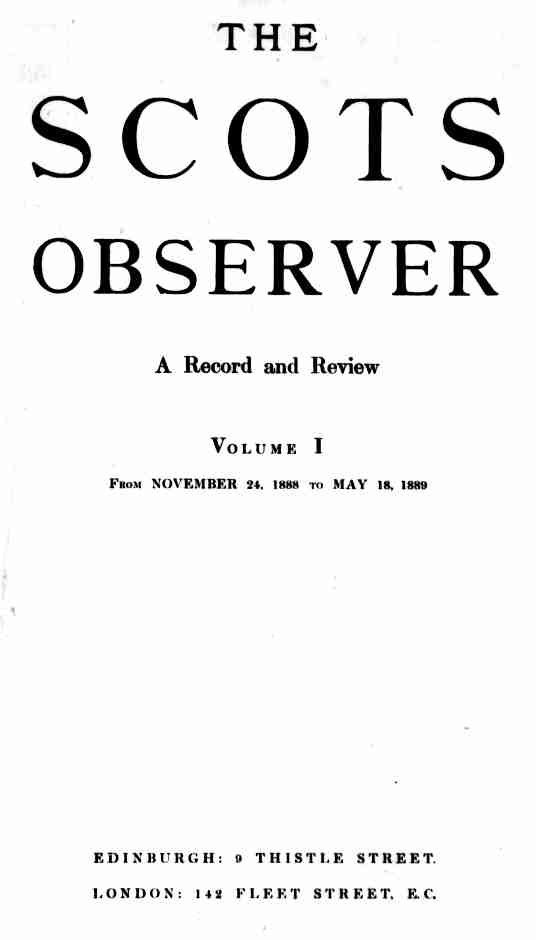
Reproduced by permission, British Library
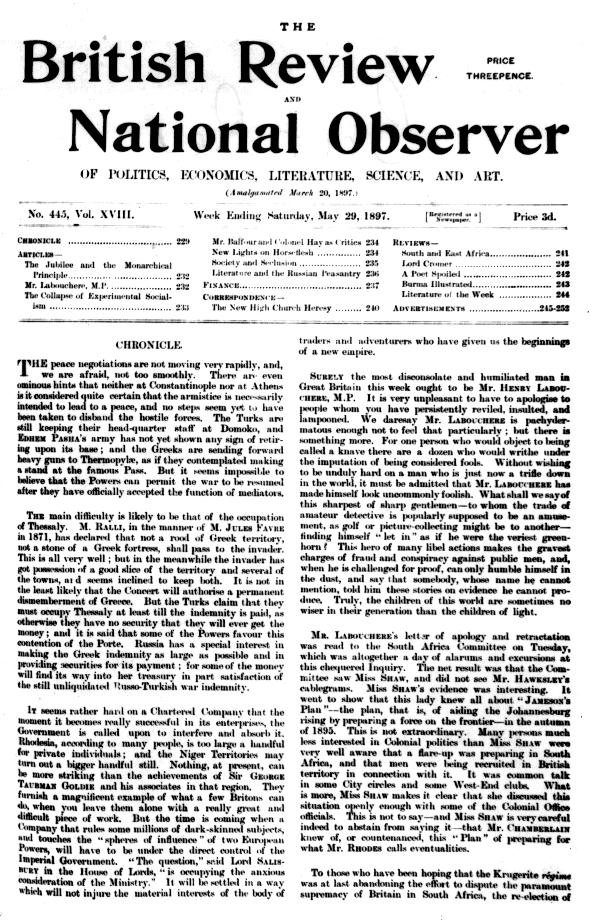
Reproduced by permission, British Library
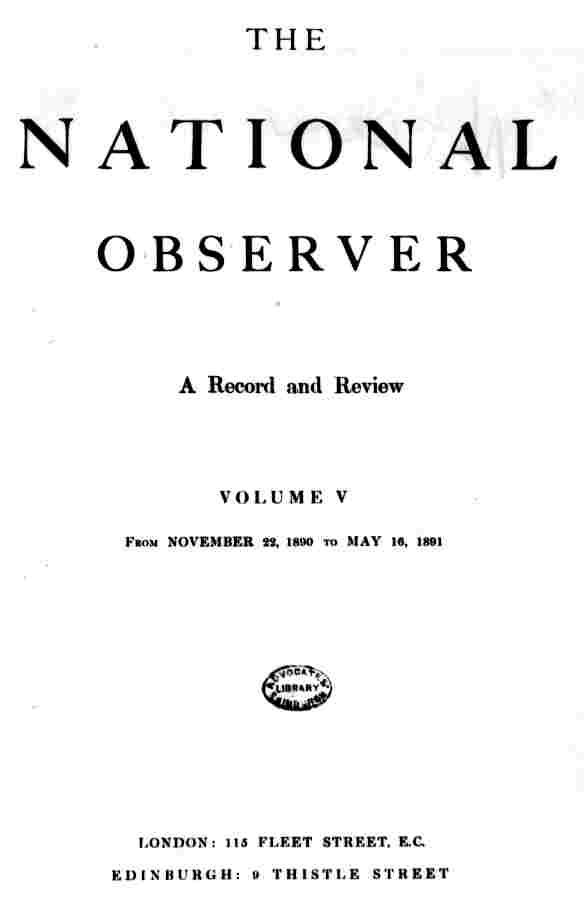
Reproduced by permission, National Library of Scotland

Reproduced by permission, British Library
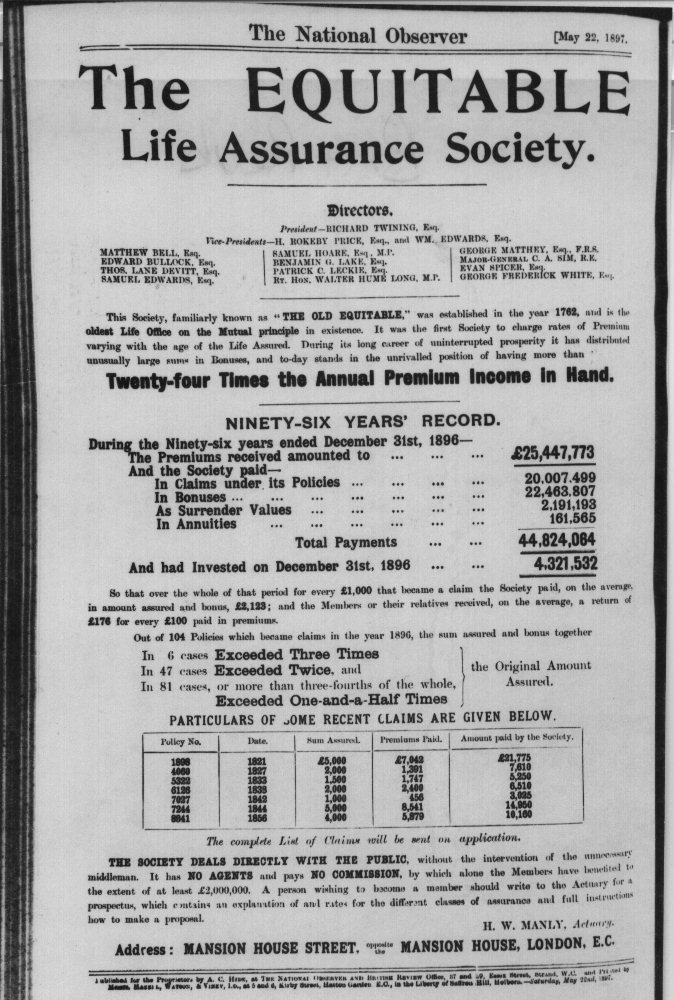
Reproduced by permission, British Library