Detailed Record
Chatterbox, The
no 1, 01 Dec 1866 - 1953

London,Middlesex
Editor:
William Erskine Clarke (Rev.)
Proprietor:
William Erskine Clarke (Rev.)
Publisher:
William Francis
W.W. Gardner (1874)
William Macintosh
Richard Taylor
W.W. Gardner (1874)
William Macintosh
Richard Taylor
Printer:
Strangeways and Walden
Contributors:
W. Baird
James F. Cobb (Esq.)
Mary Howitt
J. Johnston (ill.)
F.W. Keyl
John Critchley Prince
T.A. Smith
Dean Swift
James F. Cobb (Esq.)
Mary Howitt
J. Johnston (ill.)
F.W. Keyl
John Critchley Prince
T.A. Smith
Dean Swift
Size:
24cm, 8pp
Price:
½d; 1d (1912); 3d (1912)
Frequency:
weekly (Thu 1866); monthly (25th day)
Illustration:
many full-page engravings, coloured frontispieces, music scores, colour and b/w illustrations
Indexing:
list of ill/vol, T of C/vol, index of ill
Departments:
short fiction, serial fiction, poetry, illustrations, advisory articles, competitions
Orientation:
Church of England
Sources:
Bodleian Library Pre-1920 Catalogue; Avery, Gillian. Childhood's Pattern. A Study of the Heroes and Heroines of Children's Fiction 1770-1950. London: Hodder and Stoughton, 1975.; Carpenter, Humphrey, and Mari Prichard. The Oxford Companion to Children's Literature. Oxford, NY: Oxford UP, 1984.; Cooper, Dictionary of Contemporaries.; COPAC; Dixon, “Children and the Press”.; Egoff, Sheila A. "Children's Periodicals of the Nineteenth Century, a Survey and Bibliography." Library Association: Pamphlet no 8 (1951): 55.; Ellis, “Reading for Working Class Children”.; Ellis, Alec. A History of Children's Reading and Literature. London: Pergamon Press, 1968.; I.D. Edrich, Periodicals. London, 1974, 1979. (Sales catalogue 'ZENO').; Lang, “Childhood’s Champions”.; Layton, Handy Newspaper List.; Salmon, "Literature for the Little Ones.".; Sumpter, Caroline. The Victorian Press and the Fairy Tale. Palgrave Macmillan, 2008.; Turner, E. S. Boys Will Be Boys. London: Michael Joseph, 1974.; Uffelman, 1992
Histories:
Altholz, Religious Press in Britain.; Beetham, "Reading the Working Woman's Reading".; Drotner, Children and Their Magazines.; Harris, Lee, Press in English Society.; Kent, C. "The 1980 RSVP conference." VPR 13 (1980): 134-6.; Moruzi, "Children's Periodicals" p.301.; VPR 13:4,p. 134.
Comments:
Volume 2 [?] is entitled, Chatterbox Annual. This is a children's magazine containing short stories, articles, serial stories, poems, competitions & illustrations in colour and black and white. Also issued the Chatterbox Christmas Box (c.1898-c.1899).
"Chatterbox was nearer the mark of the nursery than Aunt Judy. No undue sentimentality characterises this as it characterises so many children's magazines, and its editor has adhered firmly to the irreproachable principles which he set forth in his first number: 'As there are tears as well as smiles on the cheeks even of children, so, in spite of its lightsome name, this Chatterbox will from week to week whisper a few words about the solemn lessons we must learn, and the duties we must try to do to God and to those around us, if we would be happy here and happy in the Great Forever'" (Salmon, Edward; Literature for the Little Ones, p.577).
"The most famous and successful of these inexpensive, pious children's magazines. Clarke's aims were less lofty but no less determined than those of Mrs. Gatty [Aunt Judy's Magazine for Young People] or Alexander Strahan [Good Words for the Young]....To oust the insidious 'blood and thunders' was his major goal. Though the stories and articles of Chatterbox might do little to broaden the minds of young readers they did provide competitively priced distractions to cheap sensational papers. While Chatterbox eventually found a steady clientele, it seems unlikely that independent working-class juveniles, without zealous adult supervisors, would offer precious coppers for the good-boy stories of Chatterbox. Like many penny papers intended by their patrons for the edification of the working class, Chatterbox probably won its readership among the children of the lower middle class. Predictably, Chatterbox did not win laurels from highbrow critics" (Lang, Marjory; p.25). "Chatterbox was designed to counteract the influence of some of the boys' papers then in vogue and was extremely pious" (Ellis, p.78).
"The ubiquitous and cheap weekly serials known as PENNY DREADFULS inspired the godly and caring to produce magazines that would compete vigorously with them, would cost as little, and would offer as much action and illustration, but of a healthier sort....J.Erskine Clarke set up his...Chatterbox with these aims" (Carpenter, Humphrey and Prichard, p.551).
This was the "longest running of mixed-gender children's magazines" which Erskine founded "in reaction to penny dreadful magazines" (Moruzi 301).
"Chatterbox was not envisaged as a nursery periodical by its founder, William Erskine Clarke, but the slightness of its contents meant that it gained a loyal readership in the nursery. It had been intended...for children of the lower classes" (Dixon, p.140).
"Chatterbox was nearer the mark of the nursery than Aunt Judy. No undue sentimentality characterises this as it characterises so many children's magazines, and its editor has adhered firmly to the irreproachable principles which he set forth in his first number: 'As there are tears as well as smiles on the cheeks even of children, so, in spite of its lightsome name, this Chatterbox will from week to week whisper a few words about the solemn lessons we must learn, and the duties we must try to do to God and to those around us, if we would be happy here and happy in the Great Forever'" (Salmon, Edward; Literature for the Little Ones, p.577).
"The most famous and successful of these inexpensive, pious children's magazines. Clarke's aims were less lofty but no less determined than those of Mrs. Gatty [Aunt Judy's Magazine for Young People] or Alexander Strahan [Good Words for the Young]....To oust the insidious 'blood and thunders' was his major goal. Though the stories and articles of Chatterbox might do little to broaden the minds of young readers they did provide competitively priced distractions to cheap sensational papers. While Chatterbox eventually found a steady clientele, it seems unlikely that independent working-class juveniles, without zealous adult supervisors, would offer precious coppers for the good-boy stories of Chatterbox. Like many penny papers intended by their patrons for the edification of the working class, Chatterbox probably won its readership among the children of the lower middle class. Predictably, Chatterbox did not win laurels from highbrow critics" (Lang, Marjory; p.25). "Chatterbox was designed to counteract the influence of some of the boys' papers then in vogue and was extremely pious" (Ellis, p.78).
"The ubiquitous and cheap weekly serials known as PENNY DREADFULS inspired the godly and caring to produce magazines that would compete vigorously with them, would cost as little, and would offer as much action and illustration, but of a healthier sort....J.Erskine Clarke set up his...Chatterbox with these aims" (Carpenter, Humphrey and Prichard, p.551).
This was the "longest running of mixed-gender children's magazines" which Erskine founded "in reaction to penny dreadful magazines" (Moruzi 301).
"Chatterbox was not envisaged as a nursery periodical by its founder, William Erskine Clarke, but the slightness of its contents meant that it gained a loyal readership in the nursery. It had been intended...for children of the lower classes" (Dixon, p.140).
Location:
partial runs: LO/N-1 A 1:1+ (01 Dec 1866-1953), OX/U-1 A (1866-1944 inc.); AB/N-1 A; LV/U-1; NW/U-1; The full text is available on CENGAGE from Gale.
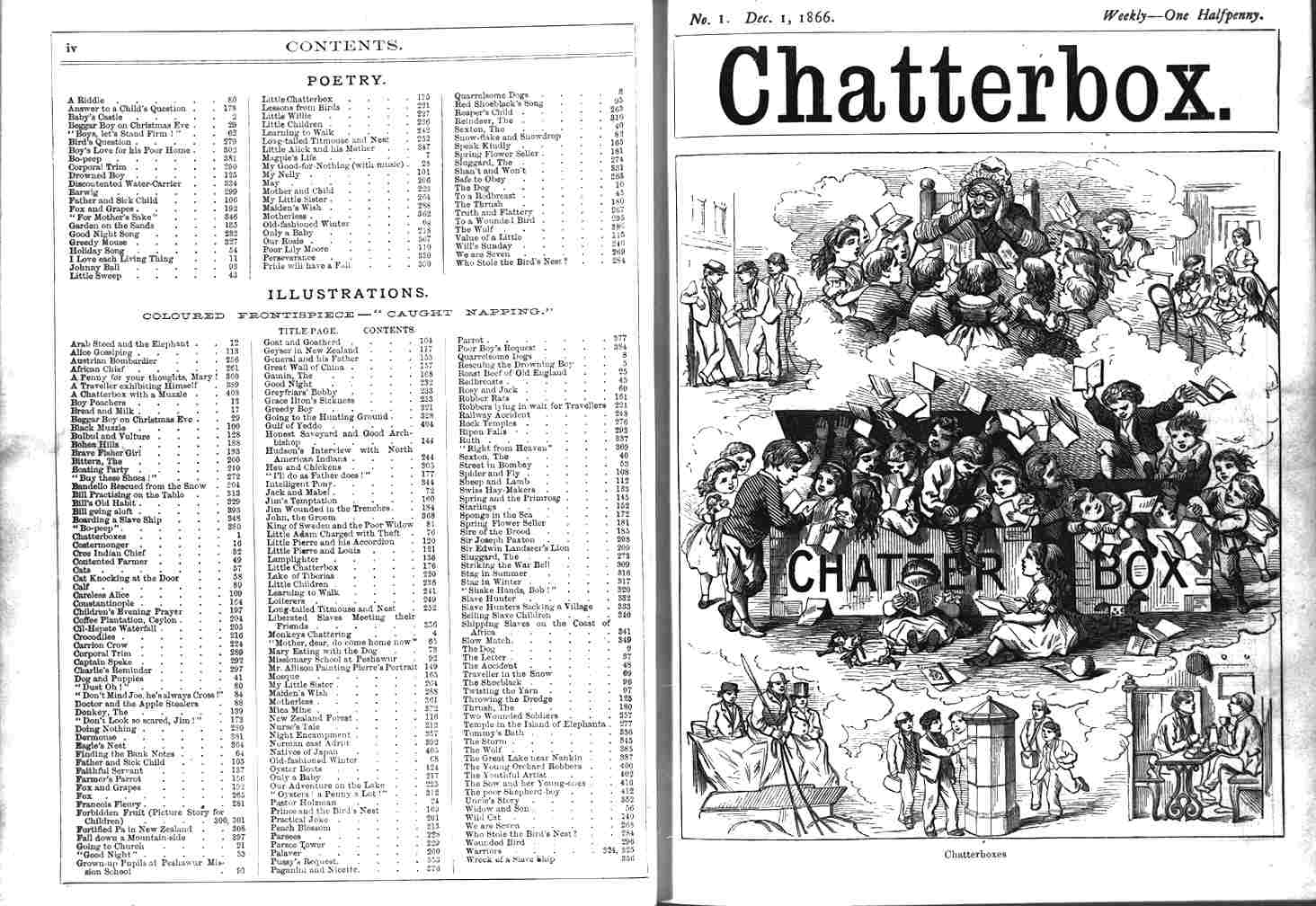
Reproduced by permission, the British Library