Detailed Record
Westminster Review, The
vol 1 no 1, 24 Jan 1824 - vol 24 no 47, Jan 1836

London,Middlesex
Editor:
Jeremy Bentham (co-editor 1831)
John Bowring (Sir) co-editor Jan 1824 - Jan 1836)
Henry Southern (co-editor Jan 1824 - 1827?)
Thomas Perronet Thompson (co-editor Jan 1829 - Jan 1836)
John Bowring (Sir) co-editor Jan 1824 - Jan 1836)
Henry Southern (co-editor Jan 1824 - 1827?)
Thomas Perronet Thompson (co-editor Jan 1829 - Jan 1836)
Proprietor:
Jeremy Bentham (Jan 1824 - Apr 1832)
John Bowring (Jul 1832 - Jan 1836)
James Mill (1824 - 1828)
William Molesworth (Sir) 1835 - 1836)
Thomas Perronet Thompson (Jan 1829 - Jul 1832)
John Bowring (Jul 1832 - Jan 1836)
James Mill (1824 - 1828)
William Molesworth (Sir) 1835 - 1836)
Thomas Perronet Thompson (Jan 1829 - Jul 1832)
Publisher:
Baldwin, Cradock and Joy (Jan 1824 - Apr 1828)
Jeremy Bentham
T.C. Hansard (Jul, Oct 1835)
Robert Heward (Jul 1829 - Apr 1834, Jul 1834 - Oct 1834)
Simpkin and Marshall (Jul 1834 - Apr 1835)
J.C. Stevens (Jan 1829 - Apr 1829)
Jeremy Bentham
T.C. Hansard (Jul, Oct 1835)
Robert Heward (Jul 1829 - Apr 1834, Jul 1834 - Oct 1834)
Simpkin and Marshall (Jul 1834 - Apr 1835)
J.C. Stevens (Jan 1829 - Apr 1829)
Printer:
T.C. Hansard (1824)
William Clowes and Sons (1836)
William Clowes and Sons (1836)
Contributors:
Richard Monckton
Sarah Taylor Austin
Andrew Bisset (1835)
John Bowring
Walter Coulson (Jul 1824)
Thomas Falconer
George Fletcher
Arthur Hallam
Francis Jeffrey
Gibbons Merle (1830, 1833)
James Mill (Jan 1824 - 1830)
John Stuart Mill (1826 - 1835)
Sarah Taylor Austin
Andrew Bisset (1835)
John Bowring
Walter Coulson (Jul 1824)
Thomas Falconer
George Fletcher
Arthur Hallam
Francis Jeffrey
Gibbons Merle (1830, 1833)
James Mill (Jan 1824 - 1830)
John Stuart Mill (1826 - 1835)
Size:
21cm, 560pp (1824)
Circulation:
2,000-3,000 (1824); 1,000 (1824); 3,000 (1831)
Frequency:
quarterly (1824 - 1836)
Illustration:
engravings
Issued by:
Philosophical Radicals, The
Indexing:
index/vol (except final vol); vols 1-24 in vol 24; vols 25-33 in vol 33; vols 1-13 separately published in 1832; vols 1-24 [1s] separately published in 1836; vols 25-33 separately published in 1840; Poole's Index to Periodicals 1824-1906; 1836-1900 in Wellesley Index, v.3. for addenda see Curran; N. America: ULS 3; T of C/no, index of illustrations/vol; General index to the Articles of the Westminster Review contained in the first series of twenty-four Volumes. January 1824 to January 1836. London: Charles Reynell, 1836.; general index/vol (1840); Jones, Index to Legal Periodical Literature; Harden. A Checklist of Contributions by...Thackeray; 19th Century Readers' Guide
Departments:
periodical literature, education, drama (1824); literary reviews, social commentary
Orientation:
Benthamite; liberal; radical; Reformer; Utilitarian (1830s)
Merges:
merged with The London Review (1836)
Sources:
Bashfor, Langley, Music and British Culture.; Bell, Visions of Global Order.; Cooper, Dictionary of Contemporaries.; Curran, Eileen. "The Wellesley Index: 'Additions and Corrections.'" VPR 30.4 (1997): 318-329.; Cushing, Morris, 19th Century Readers' Guide.; DNB ii, p.69; Harden, Contributions by Thackeray.; Henson et al. Culture and Science; Jones, L.A. An Index to Legal Periodical Literature. Boston, 1888.; Kelleher, "Prose writing and drama in English," p.458.; Layton, Handy Newspaper List.; Liddle, Dallas. The Dynamics of Genre: Journalism and the Practice of Literature in Mid-Victorian Britain., University of Virginia Press, 2009, p.1-175.; Lightman, Bernard. Victorian Popularizers of Science. Chicago and London: The University of Chicago Press, 2007. p.297.; Logan, Deborah A. Harriet Martineau, Victorian Imperialism, and the Civilizing Mission. Farnham, England: Ashgate, 2010, p.234.; Martin, Kathleen Callanan. Hard and Unreal Advice: Mothers, Social Science and the Victorian Poverty Experts. Palgrave Macmillan, 2009, p.1-182.; Mitchell, Sally. The Fallen Angel: Chastity, Class and Women's Reading 1835-1880. Ohio: Bowling Green University Popular Press, 1981.; Ofek, Galia. Representations of Hair in Victorian Literature and Culture. Farnham, England: Ashgate, 2009, p.42.; Rigg, Patricia. Julia Augusta Webster. Madison: Fairleigh Dickinson University Press, 2009.; Rubery, Matthew. Novelty of Newspapers. Oxford University Press, 2009, p.9.; Sper, Felix. Periodical Press of London, Theatrical & Literary. Boston: F.W. Faxon Co., 1937.; Teukolsky, Rachel. The Literate Eye. Oxford University Press, 2009, p.269.; The Pre-Raphaelites Writings and Sources. Vol I Ed. Bryden, Inga. London: Routledge/Thoemmes Press, 1998.; Uffelman, 1992.; White's The English Literary Journal to 1900.; Williams, Judith Blow. A Guide to the Printed Materials for English Social and Economic History 1750-1850. 2 vols. New York: Octagon Books, 1966.; vi, p.1027-1028; xxi, p.711-712; xxii, p.1018; Ward, William. Index and Finding List, p.172.; Wagner-Lawlor, Jennifer A., The Victorian Comic Spirit; New Perspectives. Hampshire: Ashgate Publishing Ltd, 2000.
Histories:
Adams, James Eli. A History of Victorian Literature. Oxford: Wiley-Blackwell, 2009.; Altholz, Religious Press in Britain.; Altick, Lively Youth of a British Institution.; Altick, English Common Reader.; Aspinall, Politics and the Press.; Baker, William, and Kenneth Womack, eds. YWES. 81. Oxford: Oxford UP, 2002.; Basch, Relative Creatures.; Bourne, H.R. Fox, vol 2 (1887): 36, 51.; Bourne, H.R. Fox. English Newspapers. vol 2. New York: Russell & Russell, 1966.; Bowers, Studies in Bibliography.; Boyce, Newspaper History from the Seventeenth Century.; Brake, Print in Transition.; Camlot, Jason. Style and the Nineteenth-Century British Critic. Aldershot: Ashgate, 2008, pp.1-194.; Coss, John Jacob. ed. Autobiography of John Stuart Mill. New York: Columbia University Press, 1924.; Cranfield, G.A. The Press and Society: From Caxton to Northcliffe London and New York: Longman, 1978.; Curran, Eileen. "Holding On By A Pen: The Story of a Lady/Reviewer Mary Margaret Busk (1779-1863)." VPR. 31.1 (Spring 1998): 9-30.; Curran, Eileen M. "The Wellesley Index: Additions and Corrections" In VPR 34:4 (Winter 2001): 324-358.; Curran, Eileen [now ed. Gary Simons]. The Curran Index: Additions, Corrections, and Expansions of The Wellesley Index to Victorian Periodicals.; Curtis, S.J. History of Education in Great Britain. 5th ed. London: University Tutorial Press, 1963.; Dingle, A.E. The Campaign for Prohibition in Victorian England: The United Kingdom Alliance, 1872-1895 . London: Croom Helm, c.1980.; Dixon, Divine Feminine. p.153.; Fetter, Frank W. "Economic Articles in the Westminster Review and Their Authors: 1824-1851." JPE 70 (1962): 570-96.; Fisher, Judith L. "In the Present Famine of Anything Substantial: Fraser's Portraits and the Construction of Literary Celebrity; or Personality, Personality is the Appetite of the Age". 39.2 (2006):97-135.; Fraiberg, Louis. "The Westminster Review and American Literature, 1824-1885." AL 24 (1952): 310-20.; Francis, M. "The origins of 'Essays and Reviews': an interpretation of Mark Pattison in the 1850's." HJ 17 (1974): 797-811.; Gates, Leigh Hunt.; Graham, British Literary Periodicals.; Griffiths, New Imperialism and the Fiction of Empire.; James, Fiction for the Working Man.; John Chapman and the Westminster Reviews.; Jones, Aled. Powers of the Press: Newspapers, Power and the Public in Nineteenth-Century England. England: Scolar Press, 1996.; Kent, Christopher A. "Higher Journalism and the Promotion of Comtism." VPR 25.2 (Summer 1992): 51-55.; King, Andrew and John Plunkett Victorian Print Media: a Reader Oxford: Oxford University Press, 2005: 340.; Lee, Origins of Popular Press; Lipkes, Jeff. Politics, Religion, and Classical Political Economy in Britain: John Stuart Mill and his Followers. London: MacMillian Press Ltd., 1999.; Lohrli, A. "English's finest prose writer." N&Q 29 (1982): 307.; Mansfield, Elizabeth. "Articulating Authority: Emilia Dilke's Early Essays and Reviews." VPR: 31.3 (Spring 1998): 75-86.; Mitchell, Chastity, Class and Women’s Reading.; Myers, W. "George Eliot's essays and reviews 1849-1857." PS 1 (1978): 5-20.; Nelson, Fatherhood in Victorian Periodicals .; Nesbit, George L. "Benthamite Reviewing: The First Twelve Years of the Westminster Review, 1824-1836". Diss. New York: Columbia University, 1934.; Nield, K. ed. Prostitution in the Victorian Age: Debates on the Issue from 19th Century Critical Journals. Westmead, 1973.; Peterson, Linda H. Becoming a Woman of Letters. Princeton: Princeton University Press, 2009.; Radford, Andrew. Victorian Sensation Fiction. Palgrave Macmillan, 2009, p.1-171.; Rivalain, Odile Boucher. "Bringing Out the Sympathies of Mankind: Reviewing Radical Poetry in Tait's Edinburgh Magazine and The Westminster's Review in the 1830s and 1840s." VPR 30.4 (Winter 1997): 350-367.; Rosenberg, Shelia. "Ecounters in the Westminster Review." Encounters in the Victorian Press: Editors, Authors, Readers. Laurel Brake and Julie F. Codell. New York: Palgrave Macmillan, 2005. p.119-137.; Rosenberg, S. "The financing of radical opinion: John Chapman and the Westminster Review". In The Victorian Periodical Press: Samplings and Soundings. Ed. Joanne Shattock and Michael Wolff. Toronto, 1982.; Rosenberg, Sheila The 'Wicked Westminster': John Chapman, His Contributors and Promises Fulfilled In VPR 33:3 (Fall 2000) 225-246; Ryan, Irish Literary Revival, p.110, 119.; Sanders, Harriet Martineau and the Victorian Novel .; Schoch, Richard W. Shakespeare's Victorian Stage, Performing History in the Theatre of Charles Kean. Cambridge: Cambridge University Press, 1998.; Schoenfield, British Periodicals and Romantic Identity.; Shattock, Joanne and Michael Wolff. eds. The Victorian Periodical Press: Soundings and Samplings. Toronto: University of Toronto Press, 1982.; Schoenfield, Mark. British Periodicals and Romantic Identity. Palgrave Macmillan, 2009, p.1-296.; Skilton, Anthony Trollope.; Smart, William. Economic Annals of the Nineteenth Century: 1821 - 1830. New York: Sentry Press, 1964.; Stewart, Progressives and Radicals.; Sumpter, Caroline. "Extending the Parameters of the Text: Anne Thackeray's Fairy Talkes in the Cornhill Magazine." VPR 33.1 (2000): 65-80.; Thompson, Nicola Diane. Reviewing Sex: Gender and the Reception of Victorian Novels. New York: New York University Press, 1996.; Van Arsdel, R.T. "The Westminster Review: change of editorship, 1840." SB 25 (1972): 191-204.; Van Arsdel, Rosemary Thorstenson. "The Westminster Review, 1824-1857: With Special Emphasis on Literary Attitudes." DA 22 (1961): 251.; Wallins, Roger P. in Sullivan, British Literary Magazines, vol 2, pp.424-433.; Ward, The Factory Movement.;Wellesley Index to Victorian Periodicals (vol 3), pp.537-540, 586-593.
Comments:
Mottos: "In the service of utilitarian doctrine" (Sper, Felix).
Legitime inquisition is vera norma est, ut nihil veniat in practicam, cujus non fit etiam doctrina aliqua et theoria"--Bacon; "Those who have not thoroughly examined to the bottom all their own tenets, must confess they are unfit to prescribe to others; and are unreasonable in imposing that as truth on other men's belief which they themselves have not searched into, nor weighed the arguments of probability on which they should receive or reject it" --Locke; "Truth can never be confirmed enough, Though doubts did ever sleep."—Shakespeare.
The Westminster Review began in 1824. It was intimately linked with Jeremy Bentham and James Mill. It began as a radical leftist paper but eventually strayed from its focus. Lower readership was partially to blame. Sir William Molesworth, proprietor of the London Review took possession of the paper and eventually merged it into its counterpart to form the London and Westminster Review. The paper would continue into the 20th century. There is a separate record for the London Review which contains the family tree of the Westminster Review after 1835. Much of the scholarship listed in the two records overlaps. (Editor's note).
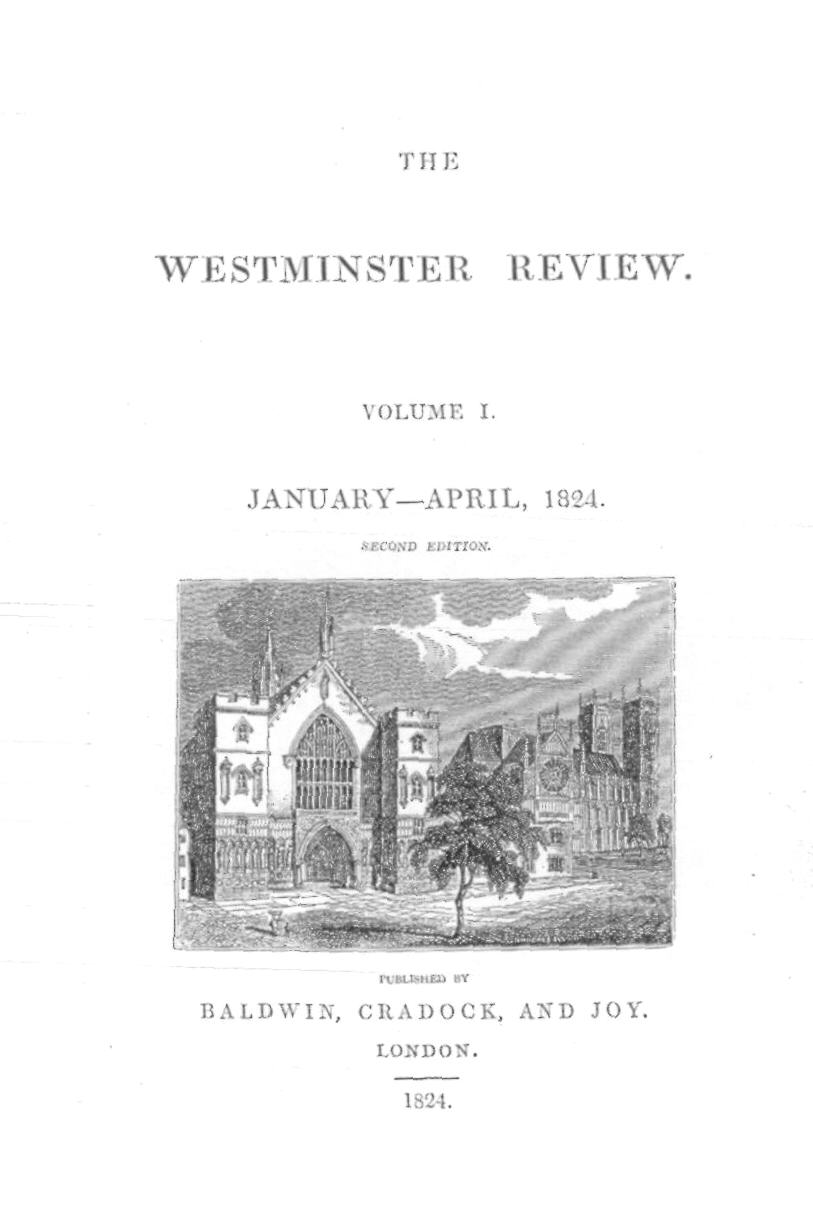
A second edition of this title was published in volume 1, January to April 1824 (title page).
Graham calls this "the most important imitator of the Edinburgh and Quarterly" (251). He also mentions that it "corresponds with the rise of a third party in English politics" (251): the Benthamite/Utilitarian political allegiances with which J.S. Mill sympathized.
"After a promising first number, the Westminster Review bitterly disappointed the young Philosophic Radicals. Eventually, the ardent - and wealthy - young Millite Sir William Molesworth came to the rescue, buying out the Westminster and merging it with his newly founded London Review" (Lipkes 11). Leader is quoted as saying: "A Review that people talk about, ask for at the clubs, and read with respect" (Gates 525).
It "opposed reform of the child labour laws in 1833" (Ward, 91).
Bowring was a pupil of Jeremy Bentham's, who "maintained his master's principles in the Westminster Review (Cooper, Thompson; p.132).
"In its inaugural issue, the Westminster Review argues that the contemporary moment imposes on all reading: 'whatever the promise of the title page; poem, play, or tale;...history, criticism, science, or even theology...Even Shakespeare and all his wonderful creations cannot induce us to forget Castlereagh and Canning..the subject...mixes familiarly with whatever company may at any time be assembled' (WR I:9)." (Schoenfield, p.33).
"'Such a publication as we project, seems to us to be called for by the voice of the people; of whom we are, from whom we have no separate interests or objects, and to whom, though we cannot sacrifice a single just principle or personal conviction, we heartily devote our efforts in the pages of The Westminster Review.'" (WR I:16 in Schoenfield, 35).
"In [James Mill's] article on the ['characteristic malady of the periodical press'] published in the Westminster in 1824, where he argues that '[p]eriodical literature depends upon immediate success' and 'must, therefore, patronize the opinions which are now in vogue, the opinions of those who are now in power.' For James Mill the reigning power is the Edinburgh Review, which he believes is in service of an aristocratic coneception of parliament." (Camlot, p.19)
"By 1820, the development of machine-made paper and the rotary steam press had begun to dramatically reduce the cost of printing, and monthly journals began to proliferate, the most notable before 1832 being Blackwood's, The London Review, The Westminster Review, Colburn's New Monthly Magazine, and Fraser's." (Adams, p.11).
"The radical associations of the Westminster, where Fox's encomiums had appeared, and Hallam's cheeky praise of the cockney school brought out from John Wilson (writing as 'Christopher North' in Blackwood's) an echo of th efierce attacks on Keats. Fox's praise in the Westminster, North pronounced, is 'a perfect specimen of the super-hyperbolical ultra-extravagance of outrageous Cockney eulogistic foolishness ... the purest mere matter of moonshine ever mouthed by an idiot-lunatic, slavering in the palsied dotage of the extremest superannuation ever inflicted on a being.'" (Adams, p.41)
For an extended list of contributors, consult the Curran Index.
It was primarily published in London, and it circulated in Dublin, Edinburgh, Leipzig, Liverpool, Manchester, Melbourne, New York, Paris.
Location:
complete runs: CA/U-1 A, BH/P-1, QS/P-1, QZ/P99, QZ/P52, LO/S-7, LD/P-1, Liverpool Athenaeum Library, Manchester Chetham's Library, QW/P23, QN/P-2, SH/P-1; partial runs: LV/P-1 (1829-1832), BD/P-1 (1824-1827, 1828-1830, 1832), LO/U-1 G vols 1-181 (1836+) (vol 34-35 inc) (vols 57-127 also as [ns] 1-71); N.America: see Fulton; ULS 2&3
Reproduced by permission, Cambridge University Library