Detailed Record
Morning Chronicle and London Advertiser, The
no 1, 28 Jun 1770 - no 29708, 02 Mar 1865//

London,Middlesex
Editor:
Alexander Black
John Black (1817 - 1843//)
Thomas Black (1817)
William Black
W.I. Clement (1821)
John Douglas Cook (1848 - 1854)
John Delane (1848)
Lewis Doxat (sub-editor)
Andrew Doyle (1843 - 1848)
John Easthope (Sir) 1834 - 1847)
G.H. Francis
Gray (1789+)
Philip Harwood (1849 sub-editor)
T.L. Holt
O'Doyle (1843)
James Perry (1789 - 1821)
Richard Porson
Michael Joseph Quin (foregin editor)
Robert Spankie
Stiff (1860s)
Tom Taylor
Street Woodfall (1828)
William Woodfall (1769 - 1789)
John Black (1817 - 1843//)
Thomas Black (1817)
William Black
W.I. Clement (1821)
John Douglas Cook (1848 - 1854)
John Delane (1848)
Lewis Doxat (sub-editor)
Andrew Doyle (1843 - 1848)
John Easthope (Sir) 1834 - 1847)
G.H. Francis
Gray (1789+)
Philip Harwood (1849 sub-editor)
T.L. Holt
O'Doyle (1843)
James Perry (1789 - 1821)
Richard Porson
Michael Joseph Quin (foregin editor)
Robert Spankie
Stiff (1860s)
Tom Taylor
Street Woodfall (1828)
William Woodfall (1769 - 1789)
Proprietor:
John Black
Cardwell (Lord)
William Innell Clement (1821 - 1834)
Duke of Newcastle (1848)
Earl of Lincoln (1848)
John Easthope (Sir) 1834 - 1847//)
W.E. Gladstone (1848 - 1854)
William Glover (1854 - 1860?)
James Gray (joint owner 1789)
Thomas Harris (1788)
Sidney Herbert (1848 - 1854)
James Perry (1789 - 1821)
Thomas Erskine Perry (Sir)
George Stiff (1860? - 1862)
William Woodfall (1769 - 1789)
Cardwell (Lord)
William Innell Clement (1821 - 1834)
Duke of Newcastle (1848)
Earl of Lincoln (1848)
John Easthope (Sir) 1834 - 1847//)
W.E. Gladstone (1848 - 1854)
William Glover (1854 - 1860?)
James Gray (joint owner 1789)
Thomas Harris (1788)
Sidney Herbert (1848 - 1854)
James Perry (1789 - 1821)
Thomas Erskine Perry (Sir)
George Stiff (1860? - 1862)
William Woodfall (1769 - 1789)
Publisher:
J. Black (1836)
William Butler (1856)
William Innell Clement (1823 - 1835)
William Delane (Delane?, 1848)
John Easthope (Sir) 1834 - 1847)
David Jones (1854)
John Lambert (1799 - 1821)
James Perry (1789 - 1821)
Richard Porson
D. Robertson (1822 - 1823)
John Adkins Tibbitts (1851)
J.N. Ward (1834 - 1835)
Henry William Wills (1846)
William Woodfall (1769 - 1788)
William Butler (1856)
William Innell Clement (1823 - 1835)
William Delane (Delane?, 1848)
John Easthope (Sir) 1834 - 1847)
David Jones (1854)
John Lambert (1799 - 1821)
James Perry (1789 - 1821)
Richard Porson
D. Robertson (1822 - 1823)
John Adkins Tibbitts (1851)
J.N. Ward (1834 - 1835)
Henry William Wills (1846)
William Woodfall (1769 - 1788)
Printer:
John Easthope (Sir) 1834 - 1847)
J. Lambert (1803 - 1812)
James Perry (1789 - 1821)
William Woodfall (1769 - 1788)
J. Lambert (1803 - 1812)
James Perry (1789 - 1821)
William Woodfall (1769 - 1788)
Contributors:
John Allen
Thomas Attwood
John Black
Charles Shirley Brooks
Henry Brougham (Lord) 1820)
Charles Buller
John Campbell
Thomas Campbell
George Canning
James Christie
Peter Clare
Coleridge (1793)
John Payne Collier
Dudley Costello (foreign correspondent)
Eyre Evans Crowe (c.1830)
William Dalton
Thomas Denman (c.1804 - 1809)
Charles Dickens (1829 - 1836)
Edward Dubois
Duke of Kent
David Morier Evans
Charles Eyles
Robert Cutlar Fergusson
Peter Finnerty
Albany Fonblanque
William Johnson Fox
W. Frankland
James Grant
James Gray
Frederick Greenwood
George Grote (c.1821)
Charles Lewis Gruneisen (musical critic 1853)
Samuel Carter Hall
Andrew Halliday (1849)
James Hannay
William Hazlitt (1814 - 1817)
William (Jr) Hazlitt
George Alfred Henty (c.1855 - 1859)
Henry Hetherington
Thomas Hodgskin (parliamentary reporter)
George Hogarth
Hollard (Lord)
Alexander James Beresford Hope (c.1851)
Leigh Hunt
John Keats
Charles Lamb
George Henry Lewes
Eliza Lynn Linton (née Lynn)
Issac Low
William Bernard MacCabe
Mackintosh (Sir)
James Mackintosh (1789? - 1795)
Richard Robert Madden (1843 - 1846)
Henry James Sumner Maine (Sir) 1851)
Henry Mayhew (1849 - 1850)
Gil James Mill
James Mill
John Stuart Mill (1850)
Thomas Moore (1820)
William Mudford (1820?)
Robert Mudie
John Mason Neale (1851 - 1853)
William Newmarch (1853)
William Newmarch (1846)
Caroline Norton (1848)
Samuel Philips
Porson
Angus Bethune Reach
Cyrus Redding (1818)
David Ricardo
Rigby
John Mackinnon Robertson
Phillip Sheridan
Richard Sheridan
George Sydney Smythe (foreign affairs)
Robert Spankie (1792)
Supple
Harriet Taylor (1850)
William Makepeace Thackeray (Nov 1844 - 1848, pseudonyms "Yellowplush", "Fitz-boodle", "Michael Angelo Titmarsh")
Francis Vincent
Samuel Wells (Jan 1830)
Thomas Attwood
John Black
Charles Shirley Brooks
Henry Brougham (Lord) 1820)
Charles Buller
John Campbell
Thomas Campbell
George Canning
James Christie
Peter Clare
Coleridge (1793)
John Payne Collier
Dudley Costello (foreign correspondent)
Eyre Evans Crowe (c.1830)
William Dalton
Thomas Denman (c.1804 - 1809)
Charles Dickens (1829 - 1836)
Edward Dubois
Duke of Kent
David Morier Evans
Charles Eyles
Robert Cutlar Fergusson
Peter Finnerty
Albany Fonblanque
William Johnson Fox
W. Frankland
James Grant
James Gray
Frederick Greenwood
George Grote (c.1821)
Charles Lewis Gruneisen (musical critic 1853)
Samuel Carter Hall
Andrew Halliday (1849)
James Hannay
William Hazlitt (1814 - 1817)
William (Jr) Hazlitt
George Alfred Henty (c.1855 - 1859)
Henry Hetherington
Thomas Hodgskin (parliamentary reporter)
George Hogarth
Hollard (Lord)
Alexander James Beresford Hope (c.1851)
Leigh Hunt
John Keats
Charles Lamb
George Henry Lewes
Eliza Lynn Linton (née Lynn)
Issac Low
William Bernard MacCabe
Mackintosh (Sir)
James Mackintosh (1789? - 1795)
Richard Robert Madden (1843 - 1846)
Henry James Sumner Maine (Sir) 1851)
Henry Mayhew (1849 - 1850)
Gil James Mill
James Mill
John Stuart Mill (1850)
Thomas Moore (1820)
William Mudford (1820?)
Robert Mudie
John Mason Neale (1851 - 1853)
William Newmarch (1853)
William Newmarch (1846)
Caroline Norton (1848)
Samuel Philips
Porson
Angus Bethune Reach
Cyrus Redding (1818)
David Ricardo
Rigby
John Mackinnon Robertson
Phillip Sheridan
Richard Sheridan
George Sydney Smythe (foreign affairs)
Robert Spankie (1792)
Supple
Harriet Taylor (1850)
William Makepeace Thackeray (Nov 1844 - 1848, pseudonyms "Yellowplush", "Fitz-boodle", "Michael Angelo Titmarsh")
Francis Vincent
Samuel Wells (Jan 1830)
Names:
Charles B. Adderly (Sir)
Burton Blyth
Joseph Archer Crowe (Sir)
William Harcourt (Sir)
Eliza Lynn
Henry Mayhew
Edgar Taylor
John Sydney Taylor
Burton Blyth
Joseph Archer Crowe (Sir)
William Harcourt (Sir)
Eliza Lynn
Henry Mayhew
Edgar Taylor
John Sydney Taylor
Size:
50cm, 4pp (1803, 1812); 38cm; 48cm; 32pp; 72pp (1859)
Price:
3d (1781); 6d (1803); 6½d (1812); 7s (1820); 4d (Jul 1847); 5d (1846, Feb 1848); 5d st
Circulation:
1,996 (1770-1854+, see Jack); 5,000/no (Dec 1770-1862, see Jones); 1,700/d (1801); 3,000/d (1803); 3,100/d (1821); 4,000/no (1829); 1,000/no (1834); 5,490 (first half of 1835); 9,000 (1837); 5,000-6,000/no (1839); 3,000 (1850); 2,500-2,800 (1854)
Frequency:
daily (am); weekly
Illustration:
engravings
Indexing:
Harden. A Checklist of Contributions by...Thackeray
Departments:
advertisements, literary reviews, parliamentary reports, letters and general news from foreigners, theatrical criticism and poetry, British and French warfare news (1793); advertisements, Imperial Parliament, editorial matter, mirror of fashion, law intelligence, ship news, sales by auction (1803); advertisements, Imperial Parliament, law intelligence, ship news, sales by auction, the mirror of fashion (1803); poetry, new parliament, books published this day, French papers (1812); naval intelligence, state lottery, ship news, bankruptcies, imperial parliament, book advertisements, crime reports, murder and execution coverage, court reports, parliamentary reports, rifles and firearms, "Street Sketches"
Orientation:
Whig (1769, 1790s-1847); "Jacobin"; peelite (1847+); pro-government (1788); pro-opposition (1790s); moderate (1809); moderate, free trade, anti-church rate, Whig-Ministerial, manufacturing (1846); liberal-conservative (1851); radical
Merges:
absorbed by the Daily Telegraph and Courier (q.v.) (1862)
Sources:
NCBEL; DNB v, 237-38; xix, 407, 450-51; xxii, 517; xxiii, supplement 2, 17-20; xxiv, 198-212, 249-51; MEB ii, 1125; Brake, Laurel. "Government by Journalism and the Silence of the Star." Encounters in the Victorian Press: Editors, Authors, Readers. Laurel Brake and Julie F. Codell. New York: Palgrave Macmillan, 2005. p.241.; Cooper, Thompson. Men of the Time: A Dictionary of Contemporaries, Containing Biographical Notices of Eminent Characters of Both Sexes. 8th ed. London: George Routledge and Sons, 1872.; Dickens, Charles. Dicken’s Journalism, Volume 2: ‘The Amusements of the People’ and Other Papers: Reports, Essays and Reviews 1834-51. Ed. Michael Slater. London: J. M. Dent, 1996.; Dickens, Charles. Sketches by Boz and Other Early Papers 1833-39. The Dent Uniform Edition of Dickens’ Journalism, Volume 1. Michael Slater, ed. Columbus, OH: Ohio State UP, 1994.; Garlick, Barbara and Harris, Margaret. Victorian Journalism: Exotic and Domestic. University of Queensland Press, 1998.; Grant, James. "The Metropolitan Weekly and Provincial Press". Vol 3 of The History of the Newspaper Press. London: George Routledge and Sons, 1871.; Grant, James. The Newspaper Press London: Tinsley Brothers, 1871.; Harden, Edgar F. A Checklist of Contributions by William Makepeace Thackeray to Newspapers, Periodicals, Books, and Serial Part Issues, 1828-1864. Victoria, BC: University of Victoria, 1996.; Harden, Edgar F. Selected Letters of William Makepeace Thackeray New York: New York UP, 1996.; Henry, Nancy and Cannon Schmitt. Victorian Investments: New Perspectives on Finance and Culture. Indiana University Press, 2009, p.1-219.; Jack, Thomas C. "English Newspapers." Scottish Newspaper Directory and Guide to Advertisers. Edinburgh, 1855: 141-157.; Liddle, Dallas. The Dynamics of Genre: Journalism and the Practice of Literature in Mid-Victorian Britain., University of Virginia Press, 2009, p.1-175.; Mill, John Stuart. Collected Works of John Stuart Mill. Vols 22-25, Newspaper Writings. Eds. Ann P. Robson et al. Toronto: U Toronto P.; Millar, Mary S. "Very Like Assassination: George Smythe's Journalism in the Morning Chronicle." VPR 36:3 (Fall 2003): 242-257.; Mitchell's Newspaper Press Directory, 1846, 1851.; Mitchell, Sally. The Fallen Angel. Chastity, Class and Women's Reading 1835-1880. Bowling Green, Ohio: Bowling Green University Popular Press, 1981.; O'Leary, Patrick. Sir James Mackintosh: The Whig Cicero. Aberdeen: Aberdeen University Press, 1989: 30, 129-130.; Slavery Part One (1980).; Sumpter, Caroline. The Victorian Press and the Fairy Tale. Palgrave Macmillan, 2008, p.1-178.; Sutherland, John. The Longman Companion to Victorian Fiction. Burnt Hill, Engl.: Longman, 1988.; Uffelman, 1992.; White's The English Literary Journal To 1900.; Williams, Judith Blow. A Guide to the Printed Materials for English Social and Economic History 1750-1850. 2 vols. New York: Octagon Books, 1966.; Worzala, Diane. Review "Woman Against Women in Victorian England: A Life of Eliza Lynn Linton." VPR 22:2 (Summer 1989): 83.
Histories:
VPR 13:3, pp.109-10, 14:3, pp.124-27; 17: pp.16-19, 21, 24-5; 17:3, pp.115-16; 19:1, pp.6, 8.; Altick, Lively Youth of a British Institution.; Altick, English Common Reader.; Aspinall, A. “Statistical Accounts”. pp. 222-234. II, 372-382.; Aspinall, Politics and the Press.; Barker, Hannah. Newspapers, Politics, and English Society, 1695-1855. Harlow: Longman, 2000.; Barnes, Donald Grove. A History of the English Corn Laws: From 1660 - 1846. New York: Augustus Kelley, 1961.; Basch, Relative Creatures.; Bendiner, Ford Madox Brown.; Black, Jeremy. The English Press 1621-1861. Stroud: Sutton Publishing, 2001.; Bostick, D.F. "Sir John Easthope and the Morning Chronicle, 1834-1848." VPR 12 (1979): 51-60.; Bourne, H.R. Fox (1887), vol 1, pp.192, 261-66, vol 2 pp.87-95, 151-59.; Bourne, H.R. Fox. English Newspapers. vol 1 & 2. New York: Russell & Russell, 1966.; Bowers, Fredson. ed. Studies in Bibliography vol 25. Charlottesville: The University Press of Virginia, 1972.; Boyce, Newspaper History from the Seventeenth Century.; Boyce, George. "The Fourth Estate: the reappraisal of a concept." Newspaper History from the Seventeenth Century to the Present Day. Ed. Jeremy Tunstall. 11 vols. London: Constable and Company Ltd., 1978. 19-40.; Breton, "Portraits of the Poor".; Burnett, John. ed. Useful Toil. London: Allen Lane, 1974.; Carlton, W. "The Story Without a Beginning: An Unrecorded Contribution by Boz to the Morning Chronicle." Dickensian 47 (1951): 67-70.; Carpenter, Mary Wilson. Health, Medicine, and Society in Victorian England. Santa Barbara, Calif.: Praeger, 2010. pp.1-214.; Clarke, Grub Street to Fleet Street, p.97.; Cline, C.L. "Thackeray and the Morning Chronicle." TLS (19 December 1942): 619.; Cole, Chartist Portraits5.; Cranfield, G.A., The Press and Society: From Caxton to Northcliffe London and New York: Longman, 1978; Dexter, Walter. "Dickens and the Morning Chronicle: Some Hitherto Unpublished Letters." FR 136 (1934): 591-98.; Dickens Journalism: the amusements of the people and other papers Michael Slater ed. London: J. M. Dent, 1996.; Drew, Dickens the Journalist.; Drew, "Pictures from the Daily News".; Dudek, Literature and the Press.; Erdman, David V. "Byron's Mock Review of Rosa Matilda's Epic on the Prince Regent--A New Attribution." KSJ 19 (1970): 101-17.; Escott, Masters of English Journalism; Esterhammer, "Coleridge in the Newspapers".; Flick, Carlos. The Birmingham Political Union and the Movements for Reform in Britain 1830-1839. Hamden, CT: Archon, 1978.; Gates, Leigh Hunt.; Graham, British Literary Periodicals.; Grant, James. The Newspaper Press: Its Origin - Progress - and Present Position. London: Tinsley Brothers, 1871.; Harmondsworth: Penguin, 1977.; Harris, Politics and the Rise of the Press.; Harrison, Brian. Drink and The Victorians: the Temperance Question in England 1815-1872. London: Faber and Faber, [1971].; Harrison, Poor Men’s Guardians.; Herd, March of Journalism.; Jones, Fleet & Downing. 1919, 1920.; Kinealy, Great Calamity.; Kinealy, Repeal and Revolution, p.166.; Kortsch, Christine Bayles. Dress Culture in Late Victorian Women's Fiction. Farnham, England: Ashgate, 2009.; Koss, Rise and Fall of the Political Press.; Landon, Richard G. ed. Book Selling and Book Buying: Aspects of the Nineteenth Century British and American Book Trades. Chicago: American Library Association, 1978.; Lee, Origins of Popular Press.; Lopatin, “Limits of Political Reporting”.; Mineka, Dissidence of Dissent.; Moore, Tara. Victorian Christmas in Print. New York: Palgrave MacMillan, 2009.; Murray, E.B. "The trial of Mr. Perry, Lord Eldon and Shelley's Address to the Irish." SIR 17 (1978): 35-49.; Patten, Charles Dickens and Boz.; Patten, Robert L. “From Sketches to Nickleby.” The Cambridge Companion to Charles Dickens. John O. Jordan. Cambridge: Cambridge University Press, 2001. p.18.; Pykett. "Dickens: The Novelist." p.190.; Robson, "Mill's Radical Journalism".; Schoenfield, British Periodicals and Romantic Identity, p.62, 219.; Schoyen, George Julian Harney.; Shelden, M. "Dickens, The Chimes, and the Anti-Corn Law League." VS 25 (1982): 329-53.; Smart, Economic Annals.; Tener, Robert H., and Malcolm Woodfield. eds. A Victorian Spectator: Uncollected Writings of R.H. Hutton. Bristol: The Bristol Press, 1989.; "The Periodical Press." Edinburgh Review 38:76 (May 1823), pp.349-378.; Thomas, Donald. A Long Time Burning: the History of Literary Censorship in England. London: Routledge & Kegan Paul, [1969]; Totowa, N.J.: Rowman and Littlefield, c.1976.; Warne, Vanessa. "Thackeray Among the Annuals: Morality, Cultural Authority and the Literary Annual Genre." VPR vol 39 no 2 (summer 2006):158-178.; Waters, "Doing the Graphic".; Webb, Working Class Reader.; Wiener, "British and American Newspaper Journalism".; Zall, P. M. "The cool world of Samuel Taylor Coleridge: Richard Porson, don or devil." WC 6 (1975): 255-60.
Comments:
Established 1770.
COPAC notes that The Morning Chronicle was suspended with the Dec. 21, 1862 issue and resumed with the Jan. 9, 1864 issue. Then it was suspended again with the Jan. 10, 1864 issue and again resumed with the Mar. 2, 1865 issue.
"Advocates moderate constitutional liberalism apart from, and in opposition to, the more ultra and violent views of extreme, or 'radical' policy. No doubt it is a difficult task to adhere to the moderate course, and requires a great degree of determination which this journal has often displayed; as in the instance of the Anti-Corn Law League, which it had strenuously supported until it pressed its object in a manner, and by means, not deemed proper by the face of an immense body, the majority, perhaps, of its party further to connect itself with these measures. It is, however, devoted most energetically to the interests of manufactures, and unceasingly advocates the principles of free-trade. Its articles are written with greater liveliness and raciness perhaps on questions of foreign policy than on any other, and evince a great range of information. To the affairs of the sister isle, also, great attention is paid; and the most intimate acquaintance manifested with its internal condition....Though not, we believe, altogether hostile to the existence of a Church Establishment, it is ardently opposed to anything approximating to ecclesiastical domination, and is the organ of a large body of moderate enlightened Dissenters" (Mitchell's, 1846).
"Since the last publication of the Directory, a complete change has come over the principles of this Journal. Then it was in the hands of Sir John Easthope, the exponent of Whig principles, the defender of Whig policy. Now, in the hands of a proprietary, it is liberal-conservative and the ablest advocate of the policy and measures of the late Sir Robert Peel, in the wide circle of the press.... This Journal is favourable to popular education; and has strongly advocated the necessity of state interference, for the purpose of improving the quality of that instruction which is given in the schools devoted to the children of the working classes, rather than its 'quantity.' Its principle is, that there is 'decisive evidence that the kind of schooling, the extension of which is so much relied upon, is not a preventive of crime;' and it argues for inspection, and the appointment of more competent teachers" (Mitchell's, 1851).
Evening Chronicle started in 1837. Some of contributors over the years included: James Mackintosh, Richard Sheridan, Thomas Campbell, Thomas Moore, John Campbell, Samuel Coleridge, Charles Lamb, William Hazlitt, Albany Fontblanque (1821-1824), James Mill, John Stuart Mill, John Payne Collier, George Hogarth, Charles Dickens, William Makepeace Thackeray. In 1848 Henry Mayhew contributed articles on the aspects of low life in London, which lead to his book London Labour and London Poor.
The Morning Chronicle published some of Dickens's earliest work (Pykett 190).
"Palmerston used the Morning Chronicle against the hated Times" (Young, p.13).
"Linton was the first woman to join the staff of an English newspaper; she was hired by the Morning Chronicle in 1848" (VPR).
There is some discrepancy regarding the ending date and run numbers of this periodical.
James Perry's constant advocacy of Whig principles kept The Morning Chronicle in the public eye as the leading opposition paper in the 1790s and early nineteenth century" (Barker, Hannah; p.120). By 1820, the Morning Chronicle was making an annual profit of 12,000 pounds (Barker, Hannah; p.95). The paper supported Catholic emancipation in 1829 (Barker, Hannah; p.204). The paper attacked Anti-Corn Law Leaguers for being "narrow minded bigots" in the 1840s (Barker, Hannah; p.219).
Dickens worked for this publication as a court and parliamentary reporter (Garlick and Harris p.203).
The "Morning Chronicle almost certainly gained most of its readership from Whig or opposition supporters" (Harris, p.47).
Hunt wrote a tribute to Egerton Webb in 1840 (Gates, Eleanor; p.291). Finnerty and Hazlitt were parliamentary reporters (Gates, Eleanor; p.435). William Hazlitt, Jr. became a parliamentary reporter after his father's death (Gates, Eleanor; p.441).
Hazlitt wrote theatrical criticisms for the paper (Herd, Harold; p.90).
"In the years from 1844 to 1846 he [Thackeray] was the principle book reviewer for the Morning Chronicle, earning about 20 pounds a month from that quarter" (Dudek).
"In the summer of 1834 the long established but now faltering London paper, the Morning Chronicle, was bought by a trio of bankers and stockbrokers led by a self made man called John Easthope. The object was to make the chronicle a more effective supporter of the Whig Government in all the post-Reform Bill measure it was carrying out against virulent Tory opposition, opposition most trenchantly and influentially expressed in The Times. In particular, Easthope wanted the Chronicle to be a strong champion of the New Poor Law, the centerpiece of the Whig's legislative program" (Slater).
"Usually contains full accounts of riots and chartist trials" (Schoyen p.291).
"Mr. Clement after achieving great commercial success with the Observer, determined soon after the death of Mr. Perry to purchase the Morning Chronicle. This was in 1821.This did not prove a good speculation. He continued to lose annually a large amount of money on the Chronicle until he sold it to Sir John Easthope and two other gentlemen, in 1834" (Grant, James; p.31).
"Early gave full reports of Parliament" (Williams, Judith; vol 1, p.75).
It faced resistance from the Anti-Jacobin who claimed that "the nation's will is more legible in its economic policies...than in those representations epitomized by the Jacobin Morning Chronicle" (Schoenfield 62).
One of only nine daily newspapers, five of which were advertising journals and all of which were published in London, being published in Great Britain at the end of 1783 (Aspinall p.6).
The Morning Chronicle prophesied that half the existing newspapers would be extinguished by the new taxation (2nd June 1815)" (Aspinall p.21). "The Morning Chronicle was then [in 1852] being supported by the money of Sidney Herbert and other Peelites" (Aspinall p.199). "Of the principal papers opposing the Addington ministry of 1801-4, the Morning Chronicle was the organ of the Foxite Whigs" (Aspinall p.281). "During the Peninsular War the Morning Chronicle...obtained news from a secret source which was obviously connected with military headquarters there" (Aspinall p.282). "Everyone agreed that the Morning Chronicle was an unsatisfactory Opposition newspaper" (Aspinall p.294). Despite declining circulation, "when in 1834 Clement disposed of the copyright, he obtained for it more than a hundred times as much as Perry and Gray had given for it" (Aspinall p.306). "The people were keenly interested in [The Princess of Wales'] affairs; newspapers like the Morning Chronicle, the Pilot, and the Star could hope considerably to increase their circulation by devoting themselves to her" (Aspinall p.306). "Started in 1769 in the Whig interest, but in 1788, when William Woodfall was about to retire from its direction, it was a Government paper" (Aspinall p.69).
In the late 1700's and/or early 1800's, this newspaper was "of a very different character from those with which we are familiar; they had nothing in the shape of general intelligence -- law and police news, and public proceedings of all kinds were entirely ignored" (Smart, William; pp.40-41).
By 1789, the Chronicle had declined and was put up for sale. James Perry bought the paper and took over editorial responsibilities (Clarke 97).
Gray was the co-editor with James Perry until his death (unknown date). John Black edited the periodical until it ended. The size of the periodical was two to three columns daily.
Thackeray contributed 35 articles to the paper between 1844 and 1848. John Campbell contributed to The Morning Chronicle as a theatrical critic for the plays: The Exile of Erin and Ye Mariners of England. "The training school for the clever writers who began to make the Saturday Review" (Escott). Black was "[t]he first newspaper critic of English institutions in detail" (Escott).
Leigh Hunt was the dramatic critic; Lord Brougham, Sir James Mackintosh and David Ricardo were leader-writers (Jones, Kennedy). Brooks wrote the "Parliamentary summary" for the Morning Chronicle (Cooper, Thompson; p.146).
Anthony Angus Reach worked as a parliamentary and trial correspondent for the Morning Chronicle. He also wrote a powerful series of reports on industrial conditions in the north of England. Linton worked on the Morning Chronicle for three years after 1845 in London, than for three years in Paris from 1853 as a foreign correspondent after quarrelling with her employer, John Douglas Cook. James Hannay's first post as a writer was at the Morning Chronicle. William Bernard MacCabe wrote for the Morning Chronicle. Thomas Campbell and Thomas Moore wrote prose and verse for the paper. Moore's Epistle form Tom Cribb appeared in September of 1815 (Bourne, p.364). William Hazlitt wrote political articles and continued as a theatrical critic and writer on art. Collection of articles written for The Morning Chronicle were put into A View of the English Stage (Bourne, p.364). Thomas Black started as a reporter for the paper in 1810 and was promoted to become the editor in 1817 (Bourne, p.363).
Powerful Whig journal under Perry (1789-1821).
"At the beginning of the nineteenth century...it was London's leading daily" (Jones, Kennedy; p.5n).
"First newspaper to make a reputation for its parliamentary reports" (Jones, Kennedy; p.55).
The "principal mouthpiece" of the Whig party (Jones, Kennedy; p.61).
By 1819, the Morning Chronicle was making over £12,000 pounds annually in ad revenue.
John Cleave advertised (in Working Man's Friend and Political Magazine, 12 January 1833) the Morning Chronicle for sale, post free, at half price, on the second day of publication. Printed on rag paper (Webb, p.33).
During the Famine, the Morning Chronicle and The Times "not only discredited the relief measures operating in Ireland but also at times cast aspersions on the character of the Irish people" (Kinealy 105).
"In the early 1850s the Morning Chronicle ran a vigorous campaign against the monopolistic brewers, and the full-scale inquiry into the licensing system conducted by the Villiers committee in 1853-4 was strongly influenced by free traders." "The Whig Morning Chronicle welcomed Lovett's `new move' and Vincent's temperance address" (Harrison).
The first message to be transmitted by telegraph for a newspaper was in May 1845 for The Morning Chronicle along the London and South Western Railway Company's line from Portsmouth to London (Lee, Alan; p.60).
Black writes The Morning Chronicle was most prominent among the Foxite press and continuing critic of the war in 1793. Black also notes incidence of reporting of boxing matches.
"Dickens obtained a position at the liberal, Whig-owned Morning Chronicle, second only to The Times in circulation. The editor, John Black, sent him out to cover events throughout Britain; the curb reporter relished the coach races home to beat competition to press" (Patten, p.18). "When she was 23 years of age, the Morning Chronicle hired [Eliza Lynn] Linton on a salaried contract, making her the first English woman to become a salaried journalist." (Kortsch, p.35)
"Samuel and Sarah Coleridge moved to Bristol where he lectured at Unitarian chapels and wrote over fifty articles for the Morning Chronicle that gave him the opportunity to explain the ideas of Joseph Priestley and William Godwin to a large audience. The Morning Chronicle also published Coleridge's anti-war poem, Fire, Famine, Slaughter: A War Eclogue" (Wikipedia).
It circulated in New York, Boston, and Philadelphia (Wiener 265).
COPAC notes that The Morning Chronicle was suspended with the Dec. 21, 1862 issue and resumed with the Jan. 9, 1864 issue. Then it was suspended again with the Jan. 10, 1864 issue and again resumed with the Mar. 2, 1865 issue.
"Advocates moderate constitutional liberalism apart from, and in opposition to, the more ultra and violent views of extreme, or 'radical' policy. No doubt it is a difficult task to adhere to the moderate course, and requires a great degree of determination which this journal has often displayed; as in the instance of the Anti-Corn Law League, which it had strenuously supported until it pressed its object in a manner, and by means, not deemed proper by the face of an immense body, the majority, perhaps, of its party further to connect itself with these measures. It is, however, devoted most energetically to the interests of manufactures, and unceasingly advocates the principles of free-trade. Its articles are written with greater liveliness and raciness perhaps on questions of foreign policy than on any other, and evince a great range of information. To the affairs of the sister isle, also, great attention is paid; and the most intimate acquaintance manifested with its internal condition....Though not, we believe, altogether hostile to the existence of a Church Establishment, it is ardently opposed to anything approximating to ecclesiastical domination, and is the organ of a large body of moderate enlightened Dissenters" (Mitchell's, 1846).
"Since the last publication of the Directory, a complete change has come over the principles of this Journal. Then it was in the hands of Sir John Easthope, the exponent of Whig principles, the defender of Whig policy. Now, in the hands of a proprietary, it is liberal-conservative and the ablest advocate of the policy and measures of the late Sir Robert Peel, in the wide circle of the press.... This Journal is favourable to popular education; and has strongly advocated the necessity of state interference, for the purpose of improving the quality of that instruction which is given in the schools devoted to the children of the working classes, rather than its 'quantity.' Its principle is, that there is 'decisive evidence that the kind of schooling, the extension of which is so much relied upon, is not a preventive of crime;' and it argues for inspection, and the appointment of more competent teachers" (Mitchell's, 1851).
Evening Chronicle started in 1837. Some of contributors over the years included: James Mackintosh, Richard Sheridan, Thomas Campbell, Thomas Moore, John Campbell, Samuel Coleridge, Charles Lamb, William Hazlitt, Albany Fontblanque (1821-1824), James Mill, John Stuart Mill, John Payne Collier, George Hogarth, Charles Dickens, William Makepeace Thackeray. In 1848 Henry Mayhew contributed articles on the aspects of low life in London, which lead to his book London Labour and London Poor.
The Morning Chronicle published some of Dickens's earliest work (Pykett 190).
"Palmerston used the Morning Chronicle against the hated Times" (Young, p.13).
"Linton was the first woman to join the staff of an English newspaper; she was hired by the Morning Chronicle in 1848" (VPR).
There is some discrepancy regarding the ending date and run numbers of this periodical.
James Perry's constant advocacy of Whig principles kept The Morning Chronicle in the public eye as the leading opposition paper in the 1790s and early nineteenth century" (Barker, Hannah; p.120). By 1820, the Morning Chronicle was making an annual profit of 12,000 pounds (Barker, Hannah; p.95). The paper supported Catholic emancipation in 1829 (Barker, Hannah; p.204). The paper attacked Anti-Corn Law Leaguers for being "narrow minded bigots" in the 1840s (Barker, Hannah; p.219).
Dickens worked for this publication as a court and parliamentary reporter (Garlick and Harris p.203).
The "Morning Chronicle almost certainly gained most of its readership from Whig or opposition supporters" (Harris, p.47).
Hunt wrote a tribute to Egerton Webb in 1840 (Gates, Eleanor; p.291). Finnerty and Hazlitt were parliamentary reporters (Gates, Eleanor; p.435). William Hazlitt, Jr. became a parliamentary reporter after his father's death (Gates, Eleanor; p.441).
Hazlitt wrote theatrical criticisms for the paper (Herd, Harold; p.90).
"In the years from 1844 to 1846 he [Thackeray] was the principle book reviewer for the Morning Chronicle, earning about 20 pounds a month from that quarter" (Dudek).
"In the summer of 1834 the long established but now faltering London paper, the Morning Chronicle, was bought by a trio of bankers and stockbrokers led by a self made man called John Easthope. The object was to make the chronicle a more effective supporter of the Whig Government in all the post-Reform Bill measure it was carrying out against virulent Tory opposition, opposition most trenchantly and influentially expressed in The Times. In particular, Easthope wanted the Chronicle to be a strong champion of the New Poor Law, the centerpiece of the Whig's legislative program" (Slater).
"Usually contains full accounts of riots and chartist trials" (Schoyen p.291).
"Mr. Clement after achieving great commercial success with the Observer, determined soon after the death of Mr. Perry to purchase the Morning Chronicle. This was in 1821.This did not prove a good speculation. He continued to lose annually a large amount of money on the Chronicle until he sold it to Sir John Easthope and two other gentlemen, in 1834" (Grant, James; p.31).
"Early gave full reports of Parliament" (Williams, Judith; vol 1, p.75).
It faced resistance from the Anti-Jacobin who claimed that "the nation's will is more legible in its economic policies...than in those representations epitomized by the Jacobin Morning Chronicle" (Schoenfield 62).
One of only nine daily newspapers, five of which were advertising journals and all of which were published in London, being published in Great Britain at the end of 1783 (Aspinall p.6).
The Morning Chronicle prophesied that half the existing newspapers would be extinguished by the new taxation (2nd June 1815)" (Aspinall p.21). "The Morning Chronicle was then [in 1852] being supported by the money of Sidney Herbert and other Peelites" (Aspinall p.199). "Of the principal papers opposing the Addington ministry of 1801-4, the Morning Chronicle was the organ of the Foxite Whigs" (Aspinall p.281). "During the Peninsular War the Morning Chronicle...obtained news from a secret source which was obviously connected with military headquarters there" (Aspinall p.282). "Everyone agreed that the Morning Chronicle was an unsatisfactory Opposition newspaper" (Aspinall p.294). Despite declining circulation, "when in 1834 Clement disposed of the copyright, he obtained for it more than a hundred times as much as Perry and Gray had given for it" (Aspinall p.306). "The people were keenly interested in [The Princess of Wales'] affairs; newspapers like the Morning Chronicle, the Pilot, and the Star could hope considerably to increase their circulation by devoting themselves to her" (Aspinall p.306). "Started in 1769 in the Whig interest, but in 1788, when William Woodfall was about to retire from its direction, it was a Government paper" (Aspinall p.69).
In the late 1700's and/or early 1800's, this newspaper was "of a very different character from those with which we are familiar; they had nothing in the shape of general intelligence -- law and police news, and public proceedings of all kinds were entirely ignored" (Smart, William; pp.40-41).
By 1789, the Chronicle had declined and was put up for sale. James Perry bought the paper and took over editorial responsibilities (Clarke 97).
Gray was the co-editor with James Perry until his death (unknown date). John Black edited the periodical until it ended. The size of the periodical was two to three columns daily.
Thackeray contributed 35 articles to the paper between 1844 and 1848. John Campbell contributed to The Morning Chronicle as a theatrical critic for the plays: The Exile of Erin and Ye Mariners of England. "The training school for the clever writers who began to make the Saturday Review" (Escott). Black was "[t]he first newspaper critic of English institutions in detail" (Escott).
Leigh Hunt was the dramatic critic; Lord Brougham, Sir James Mackintosh and David Ricardo were leader-writers (Jones, Kennedy). Brooks wrote the "Parliamentary summary" for the Morning Chronicle (Cooper, Thompson; p.146).
Anthony Angus Reach worked as a parliamentary and trial correspondent for the Morning Chronicle. He also wrote a powerful series of reports on industrial conditions in the north of England. Linton worked on the Morning Chronicle for three years after 1845 in London, than for three years in Paris from 1853 as a foreign correspondent after quarrelling with her employer, John Douglas Cook. James Hannay's first post as a writer was at the Morning Chronicle. William Bernard MacCabe wrote for the Morning Chronicle. Thomas Campbell and Thomas Moore wrote prose and verse for the paper. Moore's Epistle form Tom Cribb appeared in September of 1815 (Bourne, p.364). William Hazlitt wrote political articles and continued as a theatrical critic and writer on art. Collection of articles written for The Morning Chronicle were put into A View of the English Stage (Bourne, p.364). Thomas Black started as a reporter for the paper in 1810 and was promoted to become the editor in 1817 (Bourne, p.363).
Powerful Whig journal under Perry (1789-1821).
"At the beginning of the nineteenth century...it was London's leading daily" (Jones, Kennedy; p.5n).
"First newspaper to make a reputation for its parliamentary reports" (Jones, Kennedy; p.55).
The "principal mouthpiece" of the Whig party (Jones, Kennedy; p.61).
By 1819, the Morning Chronicle was making over £12,000 pounds annually in ad revenue.
John Cleave advertised (in Working Man's Friend and Political Magazine, 12 January 1833) the Morning Chronicle for sale, post free, at half price, on the second day of publication. Printed on rag paper (Webb, p.33).
During the Famine, the Morning Chronicle and The Times "not only discredited the relief measures operating in Ireland but also at times cast aspersions on the character of the Irish people" (Kinealy 105).
"In the early 1850s the Morning Chronicle ran a vigorous campaign against the monopolistic brewers, and the full-scale inquiry into the licensing system conducted by the Villiers committee in 1853-4 was strongly influenced by free traders." "The Whig Morning Chronicle welcomed Lovett's `new move' and Vincent's temperance address" (Harrison).
The first message to be transmitted by telegraph for a newspaper was in May 1845 for The Morning Chronicle along the London and South Western Railway Company's line from Portsmouth to London (Lee, Alan; p.60).
Black writes The Morning Chronicle was most prominent among the Foxite press and continuing critic of the war in 1793. Black also notes incidence of reporting of boxing matches.
"Dickens obtained a position at the liberal, Whig-owned Morning Chronicle, second only to The Times in circulation. The editor, John Black, sent him out to cover events throughout Britain; the curb reporter relished the coach races home to beat competition to press" (Patten, p.18). "When she was 23 years of age, the Morning Chronicle hired [Eliza Lynn] Linton on a salaried contract, making her the first English woman to become a salaried journalist." (Kortsch, p.35)
"Samuel and Sarah Coleridge moved to Bristol where he lectured at Unitarian chapels and wrote over fifty articles for the Morning Chronicle that gave him the opportunity to explain the ideas of Joseph Priestley and William Godwin to a large audience. The Morning Chronicle also published Coleridge's anti-war poem, Fire, Famine, Slaughter: A War Eclogue" (Wikipedia).
It circulated in New York, Boston, and Philadelphia (Wiener 265).
Location:
partial runs: BH/P-1 G, MA/U-1, LO/S-7 B, LO/N38 A nos 9864-29701 (01 Jan 1801-19 Mar 1862), CA/U-1 A 3356-?, 9892-16203 (19 Feb 1780-18??, 03 Feb 1801-26 Mar 1827), QZ/P-1 (Jul 1792-Jun 1821), Centre for Kentish Studies (18 Jul 1812, 1820,1825); Microfilm: EEN units 5, 11, 15; N.America: see Fulton; ULS 2&3; The full text is available on CENGAGE from Gale.; Full text at BNA
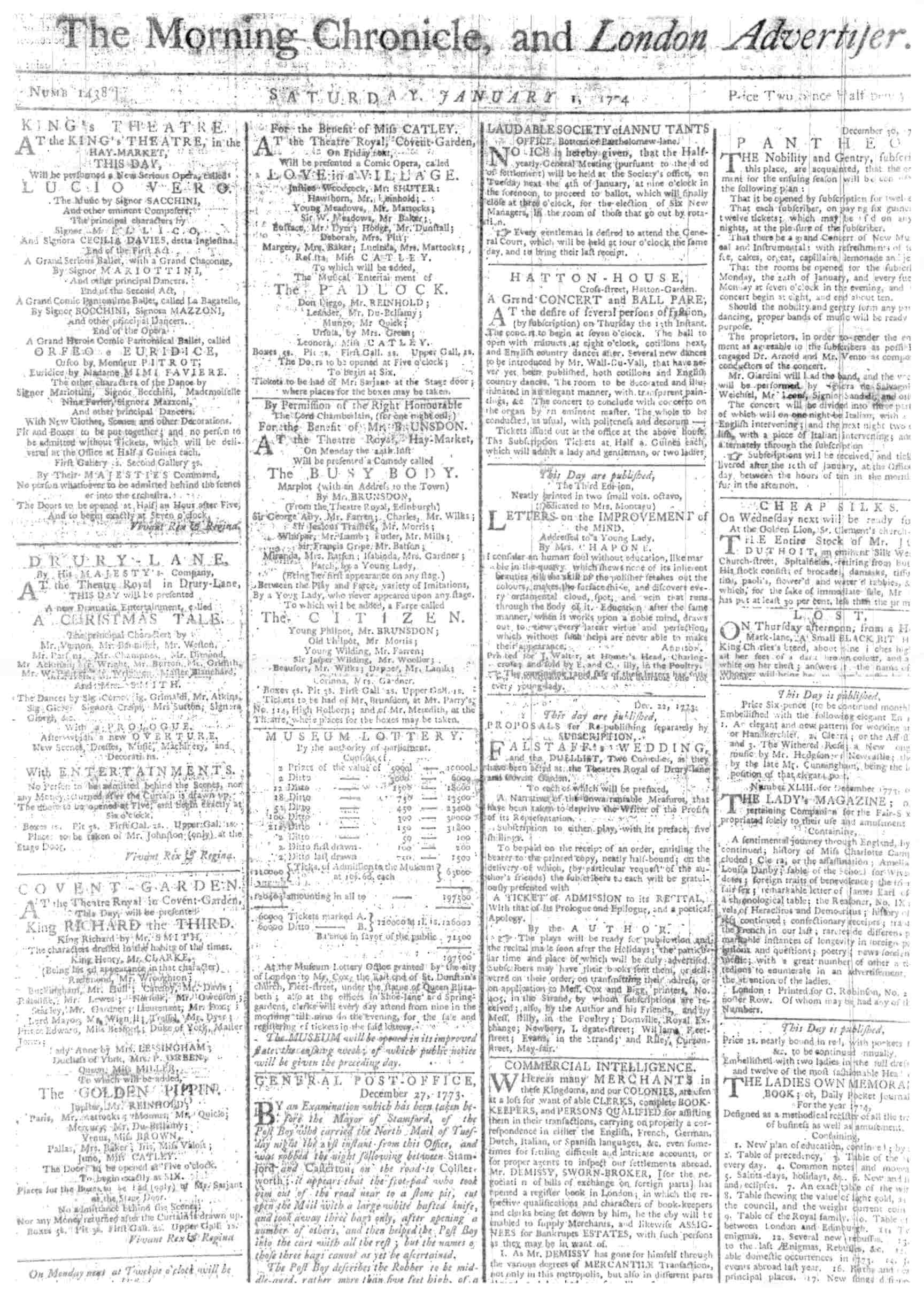
Reproduced by permission, Cambridge University Library
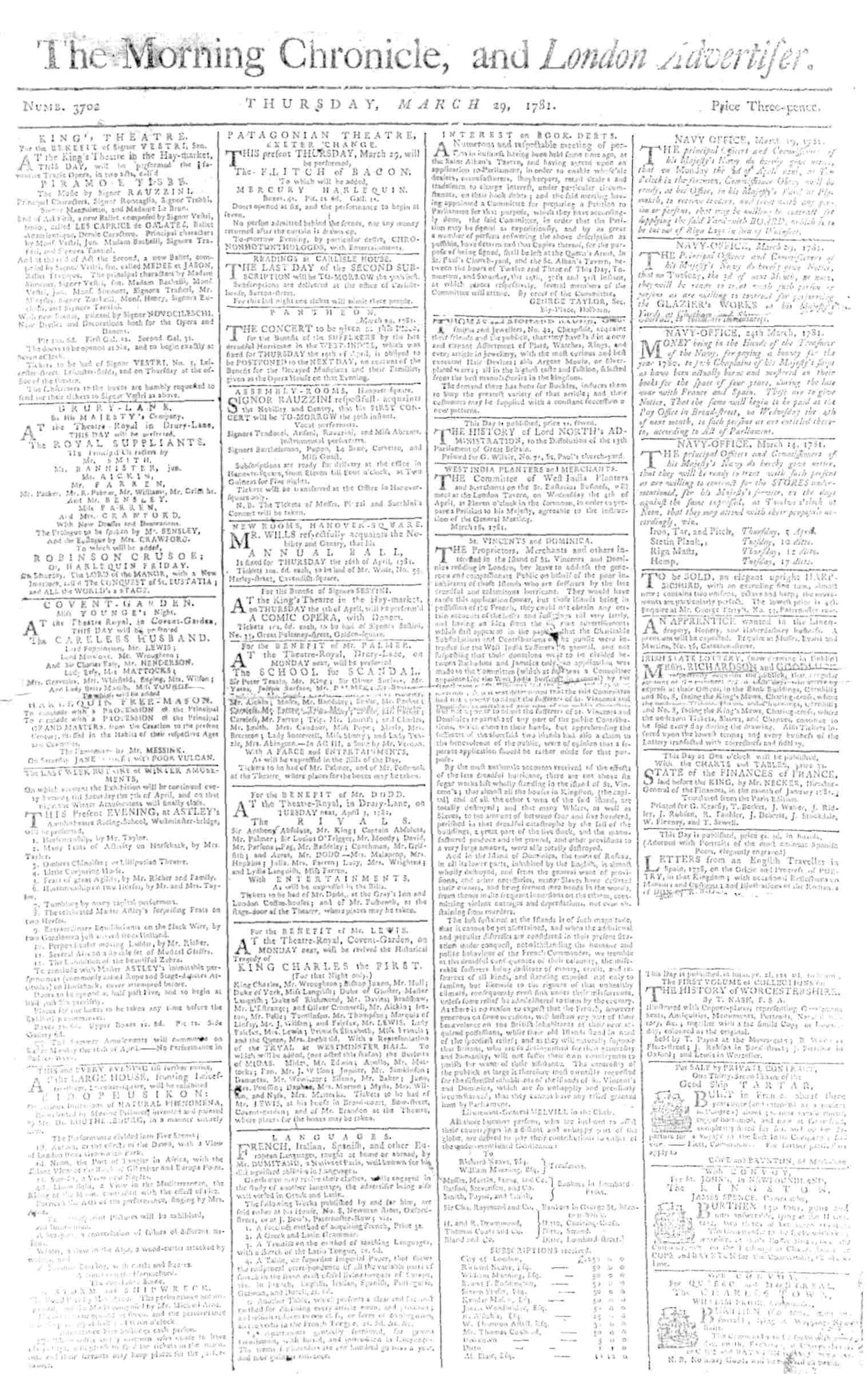
Reproduced by permission, Cambridge University Library
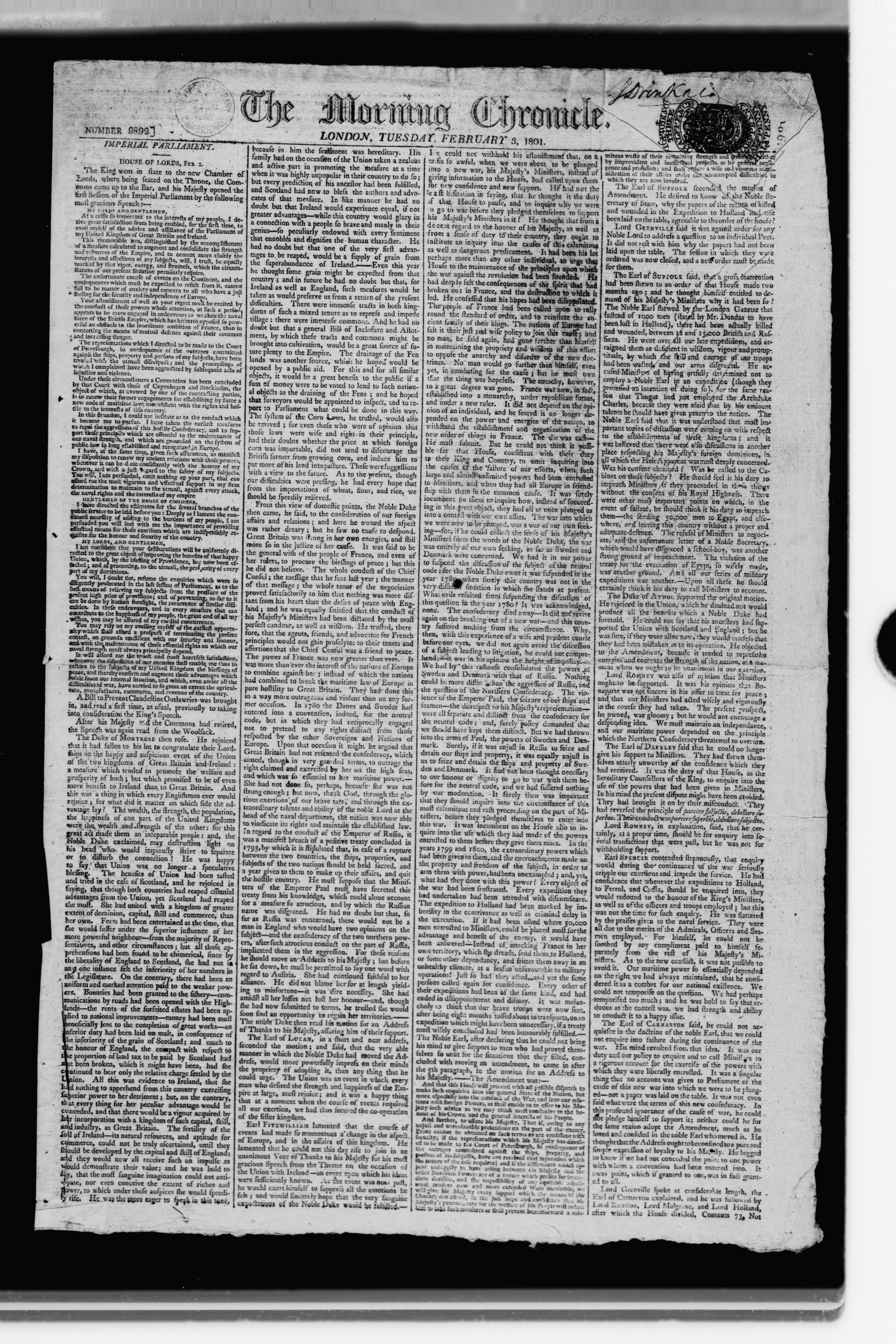
Reproduced by permission, British Newspaper Library

Reproduced by permission, Cambridge University Library