Detailed Record
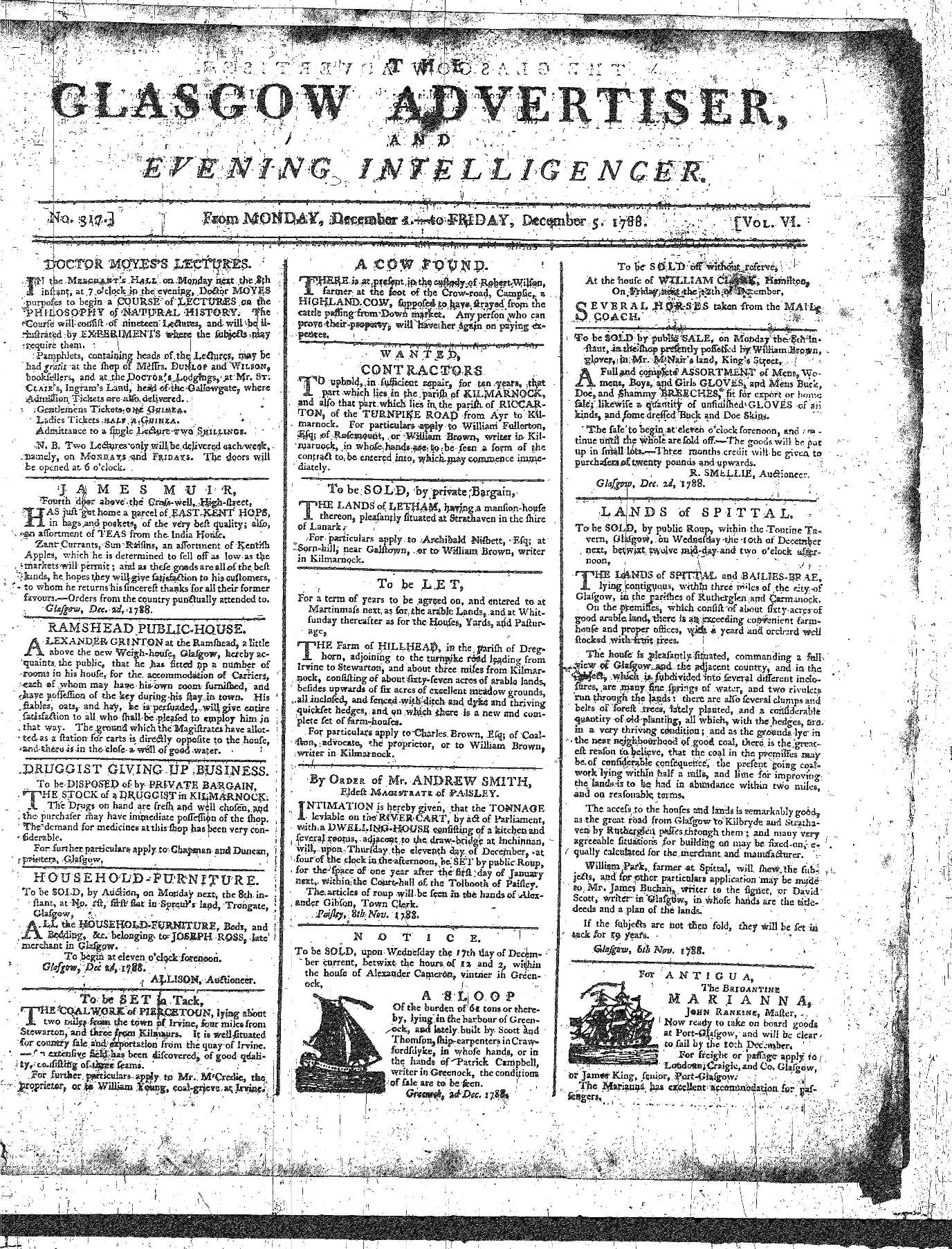
Glasgow Advertiser and Evening Intelligencer
no 1, 27 Jan 1783 - vol 7 no 841, 17 Jan 1794

then: Glasgow Advertiser. vol 12 no 842, 24 Jan 1794 - no 1248, 28 Dec 1801
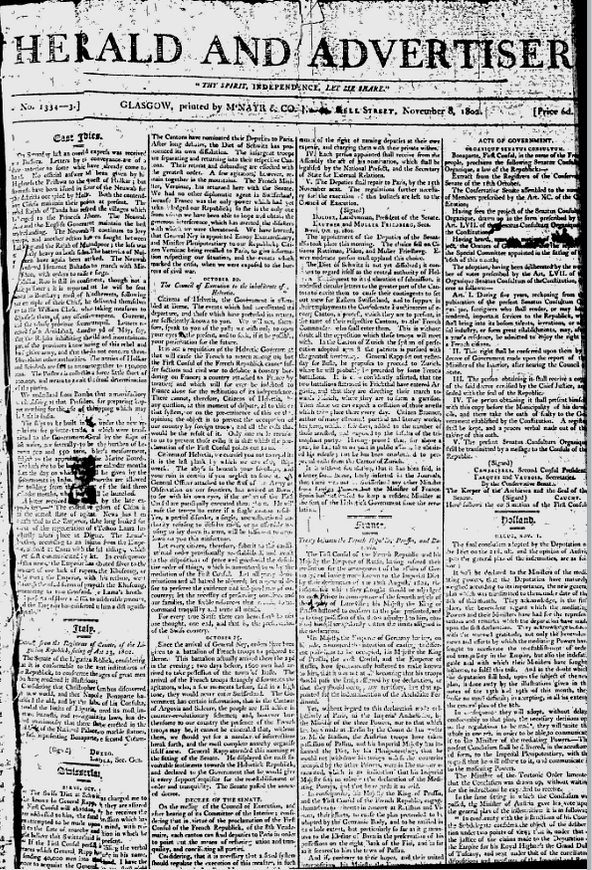
then: Herald and Advertiser. no 1 [ns], 01 Nov 1802 - no 293, 23 Aug 1805
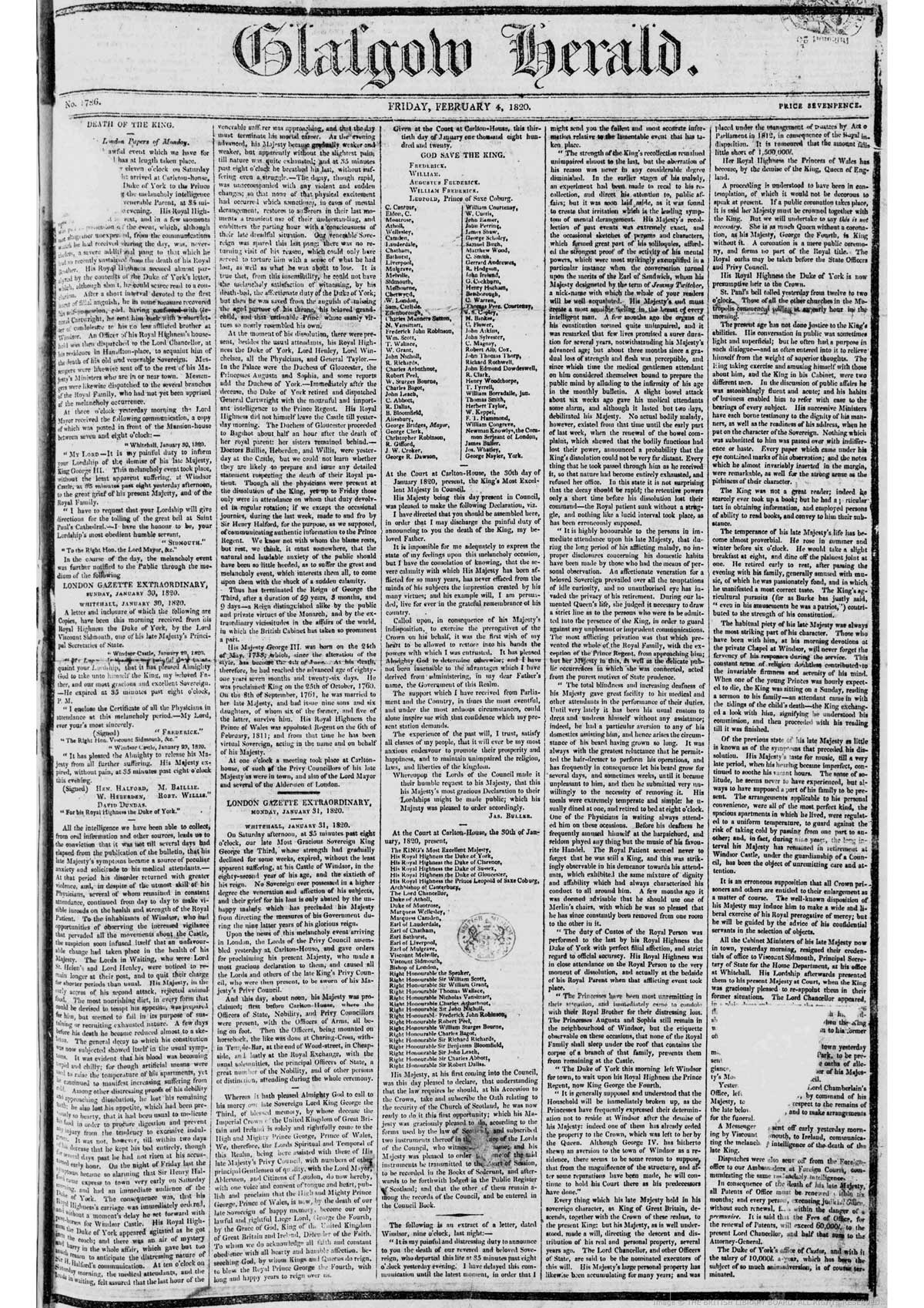
then: Glasgow Herald. no 294, 26 Aug 1805 - 1964+
then: Herald and Advertiser. no 1 [ns], 01 Nov 1802 - no 293, 23 Aug 1805
then: Glasgow Herald. no 294, 26 Aug 1805 - 1964+
Edinburgh,Midlothian (1900)
Glasgow,Lanarkshire
Editor:
Samuel Hunter (Dr.) 1803 - 1837)
William Jack (1870 - 1875)
Jamie McNab (1810 - 1839)
Bailie McNayr (Dr., two months 1802)
John Mennons (1783 - 1803)
George Outram (1837 - 1856)
James Pagan (1856 - 1870)
Charles Russell (1888 - 1907)
William Walker Scott (sub-editor, c.1857)
John Sinclair (1898)
James Hasrie Stoddart (Dr.) 1875 - 1888)
Francis Weir (1836 - 1837)
William Jack (1870 - 1875)
Jamie McNab (1810 - 1839)
Bailie McNayr (Dr., two months 1802)
John Mennons (1783 - 1803)
George Outram (1837 - 1856)
James Pagan (1856 - 1870)
Charles Russell (1888 - 1907)
William Walker Scott (sub-editor, c.1857)
John Sinclair (1898)
James Hasrie Stoddart (Dr.) 1875 - 1888)
Francis Weir (1836 - 1837)
Proprietor:
George Outram and Co (1836 - 1964)
Benjamin Mathie (senior partner) 1801+)
James McNayr (Dr) managing partner Nov 1802 - Jan 1803)
John Mennons (founder) 1783 - 1801)
Thomas Mennons (1801+)
George Mills (1860)
Alexander Morrison (1837)
Samuel Hunter and Co (1803 - 1837) partner)
Benjamin Mathie (senior partner) 1801+)
James McNayr (Dr) managing partner Nov 1802 - Jan 1803)
John Mennons (founder) 1783 - 1801)
Thomas Mennons (1801+)
George Mills (1860)
Alexander Morrison (1837)
Samuel Hunter and Co (1803 - 1837) partner)
Publisher:
George Outram and Co (1855)
John Mennons (1785 - 1794; 1801)
Thomas Mennons (1801)
George Milk (1860)
George Outram (1836+)
John Mennons (1785 - 1794; 1801)
Thomas Mennons (1801)
George Milk (1860)
George Outram (1836+)
Printer:
Lindsay Anderson (1830 - 1870)
McNayr and Co (1802)
John Mennons (1783 - 1794, 1801)
T. Mennons (1801)
Mennons and Co (23 Aug 1805)
George Mills (1860)
Alexander Morrison (1837)
George Outram (1839)
Samuel Hunter and Co (26 Aug 1805 - 1837)
McNayr and Co (1802)
John Mennons (1783 - 1794, 1801)
T. Mennons (1801)
Mennons and Co (23 Aug 1805)
George Mills (1860)
Alexander Morrison (1837)
George Outram (1839)
Samuel Hunter and Co (26 Aug 1805 - 1837)
Contributors:
Bernard F. Bussy (parliamentary correspondent)
William Power
Thomas Reid (chief reporter)
William Sharp (art critic)
William Westall
William Power
Thomas Reid (chief reporter)
William Sharp (art critic)
William Westall
Names:
Robert Anderson (staff member)
Richard Cameron (managing partner 1786 - 1789)
James Pagan (office staff and reporter 1845 - 1856)
Alexander Sinclair (managing partner) 1845 - 1897+)
Alexander Water (managing partner)? - 1845+)
Richard Cameron (managing partner 1786 - 1789)
James Pagan (office staff and reporter 1845 - 1856)
Alexander Sinclair (managing partner) 1845 - 1897+)
Alexander Water (managing partner)? - 1845+)
Size:
4pp (1783); 8pp (1783, 1801); 4pp (1802); fol (1805 - 1808); 4pp (1832); 74cm, 4pp (1839); 61cm, 8pp (1860)
Price:
3d (1783 - 1788); 3 l/2d (17 Jan 1794); 4d (24 Jan 1794); 6d (1802); 7d (1815, 1820); 4 l/2d (1847); 3d, 4d st (1856); 3d (1859); 1d (1870 - 1900); 34,379 (2015)
Circulation:
1600 (stamps sold 1820s); 2538 (Jan-Jun 1837); 2800 (1838); 3076 (Jan-Mar 1839); 3500 (Jan-Mar 1840); 3500 (Jan-Mar 1840); 3000 (Jan- Dec 1841); 3824 (Apr-Jun 1842); 3355 (Jul-Dec 1842); 3384 (Apr-Jun 1843); 380,000/a (1845) 391,000/a (1850); 4505 (1853 [as Glasgow Herald]); 5207 (1854); 5,200/w (1855); 561,000/a (1855); 2800; 15,000/w (1858); 31,000 (1870); 50,000 (1881)
Frequency:
weekly (Mon 1783); twice weekly (Mon Fri 1792-1855); thrice weekly (Mon Wed Fri 1855 - 1856); weekly (Sat 1860); daily (1871 - 1900)
Indexing:
Ewing, Alexander M. A History of the Glasgow Herald, 1783-1948. (Glasgow, 1949); external index (1889 - 1900+, (QZ/P-1]); Curtice's Index. 01 Jul-Sep 1893 London, 1894; The Glasgow Herald Index. G. Outram, 1906.
Departments:
news, summary of news, Glasgow and district news, latest news, markets, railway and river steamers time tables, serial novel, light reading for the rail, varieties, punchiana, b/m/d, literature, fiction, poetry, Scottish History, William Wallace's legacy, monuments, public events, telegraph, stock markets in Britain and abroad, births, new companies, railways, war, war correspondence, war events
Orientation:
conservative (1803-1836); Whig, liberal (1836-1886); liberal unionist/reformist (1886+)1886 independent (1871 - 1900)
Sources:
BLC Consolidated List, p.27.; COPAC; Couper, SNQ 8:2s (May 1907), p.167.; Couper, SNQ 9:3 (Feb 1931), p.30.; Dunlop, Fifty Years of Irish Journalism, 1911. p.281.; Ferguson, Directory of Scottish Newspapers.; Fraser's, vol 17 (1838), 18:103 (1838), p.76.; Gillespie, A Hundred Years of Progress, p.13.; Hubbard, Newspaper and Bank Directory, 1882. p.1765.; Layton, p.108?.; Mitchell's Newspaper Press Directory; NCBEL vol 3.; The Glasgow Herald 150th Anniversary Supplement, (27 January 1933).; Willing's Press Guide, 1891. p.210.
Histories:
Aird, Printers and Printing in Glasgow, pp.11-13, 32.; Centenary of The Glasgow Herald. Glasgow: Banquet in St. Andrew's Halls, 1882.; Coleman, Remembering the Past, pp.149, 181-185.; Cowan, pp.141, 287.; Craig, Scottish Periodical Press 1750-1789, pp.39-42.; Devine, The Scottish Nation, pp.320, 589.; Ewing, Alexander M. A History of the Glasgow Herald. 1783-1948.; Donaldson, Literature in Victorian Scotland, pp.1,6,99.; Graham, Michael (1906), pp.13-21.; Hancock, P.D. Works Relating to Scotland p.94.; Harris, "Literary Journalism, 1707-1918," p.310.; Jack 1855, pp.78, 190.; Phillips, Alastair. Glasgow's Herald 1783-1972. Glasgow: Drew, 1983.; Murray, "Newspapers" p.371.; Pittcock and Jack, Geddes and the Celtic Revival, p.342.; Riley, Life is Local, p.30.; Sinclair, Fifty Years of Newspaper Life.; Stewart, William, The Glasgow Herald: The Story of a Great Newspaper from 1783 to 1911. (Glasgow: George Outram & Co. 1911), p.50.; "The Centenary of the Glasgow Herald". Athenaeum (04 Feb 1882): 158.; "The Herald." Wikipedia.; Wilkinson, Images of War in Edwardian Newspapers.
Comments:
Sinclair, a managing partner of the paper, writes that it began in 1782 as The Glasgow Advertiser and Evening Intelligencer, it became The Herald and Advertiser, and The Glasgow Herald without a change in numbering.
Craig writes that "its advent seems to have marked the beginning of a new era in newspaper journalism in Glasgow" (40).
It was a daily newspaper that "catered to the urban middle classes...whereas many evening newspapers catered to those members of the working classes who had the luxury of reading only in the evenings" (Murray 371).
For a brief video summary of The Glasgow Herald, see the following video: YouTube. "Circulates extensively throughout the whole of the towns in the West of Scotland, it is also well patronised in many other parts, and by a wealthy and influential class. Advocates no one particular interest, but as events arise in connection with agriculture, commerce, or manufacture, they are treated with a spirit of fairness; it is more especially a political than religious journal, and occasionally devotes some space to literature and the fine arts" (Mitchell's 1847).
"Has long been esteemed a substantial family paper in the West of Scotland, on account of its careful collation and judicious selection of news, and temperately expressed political opinions. Its politics are those of the moderate Conservative party, and it is attached to the Established Church of Scotland, but endeavours to conciliate all parties. Supports the present system of parochial education. The rights of Scotland, social reform, and other topics upon which there is little difference of opinion, arc almost the only subjects upon which it takes a decided stand, or which it advocates with vigour and confidence.... The foreign news is copious and complete, the domestic intelligence is judiciously selected, whilst for local news the Herald is generally allowed lo be a good authority. Contains reports of the leading markets, and commerce and agriculture generally receive a share of attention. New works are criticised with justice and ability, and often at considerable length. Enjoys a larger share of advertisements than any other Glasgow newspaper, without being under the necessity of reducing its prices, the space occupied by advertisers extending usually to one-half of the paper, and frequently exceeding it. Retains an extensive general circulation in Glasgow and the West of Scotland, and is popular with the upper and middle classes" (Jack).
Devine calls this "the paper of the west of Scotland middle class" (320).
"In the eighteen-fifties The Glasgow Herald indisputably took first place among the newspapers of the West. To its long-held commercial supremacy was now added a more controversial spirit, active in defence of its city; politically, there was meantime no practicable alternative to its central course behind Palmerston; and. lastly, its solidity was the rock against which the new journals of 1855, and some of their ciders, were broken" (Cowan, p.287).
It was a very profitable paper, but it was negatively affected by the mid-century stamp taxes. As one of the three most profitable papers in the UK (superseded by only the Times and the Daily Telegraph. In 1845, Alexander Sinclair says that the Herald paid over 21,000 pounds for stamp taxes. This number soon increased and Sinclair's team predicted that they would pay up to 40,000 pounds annually (Sinclair 5).
After abolishing the stamp taxes, the paper's advertising rates decreased around the mid-century, allowing discounted rates to repeated customers and for the size of the advertisement (Sinclair 93).
Aird explains that the Glasgow Herald was the most popular newspaper in Glasgow between 1830 and 1890 (11). Of all the papers which existed during this period, it was the only one which survived and maintained its popularity, getting stronger with age (79).
The Saturday companion to the Glasgow Herald was the Glasgow Mail (Cowan, p. 141).
Motto for Herald and Advertiser (1802) is "Thy Spirit, Independence, let me share".
It is considered 'one of three principal business papers in Scotland'.
In the face of Anti-Catholic sentiments in 1888, the Glasgow Herald defended Catholicism (Coleman 149).
"Under [Mr. Hunter's) management, the [paper] rose in steady circulation; the number of its advertisements increased and multiplied; and it soon acquired a deservedly high character among Scottish papers, which it has always retained. The editor was at all times exceedingly careful as to the tone of the articles which obtained admission; and it may be safely said that, during the long period that Mr. Hunter was at the helm of the [paper], being no less than thirty-three years, nothing of a personal or offensive nature ever appeared in its columns.... The Herald has been hitherto distinguished for never giving any countenance to the modern practice of puffery; and, during his occupancy of the editorial throne, Mr. Hunter was universally acknowledged as the head of the press in the west" (Fraser's 18:103 1838).
Sinclair provides a comprehensive overview of how fire threatened newspaper businesses, including the Herald which had four fires at its Buchanan street location. Sinclair provides a detailed explanation of those events and how the newspaper adapted to this threat (166-169).
Over time, the number of staff members and reporters working for the paper increased from six (1859) to 49 (1895) (Harris 310).
William Westall was among the contributors. It continued an advocate of the Established church to the end.
The paper had a London publishing office as well, but it was primarily based out of Edinburgh.
The Herald remained a force into the 1960s and beyond. There is evidence that the Johnston Press company was trying to expand around this time to compete with the Herald's vast circulation. The newspaper continues today.
Craig writes that "its advent seems to have marked the beginning of a new era in newspaper journalism in Glasgow" (40).
It was a daily newspaper that "catered to the urban middle classes...whereas many evening newspapers catered to those members of the working classes who had the luxury of reading only in the evenings" (Murray 371).
For a brief video summary of The Glasgow Herald, see the following video: YouTube. "Circulates extensively throughout the whole of the towns in the West of Scotland, it is also well patronised in many other parts, and by a wealthy and influential class. Advocates no one particular interest, but as events arise in connection with agriculture, commerce, or manufacture, they are treated with a spirit of fairness; it is more especially a political than religious journal, and occasionally devotes some space to literature and the fine arts" (Mitchell's 1847).
"Has long been esteemed a substantial family paper in the West of Scotland, on account of its careful collation and judicious selection of news, and temperately expressed political opinions. Its politics are those of the moderate Conservative party, and it is attached to the Established Church of Scotland, but endeavours to conciliate all parties. Supports the present system of parochial education. The rights of Scotland, social reform, and other topics upon which there is little difference of opinion, arc almost the only subjects upon which it takes a decided stand, or which it advocates with vigour and confidence.... The foreign news is copious and complete, the domestic intelligence is judiciously selected, whilst for local news the Herald is generally allowed lo be a good authority. Contains reports of the leading markets, and commerce and agriculture generally receive a share of attention. New works are criticised with justice and ability, and often at considerable length. Enjoys a larger share of advertisements than any other Glasgow newspaper, without being under the necessity of reducing its prices, the space occupied by advertisers extending usually to one-half of the paper, and frequently exceeding it. Retains an extensive general circulation in Glasgow and the West of Scotland, and is popular with the upper and middle classes" (Jack).
Devine calls this "the paper of the west of Scotland middle class" (320).
"In the eighteen-fifties The Glasgow Herald indisputably took first place among the newspapers of the West. To its long-held commercial supremacy was now added a more controversial spirit, active in defence of its city; politically, there was meantime no practicable alternative to its central course behind Palmerston; and. lastly, its solidity was the rock against which the new journals of 1855, and some of their ciders, were broken" (Cowan, p.287).
It was a very profitable paper, but it was negatively affected by the mid-century stamp taxes. As one of the three most profitable papers in the UK (superseded by only the Times and the Daily Telegraph. In 1845, Alexander Sinclair says that the Herald paid over 21,000 pounds for stamp taxes. This number soon increased and Sinclair's team predicted that they would pay up to 40,000 pounds annually (Sinclair 5).
After abolishing the stamp taxes, the paper's advertising rates decreased around the mid-century, allowing discounted rates to repeated customers and for the size of the advertisement (Sinclair 93).
Aird explains that the Glasgow Herald was the most popular newspaper in Glasgow between 1830 and 1890 (11). Of all the papers which existed during this period, it was the only one which survived and maintained its popularity, getting stronger with age (79).
The Saturday companion to the Glasgow Herald was the Glasgow Mail (Cowan, p. 141).
Motto for Herald and Advertiser (1802) is "Thy Spirit, Independence, let me share".
It is considered 'one of three principal business papers in Scotland'.
In the face of Anti-Catholic sentiments in 1888, the Glasgow Herald defended Catholicism (Coleman 149).
"Under [Mr. Hunter's) management, the [paper] rose in steady circulation; the number of its advertisements increased and multiplied; and it soon acquired a deservedly high character among Scottish papers, which it has always retained. The editor was at all times exceedingly careful as to the tone of the articles which obtained admission; and it may be safely said that, during the long period that Mr. Hunter was at the helm of the [paper], being no less than thirty-three years, nothing of a personal or offensive nature ever appeared in its columns.... The Herald has been hitherto distinguished for never giving any countenance to the modern practice of puffery; and, during his occupancy of the editorial throne, Mr. Hunter was universally acknowledged as the head of the press in the west" (Fraser's 18:103 1838).
Sinclair provides a comprehensive overview of how fire threatened newspaper businesses, including the Herald which had four fires at its Buchanan street location. Sinclair provides a detailed explanation of those events and how the newspaper adapted to this threat (166-169).
Over time, the number of staff members and reporters working for the paper increased from six (1859) to 49 (1895) (Harris 310).
William Westall was among the contributors. It continued an advocate of the Established church to the end.
The paper had a London publishing office as well, but it was primarily based out of Edinburgh.
The Herald remained a force into the 1960s and beyond. There is evidence that the Johnston Press company was trying to expand around this time to compete with the Herald's vast circulation. The newspaper continues today.
Location:
LO/N38 A nos 1,317,321,326,334,335, [377]-590, 649-841, 842-938, 1256-1361,1570-1248 [sic], 1 [2s]-5O00 [2s] (27 Jan 1783,01/05,15/19,19/22 Dec 1788, 2/5 Jan, 30 Jan/2 Feb, 09/13 Mar, 29 Jun/03 Jul 1789-22/25 Jul 1791,10/13 Feb 1792-17/20 Jan 1794,24 Jan-27 Dec 1794,01 Jan-31 Dec 1798,02 Jan-28 Dec 1801,01 Nov 1802-30 Dec 1850), nos 1466-1569,1786-2515, 2995,3202,3786,4270-4530 (03 Jan-29 Dec 1800, 04 Feb 1820-29 Jan 1827,12
Sep 1831,06 Sep 1833, 10 May 1839,01 Jan 1844-29 Jun 1846.03 Aug 1846+); ED/N-1 A nos 1-3911 (27 Jan 1783+. imp), 1805-1892; SA/U-1 A (07 Jun 1888-1904); QZ/P-1 (02 Sep 1805+ imp mic); GL/U-1 nos 1+ (27 Jan 178+ imp, 1802-1804, 1806-1843); QZ/P99 (1885-19OO+); QZ/Pll (09 Jan 1895); P (1793+ imp mic); see BUCOP (under heading of Glasgow Advertiser).; Full text at BNA (1820-1900), Google News Archive (1783-1801 imp)

Google News Archive; Public Domain

Google News Archive; Public Domain

ad in Willing's Press Guide (1891)

Image reproduced with kind permission of The British Newspaper Archive

Reproduced by permission, the British Library

Google News Archive; Public Domain
Google News Archive; Public Domain
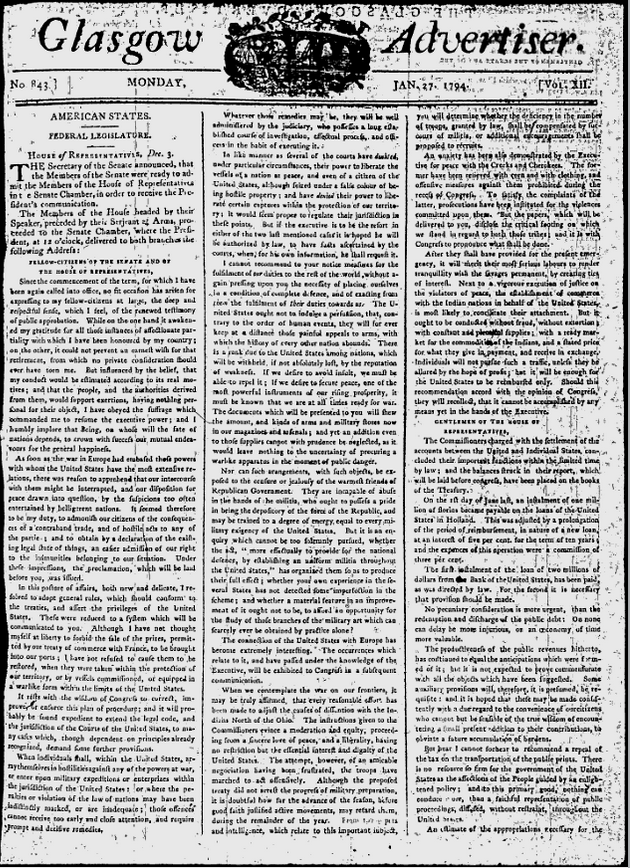
Image reproduced with kind permission of The British Newspaper Archive
Google News Archive; Public Domain
Google News Archive; Public Domain