Detailed Record
Dublin Penny Journal, The
vol 1 no 1, 30 Jun 1832 - vol 4 no 208, 25 Jun 1836//

Dublin,Dublin
London,Middlesex
Editor:
Philip Dixon Hardy (1833 - Jun 1836)
Caesar Otway (co-editor, 1832 - 27 Jul 1833)
George Petrie (co-editor, 1832 - 27 Jul 1833)
Caesar Otway (co-editor, 1832 - 27 Jul 1833)
George Petrie (co-editor, 1832 - 27 Jul 1833)
Proprietor:
John S. Folds (co-founder 1832)
Philip Dixon Hardy (Jul 1834 - Jun 1836)
Caesar Otway (co-founder 1832)
Philip Dixon Hardy (Jul 1834 - Jun 1836)
Caesar Otway (co-founder 1832)
Publisher:
John S. Folds (Jun 1832 - Jun 1833)
Philip Dixon Hardy (Jul 1834 - Jun 1836)
Philip Dixon Hardy (Jul 1834 - Jun 1836)
Printer:
John S. Folds (Jun 1832 - Jun 1833)
Philip Dixon Hardy (Jul 1834 - Jun 1836)
Philip Dixon Hardy (Jul 1834 - Jun 1836)
Contributors:
Robert Armstrong
Michael Banim
William Bethame (Sir)
William Carleton
Benjamin Clayton II (engraver)
Crofton Croker
D'Alton
Doyle
Thomas Furlong
John Thomas Gilbert
Ann Hall
Nicholas Lee
Samuel Lover
James Clarence Mangan
Martin
John O'Donovan
Terence O'Toole (pseud. Caesar Otway)
George Petrie
Edward Walsh (fiction)
James Wills (Rev.) poetry)
John Windele
Michael Banim
William Bethame (Sir)
William Carleton
Benjamin Clayton II (engraver)
Crofton Croker
D'Alton
Doyle
Thomas Furlong
John Thomas Gilbert
Ann Hall
Nicholas Lee
Samuel Lover
James Clarence Mangan
Martin
John O'Donovan
Terence O'Toole (pseud. Caesar Otway)
George Petrie
Edward Walsh (fiction)
James Wills (Rev.) poetry)
John Windele
Names:
Philip Crampton
David Herbison
David Herbison
Size:
27cm, 8pp
Price:
5s (in twelve monthly parts)
Circulation:
35,000; 15,000 (1832); 30,000 (1833); 12,000 (1836); 40,000
Frequency:
weekly (Sat)
Illustration:
b/w with wood engravings
Indexing:
index/vol (1832); T of C/vol (1835+)
Departments:
national biography, gleanings of national history in Ireland, Irish topographical articles, history, typography of antiques of Ireland, practical chemistry, geology and rural economy, moral and legendary tales, biographical notices of eminent Irishmen, original poetry, anecdotes, antiquities, critical notices, legends and stories of Ireland, natural history, poetry, science, tales and narratives, topographical descriptions (1835-1836), maps, diagrams, archaeology, fiction, Irish language, [Irish] Gaelic
Orientation:
nationalist
Sources:
A critical notice in The University Review. 1833.; Brown, Stephen J. Ireland in Fiction. Dublin: Maunsell, 1919.; Cahalan, Irish Novel: A Critical History.; Clyde, Irish Literary Magazines.; COPAC; DNB ix, 686-87.; Hayley, Voice of Nineteenth-Century Ireland.; Henson, Louise et al. Culture and Science in the Nineteenth-Century Media. Aldershot: Ashgate Publishing Company, 2004.; Irish Microforms.; Leerssen, Remembrance and Imagination; McHugh and Harmon, Anglo-Irish Literature.; McKenna, Irish Literature, 1800-1875.; NLI; Power, "Irish Literary Periodicals".; W.G. Wheeler, Libraries in Ireland before 1855 a Bibliographical Essay. May 1957. xiv, 1239; xx, 670-71; xxi, 515-17, 637.
Histories:
Altick, English Common Reader.; "An Interesting Account of 'Hell' from the Dublin Penny Journal." Come Here to Me: Dublin Life & Culture.; Benatti, "Dublin Penny Journal." DNCJ. p.183.; Benatti, "Hardy, Philip Dixon." DNCJ. p.269.;
Benatti, "Land and Landscape in the Dublin Penny Journal, 1832-1833." Land and Landscape in Nineteenth-Century Ireland, 2008: pp. 13–24.; Benson, Charles. "The Dublin Book Trade." Oxford History of the Irish Book. vol 4. 25-46.; Collins, James. Life in Old Dublin, 1913. p.165.; "Dublin Penny Journal." Wikipedia. 2013; Fallon, Donal. "Some Dublin Penny Journal Illustrations from the 1830s".; Hill, "Culture and religion," p.52.; Kelleher, "Prose writing and drama in English".; Lake, Elizabeth. "Medicine." Oxford History of the Irish Book. vol 4. 575-584.; Law, Anglo-Irish Literature, p.195.; Loeber, "Irish women authors," p.183.; Tilley, "Otway." DNCJ. p.472.; Tilley, Elizabeth. "Periodicals." Oxford History of the Irish Book. Vol 4. 144-172.; Tilley, "Periodicals in Ireland" pp.209-210.; Tilley, Elizabeth. "The Royal Irish Academy and Antiquarianism." Oxford History of the Irish Book. vol 4. 463-476.; Uí Chollatáin, "Newspaper, journals and the Irish revival".; Uı´ Chollatain, "the turning of the tide" p.36.
Comments:
"...The Penny Journal started on new and exclusively national ground, and with national as well as useful objects in view. The subjects chiefly chosen were such as were most likely to attract the attention of the Irish people, next to those of politics and polemics, by which their minds had been previously and almost exclusively occupied - namely, the history, biography, poetry, antiquities, natural history, legends and traditions of the country" (Preface, 1:1).
According to Tilley, the Dublin Penny Journal "broke new ground in focusing on articles about Ireland's history, language, antiquities, and resources" and it "remains a remarkable achievement" despite losing its identity under Philip Dixon Hardy (Periodicals in Ireland, 209-210).
Benson says that this was one of the first Irish newspapers to install power machinery to print its papers. He says that it was "remarkable, though short lived" and that it "had a circulation of 10000 copies a week for its attractive combination of essays and woodcut illustration. Philip Dixon Hardy, the proprietor, who was making 500 (pounds) a year from it, decided to cease publication in consequence of the restrictive practices of his journeymen printers" (38).
"Sir Samuel Ferguson wrote in 1840 of [the Dublin Penny Journal's] important role in 'bringing back the light of intellectual day, the already recorded facts by which the people of Ireland will be able to live back, in the land they live in'" (Hill 52).
"In our closing labours, as editor, printer and publisher of the journal, we cannot but express our grateful acknowledgements to the literary press of England, from whom we have continued to receive the most flattering support; and we think it only just to state our conviction, that to the kind manner in which the work was recommended by the editors of the Literary Gazette and Atheneum, we owe much of our success in the sister kingdom, as but for their friendly notices, it would scarcely have been known through England that such a publication as the Dublin Penny Journal had an existence; while even in our own land, their high recommendation induced many to look at it, who otherwise might have considered it beneath their notice" (To Our Readers, 4:157).
"This is a purely national publication [and] utterly pure from all taint of party bias or feeling."
This periodical contains "Information...from hitherto unnoticed or at least untranslated Irish manuscripts". It is Scarce. A Supplement to vol 2 was called " A Guide to the Giant's Causeway".
This was a part of a collection of periodicals published in the 1830s which focused on articles and stories that interested the Irish. McHugh and Harmon claim that "all were ephemeral, partly because they had no national policy" (108).
It was an early magazine containing Irish language material, which was "very important to the success of the movement so that the Irish-language critique was not marginalised, putting it on a par with other reportage in mainstream periodicals" (Uı´ Chollatain, "the turning of the tide" 36). It was revived 70 years later (1902) as Dublin Penny Journal, with pagination continuing [2s] from the 1836 issue, and same printer's device.
"A new series ran from 1902-1905. No serials, but many Irish stories. Most of these are unsigned, especially in the earlier issues" (Brown 338). It is improbable that the same people from 1832-1836 were involved in this new publication, but it nevertheless had the same name and similar parameters.
However, comments from the record itself suggest that the 1902 publication was distinct, albeit inspired by the original Dublin Penny Journal: "'As the model of our present enterprise, we have adopted the lines laid down by the conductors of the original and famous Dublin Penny Journal [1832-1836 -- ed.]], which sixty years ago proved a means of bringing together a brilliant band of writers on various subjects connected with Irish art, archaeology, literature and science." Because of the strength of the primary source information, these two publications are treated as distinct titles with distinct publication dates and contributors.
Wheeler, (p.130) says its successor was Irish Penny Journal (1841).
It was poorly indexed. "A magazine of art, archaeology, literature and science. It contained 'Reminiscences of a Rockite, and Romances of Irish History'. Was said to regretfully accept emancipation."
Clyde says that this was "a very attractive popular journal which is liberally illustrated." It had a large distribution and its quality increased steadily. Hardy's editorship increased the nationalist tone, but for the most part the journal was light-hearted (93). It provided much Irish language content. Uí Chollatáin explains that "the first issue...printed a full Irish poem in Gaelic font on the last page, and by the twentieth edition Irish was a central feature of the journal. By this time the Dublin Penny Journal sold 40,000 copies weekly" (162).
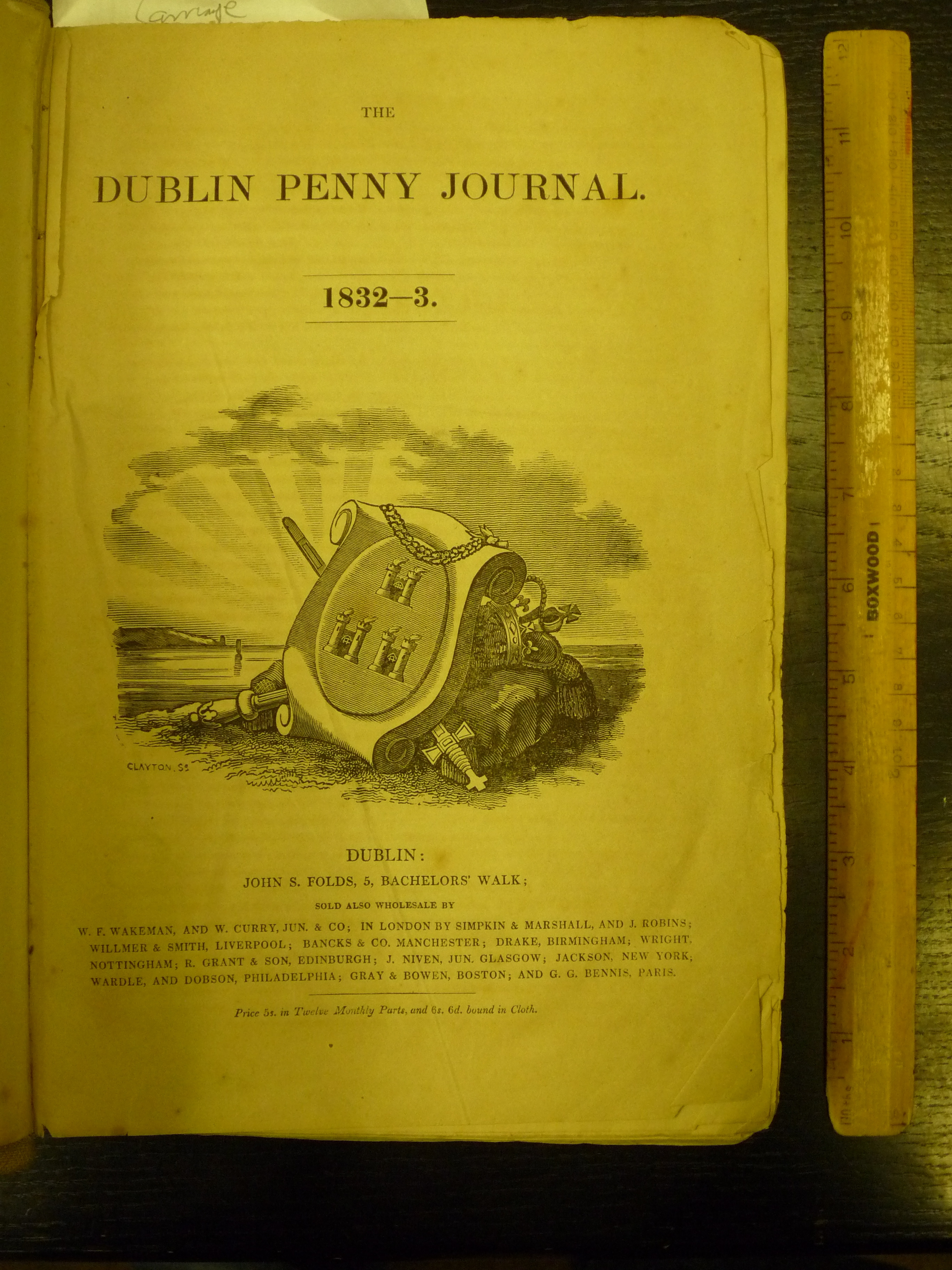
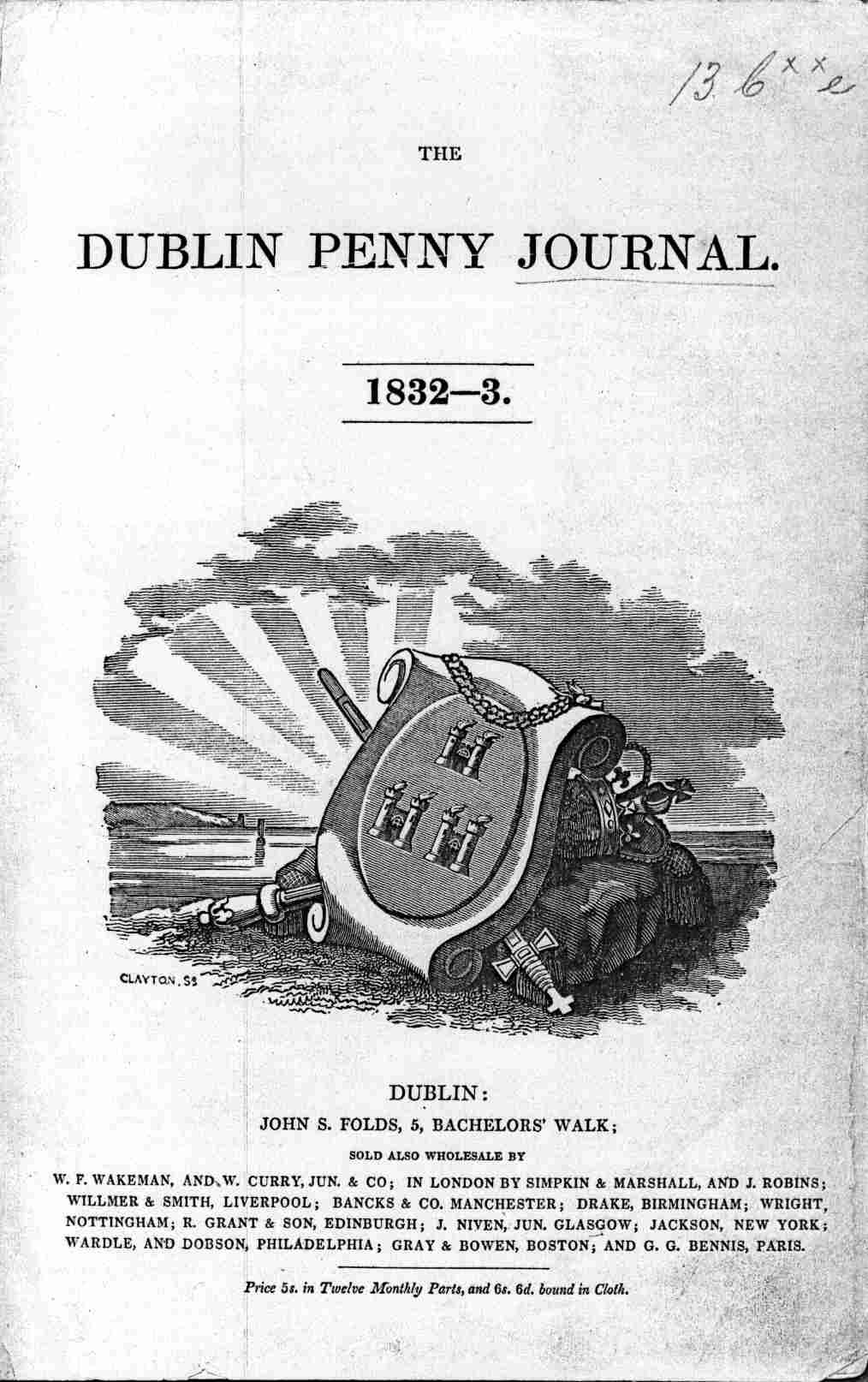
Many of the stories were afterwards reprinted in a volume, Picnics from the Dublin Penny Journal. Wood engravings were made by Clayton from sketches by Petrie.
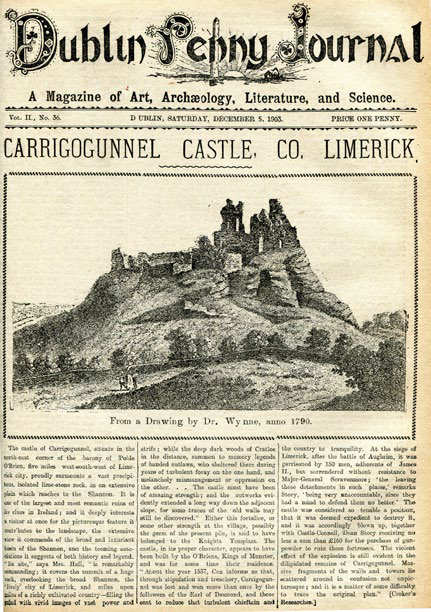
The Dublin Penny Journal (1832-6), though superficially modelled on its English counterparts, was unique in its inclusion of exclusively Irish material." Otway and Petrie desired a home audience, and they used illustrations to highlight Irish landscapes and architecture (Tilley, "Periodicals" 149-150).
"A periodical of wide scope and interest which, besides containing news and topical comment, has stories by the novelist William Carleton and learned contributions from such notables as George Petrie. Eugene O'Curry and John O'Donovan. The journal is heavily illustrated. Irish topographical and industrial and revolution subjects predominate. This unusual combination of news, history, archaeology and art is a useful adjunct to The Nation and epitomizes the stirrings of Irish cultural nationalism during the period before Young Ireland."
Tilley notes that Petrie and Otway were members of the Royal Irish Academy and this was "intended as a scientific and literary enabling space very similar to the Academy's Proceedings" ("Royal" 473). However, it was more popular than the Proceedings partially, Tilley surmises, because of the title, and partially because the Royal Irish Academy's publications suffered from moralizing and dense academic language. Tilley notes that the Dublin Penny Journal appealed to a broader audience and "its avowed purpose was to help Ireland's citizens regain their pride and fight (rhetorically) the prevailing view that nothing of importance had been done by the Irish prior to the invasion of the Normans" ("Royal" 473).
The controversy over the 'vexed question' of the nature and origin of Ireland's "round towers", which Petrie, Otway, Hardy, and the Dublin Penny Journal found themselves embroiled in following Petrie's prize-winning contribution to the Royal Irish Academy's essay competition on the subject, is detailed in Leerssen, pp.111-122
Circulated in London, Liverpool, Manchester, Birmingham, Edinburgh, Glasgow, Paris, New York, Boston, Philadelphia. James Clarence Mangan used to translate German sources for the journal, and he used to write about difficulties when learning the Irish language. This journal defied the belief that an inexpensive journal could not achieve widespread circulation (Wikipedia).
The journal had numerous illustrations including: The Donnybrook Fair (1835), the statue of George II (1835), the zoological gardens (1834), St. Michan's Church (1835), and Robert Burns (1835).
The Dublin Penny Journal's J.T. Gilbert once described Dublin's "Hell": "This was certainly a very profane and unseemly soubriquet, to give to a place that adjoined a cathedral whose name was Christ Church; and my young mind, when I first entered there, was struck with its unseemliness. Yes; and more especially, when over the arched entrance there was pointed out to me the very image of the devil, carved in oak, and not unlike one of those hideous black figures that are still in Thomas-street, hung over Tobacconists’ doors. This locale of hell, and this representation of his satanic majesty, were famous in those days even beyond the walls of Dublin; I remember well, on returning to my native town after my first visit to Dublin, being asked by all my playfellows, had I been in hell, and had I seen the devil" (Dublin Life and Culture).
"For the first year it maintained a high scholarly standard: contributions were antiquarian subjects...Unfortunately, it was taken over in 1833 by Philip Dixon Hardy, who turned it into a cheap and snippety ragbag of extracts; but in its heyday it provided a model for several splendid penny journals, far superior to their British counterpart. One interesting feature of Hardy's reign is his obsession with his printing press, which he loved to describe and illustrate" (Hayley 38).
Its circulation reached 40,000 in an 8 million person population (Kelleher 453). Comparatively, Dublin University Magazine, one of the more popular magazines of the time, only circulated 4,000 copies monthly.
Hardy's editorship indeed took the focus away from Ireland and extended this focus to English readers. McKenna: "this important journal declined in quality when Hardy became editor and publisher" (30).
"The Preface to volume 4 (June 1836) carries Hardy's announcement that he is closing the magazine, due to his own ill-health" (Clyde 93). The last issue has an 8 page supplement called "Views in the neighbourhood of Belfast."
Under George Petrie's editorship, the Journal adopted and popularized a new romantic, humorous, racy and poetic style (Law 195).
Benatti: "Hardy was an innovator and keen businessman, and study of his contentious involvement with the Dublin Penny Journal is crucial for understanding the place of popular periodicals in Ireland" (DNCJ, 269).
The final number on 25 June 1836 does not indicate that the publication was ending, but no other issues were published.
According to Tilley, the Dublin Penny Journal "broke new ground in focusing on articles about Ireland's history, language, antiquities, and resources" and it "remains a remarkable achievement" despite losing its identity under Philip Dixon Hardy (Periodicals in Ireland, 209-210).
Benson says that this was one of the first Irish newspapers to install power machinery to print its papers. He says that it was "remarkable, though short lived" and that it "had a circulation of 10000 copies a week for its attractive combination of essays and woodcut illustration. Philip Dixon Hardy, the proprietor, who was making 500 (pounds) a year from it, decided to cease publication in consequence of the restrictive practices of his journeymen printers" (38).
"Sir Samuel Ferguson wrote in 1840 of [the Dublin Penny Journal's] important role in 'bringing back the light of intellectual day, the already recorded facts by which the people of Ireland will be able to live back, in the land they live in'" (Hill 52).
"In our closing labours, as editor, printer and publisher of the journal, we cannot but express our grateful acknowledgements to the literary press of England, from whom we have continued to receive the most flattering support; and we think it only just to state our conviction, that to the kind manner in which the work was recommended by the editors of the Literary Gazette and Atheneum, we owe much of our success in the sister kingdom, as but for their friendly notices, it would scarcely have been known through England that such a publication as the Dublin Penny Journal had an existence; while even in our own land, their high recommendation induced many to look at it, who otherwise might have considered it beneath their notice" (To Our Readers, 4:157).
"This is a purely national publication [and] utterly pure from all taint of party bias or feeling."
This periodical contains "Information...from hitherto unnoticed or at least untranslated Irish manuscripts". It is Scarce. A Supplement to vol 2 was called " A Guide to the Giant's Causeway".
This was a part of a collection of periodicals published in the 1830s which focused on articles and stories that interested the Irish. McHugh and Harmon claim that "all were ephemeral, partly because they had no national policy" (108).
It was an early magazine containing Irish language material, which was "very important to the success of the movement so that the Irish-language critique was not marginalised, putting it on a par with other reportage in mainstream periodicals" (Uı´ Chollatain, "the turning of the tide" 36). It was revived 70 years later (1902) as Dublin Penny Journal, with pagination continuing [2s] from the 1836 issue, and same printer's device.
"A new series ran from 1902-1905. No serials, but many Irish stories. Most of these are unsigned, especially in the earlier issues" (Brown 338). It is improbable that the same people from 1832-1836 were involved in this new publication, but it nevertheless had the same name and similar parameters.
However, comments from the record itself suggest that the 1902 publication was distinct, albeit inspired by the original Dublin Penny Journal: "'As the model of our present enterprise, we have adopted the lines laid down by the conductors of the original and famous Dublin Penny Journal [1832-1836 -- ed.]], which sixty years ago proved a means of bringing together a brilliant band of writers on various subjects connected with Irish art, archaeology, literature and science." Because of the strength of the primary source information, these two publications are treated as distinct titles with distinct publication dates and contributors.
Wheeler, (p.130) says its successor was Irish Penny Journal (1841).
It was poorly indexed. "A magazine of art, archaeology, literature and science. It contained 'Reminiscences of a Rockite, and Romances of Irish History'. Was said to regretfully accept emancipation."
Clyde says that this was "a very attractive popular journal which is liberally illustrated." It had a large distribution and its quality increased steadily. Hardy's editorship increased the nationalist tone, but for the most part the journal was light-hearted (93). It provided much Irish language content. Uí Chollatáin explains that "the first issue...printed a full Irish poem in Gaelic font on the last page, and by the twentieth edition Irish was a central feature of the journal. By this time the Dublin Penny Journal sold 40,000 copies weekly" (162).
Many of the stories were afterwards reprinted in a volume, Picnics from the Dublin Penny Journal. Wood engravings were made by Clayton from sketches by Petrie.
The Dublin Penny Journal (1832-6), though superficially modelled on its English counterparts, was unique in its inclusion of exclusively Irish material." Otway and Petrie desired a home audience, and they used illustrations to highlight Irish landscapes and architecture (Tilley, "Periodicals" 149-150).
"A periodical of wide scope and interest which, besides containing news and topical comment, has stories by the novelist William Carleton and learned contributions from such notables as George Petrie. Eugene O'Curry and John O'Donovan. The journal is heavily illustrated. Irish topographical and industrial and revolution subjects predominate. This unusual combination of news, history, archaeology and art is a useful adjunct to The Nation and epitomizes the stirrings of Irish cultural nationalism during the period before Young Ireland."
Tilley notes that Petrie and Otway were members of the Royal Irish Academy and this was "intended as a scientific and literary enabling space very similar to the Academy's Proceedings" ("Royal" 473). However, it was more popular than the Proceedings partially, Tilley surmises, because of the title, and partially because the Royal Irish Academy's publications suffered from moralizing and dense academic language. Tilley notes that the Dublin Penny Journal appealed to a broader audience and "its avowed purpose was to help Ireland's citizens regain their pride and fight (rhetorically) the prevailing view that nothing of importance had been done by the Irish prior to the invasion of the Normans" ("Royal" 473).
The controversy over the 'vexed question' of the nature and origin of Ireland's "round towers", which Petrie, Otway, Hardy, and the Dublin Penny Journal found themselves embroiled in following Petrie's prize-winning contribution to the Royal Irish Academy's essay competition on the subject, is detailed in Leerssen, pp.111-122
Circulated in London, Liverpool, Manchester, Birmingham, Edinburgh, Glasgow, Paris, New York, Boston, Philadelphia. James Clarence Mangan used to translate German sources for the journal, and he used to write about difficulties when learning the Irish language. This journal defied the belief that an inexpensive journal could not achieve widespread circulation (Wikipedia).
The journal had numerous illustrations including: The Donnybrook Fair (1835), the statue of George II (1835), the zoological gardens (1834), St. Michan's Church (1835), and Robert Burns (1835).
The Dublin Penny Journal's J.T. Gilbert once described Dublin's "Hell": "This was certainly a very profane and unseemly soubriquet, to give to a place that adjoined a cathedral whose name was Christ Church; and my young mind, when I first entered there, was struck with its unseemliness. Yes; and more especially, when over the arched entrance there was pointed out to me the very image of the devil, carved in oak, and not unlike one of those hideous black figures that are still in Thomas-street, hung over Tobacconists’ doors. This locale of hell, and this representation of his satanic majesty, were famous in those days even beyond the walls of Dublin; I remember well, on returning to my native town after my first visit to Dublin, being asked by all my playfellows, had I been in hell, and had I seen the devil" (Dublin Life and Culture).
"For the first year it maintained a high scholarly standard: contributions were antiquarian subjects...Unfortunately, it was taken over in 1833 by Philip Dixon Hardy, who turned it into a cheap and snippety ragbag of extracts; but in its heyday it provided a model for several splendid penny journals, far superior to their British counterpart. One interesting feature of Hardy's reign is his obsession with his printing press, which he loved to describe and illustrate" (Hayley 38).
Its circulation reached 40,000 in an 8 million person population (Kelleher 453). Comparatively, Dublin University Magazine, one of the more popular magazines of the time, only circulated 4,000 copies monthly.
Hardy's editorship indeed took the focus away from Ireland and extended this focus to English readers. McKenna: "this important journal declined in quality when Hardy became editor and publisher" (30).
"The Preface to volume 4 (June 1836) carries Hardy's announcement that he is closing the magazine, due to his own ill-health" (Clyde 93). The last issue has an 8 page supplement called "Views in the neighbourhood of Belfast."
Under George Petrie's editorship, the Journal adopted and popularized a new romantic, humorous, racy and poetic style (Law 195).
Benatti: "Hardy was an innovator and keen businessman, and study of his contentious involvement with the Dublin Penny Journal is crucial for understanding the place of popular periodicals in Ireland" (DNCJ, 269).
The final number on 25 June 1836 does not indicate that the publication was ending, but no other issues were published.
Location:
complete runs: LO/N-1 A; DB/N-1 F (1832-1836, microfilm: 1832-1836) DB/U-2; LO/S-69 (1832-1836); LO/M46 (1832-1836); QZ/P-1; partial runs: LO/N38 A, OX/U-1 A (1832-1836); LN/U-1; BL/S-7 (1832-36); Gamble (1832-1834), Fermanagh Lib (1832-1836); DB/S-1; BR/U-1 A (electronic: 1832-1834); LO/U-9 (electronic: 1832-1834); AD/U-1 A vol 1:25 (1832); SH/T-2 (electronic: 1832-1834); North America: University of Michigan 1834-1836; full text in JSTOR (1832-1836); Google Books (vol 3-4); Hathitrust (1832-1836); newspapers.com (1832-1836)

Reproduced by permission, Western University

Reproduced by permission, Western University

Reproduced from Google, Original from University of Michigan
Reproduced by permission, Ulster Folk Museum
Reproduced by permission, British Library
Reproduced from Google, Original from University of Michigan