Detailed Record
Penny Bell's Life and Sporting News, The
vol 1 no 1, 24 Mar 1859 - vol 1 no 11, 27 Apr 1859

then: Sporting Life, The. vol 1 no 12, 30 Apr 1859 - 1998
London,Middlesex
Editor:
Henry Mort ["Harry"] Feist
Proprietor:
S.O. Beeton (1859)
George Maddick (1859)
George Maddick (1859)
Publisher:
J. Lake
George Maddick
George Maddick
Printer:
Edward Jonathan Dorliys (30 Apr 1859)
George Maddick (24 Mar 1859)
George Maddick (24 Mar 1859)
Contributors:
Charles Blake
W.W. Read
R.P. Watson
W.W. Read
R.P. Watson
Size:
58cm, 4pp (1859 - 1912)
Price:
1d (1859 - 1912)
Circulation:
150,000 (1859); 102,000 (1881)
Frequency:
twice weekly (Wed Sat 24 Mar 1859; Wed Sun); weekly (30 Apr 1859); four times weekly (Apr 1881); daily (Mar 1883; am 1912)
Illustration:
engravings
Departments:
Coventry races, shooting/racing/cricketing/aquatic/coursing/pedestrian record, handicaps and entries, advertisements, shooting season, training intelligence, Warwick spring meeting, record of the ring (24 Mar 1859); extra intelligence, theatricals, angling record (27 Apr 1859); hunting, pedestrianism, shooting, the ring, aquatics, cricket (30 Apr 1859)
Merges:
absorbed the Sportsman (1924)
Sources:
COPAC; Layton, Handy Newspaper List.; Mason, Tony. "Sporting News, 1860-1914." The Press in English Society from the Seventeenth to Nineteenth Centuries. Eds. Michael Harris and Alan Lee. London, Toronto: Associated University Presses, 1986. pp.168-186.
Histories:
Bently, "Legal Protection of Newspaper and Periodical Titles".; Bourne, H.R. Fox, vol 2 (1887): 321-322.; Bourne, H.R. Fox. English Newspapers. vol 2. New York: Russell & Russell, 1966.; Herd, March of Journalism.; Lambie, James The Story of Your Life: A History of the Sporting Life Newspaper (1859-1998), 2010.; Mitchell's Newspaper Press Directory.; Wilkinson, Images of War in Edwardian Newspapers, p.69.; Williams, English Newspaper: An Illustrated History.
Comments:
"It is our intention to take a hasty glance at the present position of the Turf, and to lay before our readers a brief outline of the peculiar features which distinguish Racing pursuits in the existing year of grace" (1:1, p.1).
"It has long been the error, or rather the venial vice, of racing journalists to mislead the public on this score, and in mistaken zeal for the welfare of 'our Isthmian games,' to hush up an abuse which can only be crushed by remorseless exposure. We are fully cognisant that in speaking out thus plainly we are departing from the traditions of all sporting journalists. Fortunately, however, we have perceived the error which the press has for a series of years committed. Endeavouring to screen the pursuit of Racing from charges of impurity, writers have played the game of the scamps of the Turf, who, when they found themselves protected by the press, set aside even the simulation of honesty. A Racing journal should be matter of utter indifference to us if we offend a certain body of spectators. We have firmly resolved to do our duty as an exponent of pastimes honourably and honestly pursued, and not a single abuse shall escape us in the independent and determined policy it is our intention to inaugurate" (1:1, p.1).
"Our Journal is this week published under a fresh title, according to the decision of Vice Chancellor Sir John Stuart. The Paper will, however, undergo no other alteration" (Notice 1:1, p.1).
The paper had to change its name according to the decision of the Vice-Chancellor in 1859 because of complaints from the similarly named Bell's Life (Williams 60, 64).
"Set up in opposition to Bell's Life in London, until a law-suit by the proprietors of the first paper ensued, and the name was changed to The Sporting Life."
"All branches of what is known as sport, in the contracted and technical use of the term that is, horse racing, coursing, pedestrianism, rowing, swimming, cricket, pugilism, and other athletic exercises, both on their own account and as opportunities for betting being dealt with in The Sporting Life" (Fox Bourne).
"This paper does not interfere with politics, and its news is confined to sporting intelligence racing, coursing, boxing, bicycling, cricket, football, athletics, and all minor sports" (Mitchell's, 1900).
Bell's Life in London encountered difficulties which began "with the publication of a rival, the Penny Bell's Life and Sporting News on 24 March 1859. Not only was this paper to be issued on Wednesday and Saturday, it was to cost one penny instead of fivepence; it even appeared to be poaching the old name to deceive the unwary reader. Clearly the owners of Bell's could not allow that, and they obtained an injunction in the court of chancery forbidding the new journal to use the old name. With the issue of 30 April 1859 the rival became known as the Sporting Life, dealing mainly with the sport of Kings, which it was determined to clean up, but also offering other sports news which until that time Bell's Life had largely monopolized. By the end of April the new paper was trumpeting a sale of 150,000 copies per week, which, if true, left Bell's way behind. The new paper claimed to be the first in England 'which attempted and successfully carried out, an effort to procure, within twelve hours, a detailed account of the contest for a Championship, three days before Bell's'. In spite of soothing words about competition being beneficial to old and new alike, the intention of the upstart was made clear in the issued of 14 May 1850 when it exultantly proclaimed that the celebrated Sentinel, late of Bell's Life, would in future write exclusively for the Sporting Life...The new paper also carried more and wider-ranging advertising than the old" (Mason 170-171).
"The Sportsman was taken over by the Sporting Life in 1924 and thereafter that paper became more and more monopolized by racing intelligence for the specialist and studious punter" (Mason 185).
Near the end of the nineteenth century, Britain had three major sporting newspapers: The Sporting Life, the Sportsman, and the Sporting Chronicle. "These journals catered to a diverse audience, reflecting their interests and tastes, but at a cover price of 1d, could not have been representative of 'the masses', the majority of whom would have found the expense prohibitive" (Wilkinson 69).
This may be related to Sporting Life Racing Guide (1880).
"It has long been the error, or rather the venial vice, of racing journalists to mislead the public on this score, and in mistaken zeal for the welfare of 'our Isthmian games,' to hush up an abuse which can only be crushed by remorseless exposure. We are fully cognisant that in speaking out thus plainly we are departing from the traditions of all sporting journalists. Fortunately, however, we have perceived the error which the press has for a series of years committed. Endeavouring to screen the pursuit of Racing from charges of impurity, writers have played the game of the scamps of the Turf, who, when they found themselves protected by the press, set aside even the simulation of honesty. A Racing journal should be matter of utter indifference to us if we offend a certain body of spectators. We have firmly resolved to do our duty as an exponent of pastimes honourably and honestly pursued, and not a single abuse shall escape us in the independent and determined policy it is our intention to inaugurate" (1:1, p.1).
"Our Journal is this week published under a fresh title, according to the decision of Vice Chancellor Sir John Stuart. The Paper will, however, undergo no other alteration" (Notice 1:1, p.1).
The paper had to change its name according to the decision of the Vice-Chancellor in 1859 because of complaints from the similarly named Bell's Life (Williams 60, 64).
"Set up in opposition to Bell's Life in London, until a law-suit by the proprietors of the first paper ensued, and the name was changed to The Sporting Life."
"All branches of what is known as sport, in the contracted and technical use of the term that is, horse racing, coursing, pedestrianism, rowing, swimming, cricket, pugilism, and other athletic exercises, both on their own account and as opportunities for betting being dealt with in The Sporting Life" (Fox Bourne).
"This paper does not interfere with politics, and its news is confined to sporting intelligence racing, coursing, boxing, bicycling, cricket, football, athletics, and all minor sports" (Mitchell's, 1900).
Bell's Life in London encountered difficulties which began "with the publication of a rival, the Penny Bell's Life and Sporting News on 24 March 1859. Not only was this paper to be issued on Wednesday and Saturday, it was to cost one penny instead of fivepence; it even appeared to be poaching the old name to deceive the unwary reader. Clearly the owners of Bell's could not allow that, and they obtained an injunction in the court of chancery forbidding the new journal to use the old name. With the issue of 30 April 1859 the rival became known as the Sporting Life, dealing mainly with the sport of Kings, which it was determined to clean up, but also offering other sports news which until that time Bell's Life had largely monopolized. By the end of April the new paper was trumpeting a sale of 150,000 copies per week, which, if true, left Bell's way behind. The new paper claimed to be the first in England 'which attempted and successfully carried out, an effort to procure, within twelve hours, a detailed account of the contest for a Championship, three days before Bell's'. In spite of soothing words about competition being beneficial to old and new alike, the intention of the upstart was made clear in the issued of 14 May 1850 when it exultantly proclaimed that the celebrated Sentinel, late of Bell's Life, would in future write exclusively for the Sporting Life...The new paper also carried more and wider-ranging advertising than the old" (Mason 170-171).
"The Sportsman was taken over by the Sporting Life in 1924 and thereafter that paper became more and more monopolized by racing intelligence for the specialist and studious punter" (Mason 185).
Near the end of the nineteenth century, Britain had three major sporting newspapers: The Sporting Life, the Sportsman, and the Sporting Chronicle. "These journals catered to a diverse audience, reflecting their interests and tastes, but at a cover price of 1d, could not have been representative of 'the masses', the majority of whom would have found the expense prohibitive" (Wilkinson 69).
This may be related to Sporting Life Racing Guide (1880).
Location:
complete runs: LO/N-1 A; Full text at BNA

Reproduced by permission, British Newspaper Library
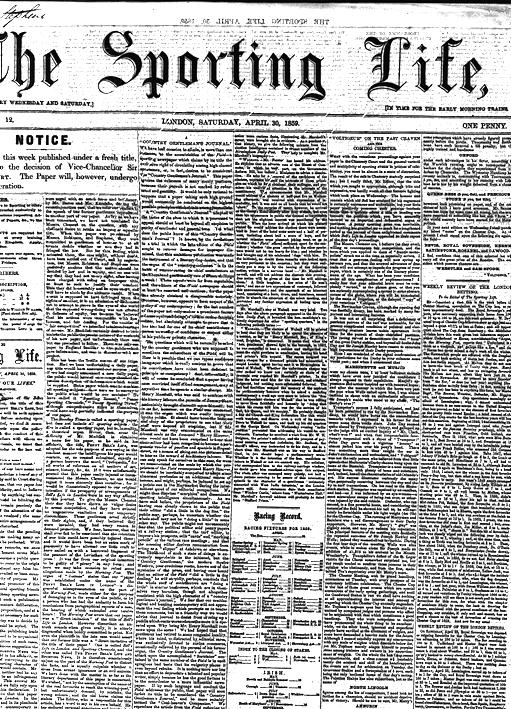
Reproduced by permission, British Newspaper Library