Detailed Record
London Journal and Weekly Record of Literature, Science, and Art, The
vol 1 no 1 [ns], 01 Mar 1845 - 1906

then: New London Journal, The. vol 1 [3s], 05 May 1906 - vol 7, 08 May 1909
then: London Journal, The. vol 7 [3s], 15 May 1909 - vol 12, 27 Jan 1912
then: London Journal, The. vol 7 [3s], 15 May 1909 - vol 12, 27 Jan 1912
London,Middlesex
Editor:
C.W. Bradley
Pierce James (Jr) Egan (editor)
Mark Lemon (conductor; 1st ed)
Howard Paul
G.W.M. Reynolds (Sir) 1845)
John Wilson Ross (1846?)
Pierce James (Jr) Egan (editor)
Mark Lemon (conductor; 1st ed)
Howard Paul
G.W.M. Reynolds (Sir) 1845)
John Wilson Ross (1846?)
Proprietor:
Herbert Ingram (1857)
W.S. Johnson
George Stiff (1857)
W.S. Johnson
George Stiff (1857)
Publisher:
Bradbury and Evans (1857)
T. Connolly (1876)
A. Galignani (Paris 1845)
W. Galignani (Paris 1844-1845)
George Vickers (London 1845; 1862)
T. Connolly (1876)
A. Galignani (Paris 1845)
W. Galignani (Paris 1844-1845)
George Vickers (London 1845; 1862)
Printer:
Nassau Steam Press (1862)
John Wortham (1845)
John Wortham (1845)
Contributors:
William H.D. Adams
Fairfax Balfour
Mary E. Braddon
M. Carew
Newton (Mrs.) Crosland
Alexandre Dumas
Fairfax
M.A. Fleming
John Gilbert (ill. woodcutter)
Elizabeth Caroline Duncan Grey
Sue Hall
Samuel Bracebridge Hemyng
Percy William Justyne (ill.)
Miles Gerald Keon (1821- 1875)
Thomas Miller
C. Montague
J. Parsons
Charles Reade
George W.M. Reynolds
Walter Scott (Sir)
John Frederick Smith (1803 - 1890)
Gordon Smythies
Yorick (Mrs.) Smythies (Harriette Maria)
Frederic Soulie
E. Southworth
Percy St. John
Eugene Sue
Camilla Toulmin
Fairfax Balfour
Mary E. Braddon
M. Carew
Newton (Mrs.) Crosland
Alexandre Dumas
Fairfax
M.A. Fleming
John Gilbert (ill. woodcutter)
Elizabeth Caroline Duncan Grey
Sue Hall
Samuel Bracebridge Hemyng
Percy William Justyne (ill.)
Miles Gerald Keon (1821- 1875)
Thomas Miller
C. Montague
J. Parsons
Charles Reade
George W.M. Reynolds
Walter Scott (Sir)
John Frederick Smith (1803 - 1890)
Gordon Smythies
Yorick (Mrs.) Smythies (Harriette Maria)
Frederic Soulie
E. Southworth
Percy St. John
Eugene Sue
Camilla Toulmin
Size:
21 x 27 cm, 8pp, 48 columns; 28cm, 16pp
Price:
1d
Circulation:
140,000 (1847); 100,000 (1849); 170,000 (1850); 450,000-510,000 (1855); 350,000 (1858); 300,000 (1860); 200,000 (1865); 120,000 (1869); 150,000 (1870)
Frequency:
weekly (Sat)
Illustration:
engravings; b/w title page illustrations; woodcuts ( by John Gilbert); vignettes
Indexing:
index/vol
Departments:
matrimonial advertisements (1850s); the arts, diagrams, didactic &c., essays, etiquette of the millions, general, good humour, historical, illustrations, mysteries of the inquisition, narratives, newspaper and periodical press of London, poetry, portraits, reviews, science &c., tales, useful receipts, voyages travels and topographical descriptions, stories, short stories, full-length/serialized novels, history, biography, antiquity, contemporary social or economic problems, household hints, recipes, puzzles, riddles, reports of factual oddities, true-life adventure, answers to correspondents on personal,legal and medical problems, novels, French literature reproduced
Orientation:
radical?
Merges:
merged with The Guide to Literature, Science, Art and General Information
Sources:
Cooper, Dictionary of Contemporaries.; COPAC; DNB x, p.450-451; Ellegard, Alvar. "The Readership of the Periodical Press in Mid-Victorian Britain." Goteborg: Goteborgs Universitets Arsskrift. 63:3 (1957); COPAC; Hoornstra, Jean, and Grace Puravs. eds. A Guide to the Early British Periodicals Collection On Microfilm.; James, Louis. Fiction for the Working Man, 1830-1850. London: Oxford University Press, 1963.; Layton, Charles and Edwin. Handy Newspaper List, 1912.; Mitchell, Chastity, Class and Women’s Reading.; Reprinted VPN no 13 (Sep 1971): 3-22.; Sutherland Longman Companion to Victorian Fiction.; Uffelman, 1992.; xi, p.35-36; xiii, p424-425; May, Frederick L. Press Guide. London: May, 1876.
Histories:
Altick, Lively Youth of a British Institution.; Altick, English Common Reader.; Anderman, "Art of Sensation".; Baldwin, British Short Story.; Atkinson, "Continental Currents".; Bourne, H.R. Fox. English Newspapers. vol 2. New York: Russell & Russell, 1966.; Cranfield, G.A. The Press and Society: From Caxton to Northcliffe London and New York: Longman, 1978.; Elwin, Victorian Wallflowers.; Fyfe, William Chambers and the Business of Publishing.; Humphreys, A. "G.W.M. Reynolds: popular literature and popular politics." Innovators and preachers: the role of the editor in Victorian England. Ed. Joel H. Wiener. Westport, 1985.; Kooistra, "Illustration".; James, Fiction for the Working Man.; Jones, Kennedy. Fleet Street & Downing Street. London: Hutchinson And Co.,1920.; King, "Education of the Gaze and The London Journal".; Hughes, “Why Poetry Matters to Periodical Studies”. pp.91-125; Léger-St-Jean, Marie. "Periodicals." Price One Penny.; Maunder, Andrew. " 'Discourses of distinction': The Reception of the Cornhill Magazine,1859-60." VPR 32.3 (1999): 239-248.; Myerson, J. "Ann Stephens the London Journal and Anglo-American copyright in 1854." Manuscripts 35 (1983): 281-6.; Phegley, "Family Magazines" p.279.; Rose, Jonathan. "Workers' Journals." Victorian Periodicals and Victorian Society. Eds. J. Don Vann and Rosemary T. VanArsdel. Toronto: U of Toronto P, 1995: 301-310.; Shattock, "Household Words and the Community of Print".; Shattock, "Literature and the Expansion of the Press".; Shattock, Joanne and Michael Wolff. eds. The Victorian Periodical Press: Soundings and Samplings. Toronto: University of Toronto Press, 1982.; Summers, Montague. ed. Victorian Ghost Stories. London: Simpkin and Marshall Ltd., 1936.; Thompson, “Gender and Reception”; King, Andrew and John Plunkett. Victorian Print Media: a Reader. Oxford: Oxford University Press, 2005: 207, 231.; Sweet, Matthew. Inventing the Victorians. London: Faber and Faber, 2002; King, Andrew. The London Journal, 1845–83: Periodicals, Production and Gender. Aldershot: Ashgate, 2004.
Comments:
"At first a journal of the Family Herald type [fiction, amusing curiosities, useful information, etc.], though even more trashy in contents, it eventually (after 1865) gave more and more prominence to women's fashions. Readers lower to middle class women, educational standard low" (Ellegard 22).
"The London Journal was by reputation more 'trashy' than the Family Herald, a judgment probably based on the front-page woodcuts which illustrated the often-violent serials...On the other hand, the instructive side of the periodical was more serious than the Family Herald's...Its authors wrote about history and science in full-length articles rather than snippets. It ran a basic French course for several years... The London Journal also printed stories about sexual irregularity. Nearly all have sordid endings, but they are not simple warnings against sin. The woman's grief and misery are usually the consequence of some other evil" (Mitchell 11).
"Wilkie Collins's witty exploration of mass-market reading in Household Words treats The London Journal as though it were an exotic artifact from a dark continent ready for cultural colonization" (King 80).
"By the 1870s, the penny weekly family magazine had come to be both more and less of a mass literature, depending on the way we use the term. No single magazine had as big a circulation as the London Journal of the middle fifties, nor did they, all together, reach so great a proportion of the now vastly expanded literate public...The London Journal began in 1868 to give away a monthly 'Ladies supplement' containing engravings of dress and descriptions of the latest styles or, sometimes, a complete folded paper pattern. There was a hand-coloured fashion plate bimonthly for a penny extra. Instead of one serial at a time, as in the forties and fifties, there were now instalments of four, chiefly romantic, at least half of them written by women" (Mitchell 145).
A supplementary volume was issued c.1873-c.1877.
"The London Journal (1845-1912)...appealed to stronger tastes. It was started by George Stiff, an engraver who had risen to a position of importance for his work on The Illustrated London News, although he had been sacked later for incompetence...With greater capital, the magazine proved a success. Its profits rose to between 10,000 and 12,000 a year an exceptional figure for this period with a circulation of 500,000 copies per issue. It established for George Vickers, its first publisher, a business which is still running today. Reynolds, the first editor, gave 'The Journal' a tone quite different from that of Lloyd's Miscellany, or of The Family Herald. He was a middle-class man of some interest in the development of cheap fiction.... After Reynolds left The London Journal, it continued under the editorship of John Wilson Ross. Its circulation was increased by the woodcuts of the young John Gilbert. In 1849 J.F. Smith [contributed to The London Journal by writing fiction]...[it] brought the Journal's circulation up to 100,000 copies a week in 1849. His next novel, Minnigrey, brought it up to half a million..." (James 40-42).
"The London Journal ... was not run by societies but by publishers whose object was to make money. [It] was astonishingly successful at it; the London Journal at one point made an annual profit of over 10000" (Mitchell 5).
"French fiction formed the backbone of The London Journal...not a single issue... between these years [1845 and 1849] was without some French literature in translation" (James 136).
This typically Victorian Magazine contains serial novels, novelettes, short stories, poems, general articles, useful items, people of interest, etc. "A weekly illustrated periodical of tales and romances" (DNB x, p.450-451).
"An analysis of the London Journal for 1848 shows that in one quarter, it devoted under 5% of its space to short fiction, while a serial novel occupied almost 27%. In another quarter, short fiction jumped to almost 18% of the magazine's contents, but serialized novels still held almost 23%" (Baldwin 27).
"Harding The Money Spinner" (1879) by Keon was first serialized in 1852.
The journal reran serialisation of "Lady Audley's Secret" by Mary E. Braddon, Mar - Aug 1863. "Lady Audley's Secret" also partially serialised in "Robin Goodfellow," July - Sept 1861 and wholly serialised in the Sixpenny Magazine, Jan - Dec 1862. Smith joined the journal in 1849 and found that his "gothic romances were enormously popular" (Sutherland, 588).
"Minnigrey" written by John Smith and illustrated by John Gilbert was serialised from 1851 - 1852. John Smith returned to the journal in 1865. "Stanfield Hall" written by John Smith was serialised in 1850. Smythies was a regular serialist.
Reynolds left the London Journal after quarrelling with Stiff (proprietor) and started his rival "Miscellany" in 1846. (Samuel) Bracebridge Hemyng "became an extremely popular and prolific author, writing low-grade serials for the London Journal."
"The London Journal appealed to stronger tastes [than that of The family Herald]. It was started by George Stiff, an engraver who had risen to a position of importance for his work on The Illustrated London News, although he had been sacked later for incompetence. To start his new venture he found a paper-making firm to back him, then got involved in such heady debt that his financiers were obliged to a much larger sum to avoid a total loss. (This procedure was later used by Ralph Rollington to start another periodical.) With greater capital, the magazine proved to be a success, Its profits rose to between £10,000 and £12,000 a year--an exceptional figure for this period--with a circulation of 500,000 copies per issue. It established for George Vickers [editor of Mysteries of Old St. Paul's], its first publisher, a business which is still running today. Its first detour was George W.M. Reynolds. Reynolds gave The London Journal a tone quite different from that of Lloyd's Miscellany of The Family Herald" (James, Louis; p.40). Motto: never to "offend with political bias, or interfere with domestic tranquility".
The London Journal published articles about child prostitution in Victorian London. "Singled out for special attention was the London Journal, which had a circulation of 100,000 when it achieved the distinction of a mention in the Select Committee on Public Libraries in 1849. There was no open indecency, but witnesses were inclined to think that such penny publications had 'perhaps a worse tendency than books positively indecent or immoral', the argument being that the latter were at least open in their evil designs, and were also too expensive for the poor to buy" (Cranfield).
"In 1850, the London Journal began publishing personal announcement for the unattached, and by the 1870s, dedicated publications such Matrimonial News went on sale... The contact ad was not the creation of a periodical publisher keen to turn loneliness into cash - it was the subscribers of the London Journal themselves who turned its correspondence column into a textual dating agency. 'We have no ambition to act the part of an amateur Hymen in concocting such marriages,' the newspaper declared in 1850 - but its readers had determined otherwise" (Sweet, pp.40-41).
Price One Penny provides a list of the fiction which the London Journal published.
While it was "appealing to a 'radical' reader...but it dare not identify itself too definitely as a political magazine" (King 86).
It circulated in Paris during the 1840s.
"The London Journal was by reputation more 'trashy' than the Family Herald, a judgment probably based on the front-page woodcuts which illustrated the often-violent serials...On the other hand, the instructive side of the periodical was more serious than the Family Herald's...Its authors wrote about history and science in full-length articles rather than snippets. It ran a basic French course for several years... The London Journal also printed stories about sexual irregularity. Nearly all have sordid endings, but they are not simple warnings against sin. The woman's grief and misery are usually the consequence of some other evil" (Mitchell 11).
"Wilkie Collins's witty exploration of mass-market reading in Household Words treats The London Journal as though it were an exotic artifact from a dark continent ready for cultural colonization" (King 80).
"By the 1870s, the penny weekly family magazine had come to be both more and less of a mass literature, depending on the way we use the term. No single magazine had as big a circulation as the London Journal of the middle fifties, nor did they, all together, reach so great a proportion of the now vastly expanded literate public...The London Journal began in 1868 to give away a monthly 'Ladies supplement' containing engravings of dress and descriptions of the latest styles or, sometimes, a complete folded paper pattern. There was a hand-coloured fashion plate bimonthly for a penny extra. Instead of one serial at a time, as in the forties and fifties, there were now instalments of four, chiefly romantic, at least half of them written by women" (Mitchell 145).
A supplementary volume was issued c.1873-c.1877.
"The London Journal (1845-1912)...appealed to stronger tastes. It was started by George Stiff, an engraver who had risen to a position of importance for his work on The Illustrated London News, although he had been sacked later for incompetence...With greater capital, the magazine proved a success. Its profits rose to between 10,000 and 12,000 a year an exceptional figure for this period with a circulation of 500,000 copies per issue. It established for George Vickers, its first publisher, a business which is still running today. Reynolds, the first editor, gave 'The Journal' a tone quite different from that of Lloyd's Miscellany, or of The Family Herald. He was a middle-class man of some interest in the development of cheap fiction.... After Reynolds left The London Journal, it continued under the editorship of John Wilson Ross. Its circulation was increased by the woodcuts of the young John Gilbert. In 1849 J.F. Smith [contributed to The London Journal by writing fiction]...[it] brought the Journal's circulation up to 100,000 copies a week in 1849. His next novel, Minnigrey, brought it up to half a million..." (James 40-42).
"The London Journal ... was not run by societies but by publishers whose object was to make money. [It] was astonishingly successful at it; the London Journal at one point made an annual profit of over 10000" (Mitchell 5).
"French fiction formed the backbone of The London Journal...not a single issue... between these years [1845 and 1849] was without some French literature in translation" (James 136).
This typically Victorian Magazine contains serial novels, novelettes, short stories, poems, general articles, useful items, people of interest, etc. "A weekly illustrated periodical of tales and romances" (DNB x, p.450-451).
"An analysis of the London Journal for 1848 shows that in one quarter, it devoted under 5% of its space to short fiction, while a serial novel occupied almost 27%. In another quarter, short fiction jumped to almost 18% of the magazine's contents, but serialized novels still held almost 23%" (Baldwin 27).
"Harding The Money Spinner" (1879) by Keon was first serialized in 1852.
The journal reran serialisation of "Lady Audley's Secret" by Mary E. Braddon, Mar - Aug 1863. "Lady Audley's Secret" also partially serialised in "Robin Goodfellow," July - Sept 1861 and wholly serialised in the Sixpenny Magazine, Jan - Dec 1862. Smith joined the journal in 1849 and found that his "gothic romances were enormously popular" (Sutherland, 588).
"Minnigrey" written by John Smith and illustrated by John Gilbert was serialised from 1851 - 1852. John Smith returned to the journal in 1865. "Stanfield Hall" written by John Smith was serialised in 1850. Smythies was a regular serialist.
Reynolds left the London Journal after quarrelling with Stiff (proprietor) and started his rival "Miscellany" in 1846. (Samuel) Bracebridge Hemyng "became an extremely popular and prolific author, writing low-grade serials for the London Journal."
"The London Journal appealed to stronger tastes [than that of The family Herald]. It was started by George Stiff, an engraver who had risen to a position of importance for his work on The Illustrated London News, although he had been sacked later for incompetence. To start his new venture he found a paper-making firm to back him, then got involved in such heady debt that his financiers were obliged to a much larger sum to avoid a total loss. (This procedure was later used by Ralph Rollington to start another periodical.) With greater capital, the magazine proved to be a success, Its profits rose to between £10,000 and £12,000 a year--an exceptional figure for this period--with a circulation of 500,000 copies per issue. It established for George Vickers [editor of Mysteries of Old St. Paul's], its first publisher, a business which is still running today. Its first detour was George W.M. Reynolds. Reynolds gave The London Journal a tone quite different from that of Lloyd's Miscellany of The Family Herald" (James, Louis; p.40). Motto: never to "offend with political bias, or interfere with domestic tranquility".
The London Journal published articles about child prostitution in Victorian London. "Singled out for special attention was the London Journal, which had a circulation of 100,000 when it achieved the distinction of a mention in the Select Committee on Public Libraries in 1849. There was no open indecency, but witnesses were inclined to think that such penny publications had 'perhaps a worse tendency than books positively indecent or immoral', the argument being that the latter were at least open in their evil designs, and were also too expensive for the poor to buy" (Cranfield).
"In 1850, the London Journal began publishing personal announcement for the unattached, and by the 1870s, dedicated publications such Matrimonial News went on sale... The contact ad was not the creation of a periodical publisher keen to turn loneliness into cash - it was the subscribers of the London Journal themselves who turned its correspondence column into a textual dating agency. 'We have no ambition to act the part of an amateur Hymen in concocting such marriages,' the newspaper declared in 1850 - but its readers had determined otherwise" (Sweet, pp.40-41).
Price One Penny provides a list of the fiction which the London Journal published.
While it was "appealing to a 'radical' reader...but it dare not identify itself too definitely as a political magazine" (King 86).
It circulated in Paris during the 1840s.
Location:
partial runs: LO/U-1 G vols 1-14,19-20,27-29,35- 36 (1845-1862 inc, wanting 1803-1844, 1862-1912); see UMI Early British Periodical Collection; XY/N-1 1:1-14:345 (01 Mar 1845-04 Oct 1851); OX/U-1 A (1845-1912); MA/U-1; Gl/U-1; N.America: see Fulton; ULS 2&3. The full text is available at ProQuest
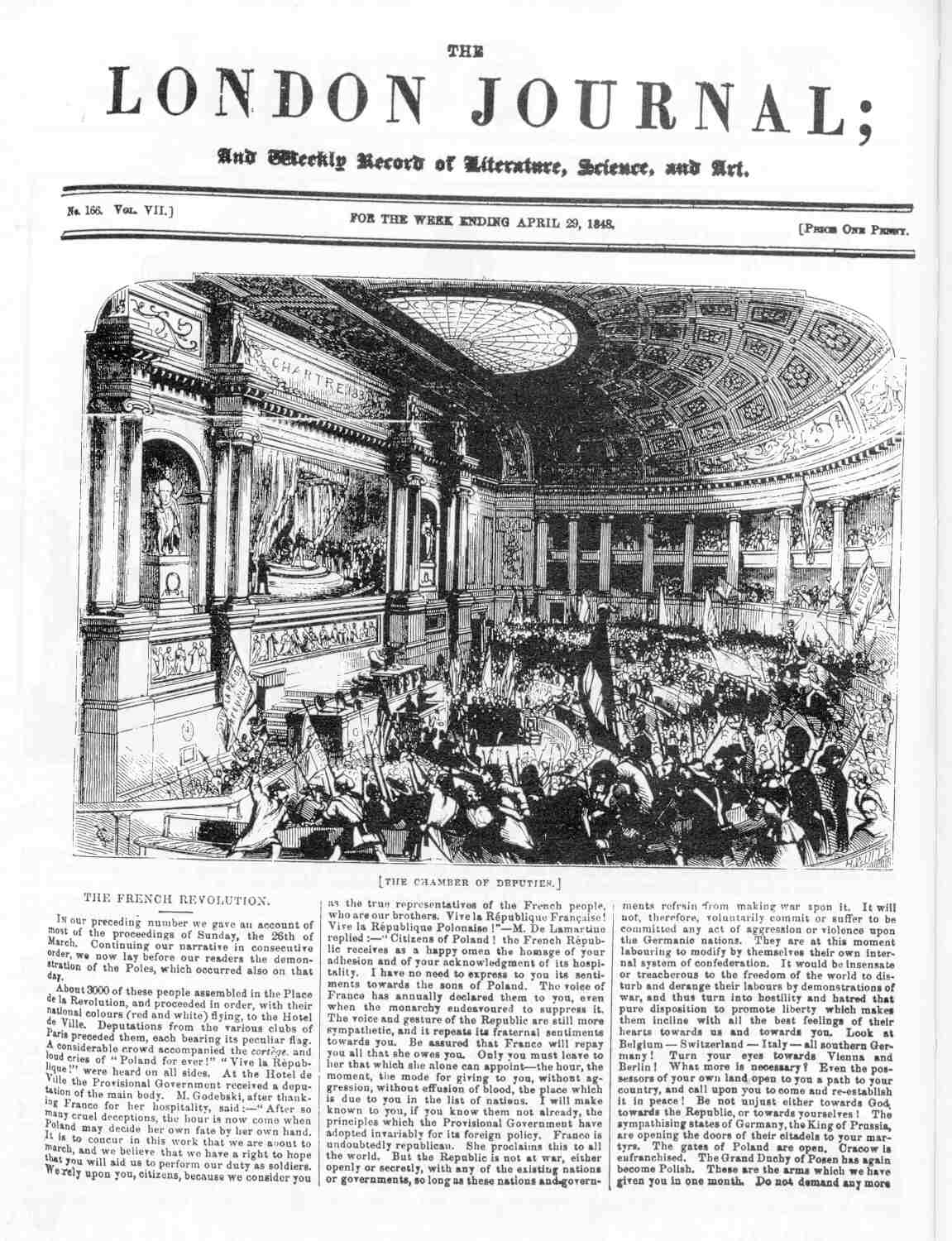
Reproduced by permission, London University Library

Reproduced by permission, London University Library