Detailed Record
Morning Post and Daily Advertising Pamphlet, The
no 1, 02 Nov 1772

then: Morning Post, or Cheap Daily Advertiser, The. 1772
then: Morning Post, and Daily Advertiser, The. 1772 - no 10081 1801?
then: Morning Post and Gazeteer, The. no 10082, 01 Jan 1801 - no 10685, 01 Jan 1803
then: Morning Post, The. no 10686, 08 Jan 1803 - no 51561, 30 Sep 1937//
then: Morning Post, and Daily Advertiser, The. 1772 - no 10081 1801?
then: Morning Post and Gazeteer, The. no 10082, 01 Jan 1801 - no 10685, 01 Jan 1803
then: Morning Post, The. no 10686, 08 Jan 1803 - no 51561, 30 Sep 1937//
London,Middlesex
Editor:
Henry Bate (Rev.) 1775 - 1781)
John Bell (1772 - ?)
John Benjafield (1786 - 1788)
Thomas Bittleson (1834)
Blagdon
Algernon Borthwick (Lord Glenesk, 1852 - 1887)
Peter Borthwick (1849 - 1852)
Nicholas Byrne (1803 - 1833)
Samuel Taylor Coleridge
Henry Bate Dudley (Rev.) 1772 - 1780)
James Nicol Dunn (1897 - 1905)
William Hardman (Sir) 1872 - 1890)
Badini Jackson (1784)
William Jackson (1780, 1781)
George Lane (asst ed. to Daniel Stuart)
Algernon Locker (1895 - 1897)
J.E. Macmanus
C.E. Michele (1833 - 1849)
Alexander Leys Moore (1890 - 1894)
J. Nott (1803 - 1833)
Lord Pelham (1880s)
Eugenius Roche (asst ed. 1817 - 1827)
Daniel Stuart (1795 - 1803)
John Taylor (1788 - 1790)
John Vent
Francis William
John Bell (1772 - ?)
John Benjafield (1786 - 1788)
Thomas Bittleson (1834)
Blagdon
Algernon Borthwick (Lord Glenesk, 1852 - 1887)
Peter Borthwick (1849 - 1852)
Nicholas Byrne (1803 - 1833)
Samuel Taylor Coleridge
Henry Bate Dudley (Rev.) 1772 - 1780)
James Nicol Dunn (1897 - 1905)
William Hardman (Sir) 1872 - 1890)
Badini Jackson (1784)
William Jackson (1780, 1781)
George Lane (asst ed. to Daniel Stuart)
Algernon Locker (1895 - 1897)
J.E. Macmanus
C.E. Michele (1833 - 1849)
Alexander Leys Moore (1890 - 1894)
J. Nott (1803 - 1833)
Lord Pelham (1880s)
Eugenius Roche (asst ed. 1817 - 1827)
Daniel Stuart (1795 - 1803)
John Taylor (1788 - 1790)
John Vent
Francis William
Proprietor:
Baldwin (1792)
Bathurst (Lady) 1908?-1924)
John Bell (1772 - 1786)
John Benjafield (1786 - 1788)
Algernon Borthwick (Sir) Lord Glenesk, 1851, 1876 - 1908)
Nicholas Byrne (1803 - 1833)
T.B. Crompton (1849 - 1858)
Christie Grant
Christie Hall
C.E. Michele (1833 - 1849)
Tattersall Perry (1792)
W.J. Rideout (1858 - 1876)
Alderman Skinner
Daniel Stuart (1795 - 1803)
John Stuart
Peter Stuart (1795 - 1803)
Richard Tattersall (1772 - 1795)
Richard Tattersall (1786 - 1795)
John Taylor
Trusler (Rev. Dr.)
Louis Weltje (1788 - 1795)
Bathurst (Lady) 1908?-1924)
John Bell (1772 - 1786)
John Benjafield (1786 - 1788)
Algernon Borthwick (Sir) Lord Glenesk, 1851, 1876 - 1908)
Nicholas Byrne (1803 - 1833)
T.B. Crompton (1849 - 1858)
Christie Grant
Christie Hall
C.E. Michele (1833 - 1849)
Tattersall Perry (1792)
W.J. Rideout (1858 - 1876)
Alderman Skinner
Daniel Stuart (1795 - 1803)
John Stuart
Peter Stuart (1795 - 1803)
Richard Tattersall (1772 - 1795)
Richard Tattersall (1786 - 1795)
John Taylor
Trusler (Rev. Dr.)
Louis Weltje (1788 - 1795)
Publisher:
Nicholas Byrne (1804 - 1833)
T.L. Coward (1891)
Hampton (1808 - 1811)
Henry Long (1854)
J. Nott (1803)
T. Payne (1820, 1833 - 1835)
E.E. Peacock (1900)
Smith
Daniel Stuart (1801 - 1803)
Joshua Paul Wanless
T.L. Coward (1891)
Hampton (1808 - 1811)
Henry Long (1854)
J. Nott (1803)
T. Payne (1820, 1833 - 1835)
E.E. Peacock (1900)
Smith
Daniel Stuart (1801 - 1803)
Joshua Paul Wanless
Printer:
N. Byrne (1803, 1808, 1812)
J. Nott (1812)
Daniel Stuart (1788 - 1795, 1803)
Peter Stuart (1788 - 1795)
Stuart Brothers (1788 - 1795)
J. Nott (1812)
Daniel Stuart (1788 - 1795, 1803)
Peter Stuart (1788 - 1795)
Stuart Brothers (1788 - 1795)
Contributors:
John Chippendall Montesquieu Bellew
Thomas Gibson Bowles
Thomas Burdon
Winston Churchill (Sir) 1898+)
Samuel Taylor Coleridge (1795 - 1802)
Richard Davey
Disraeli
Florence C. Dixie (Lady)
Charles Dunphy
Amelia B. Edwards
Joseph Gillon
Scaevola Goold
Scaevola Grant (John Allen)
St. Leger Algernon Herbert
William Blanchard Jerrold
Miles Gerald Keon (1821 - 1875)
Andrew Valentine Kirwan
James Knowles
Charles Lamb (1795 - 1798, 1800 - 1802)
George Lane (1800 - 1803)
Andrew Lang
Edward Legge
Charles Llyod (1800 - 1802)
Henry Dawson Lowry (1869 - 1906)
James Mackintosh (Sir) 1789 - 1803)
J.E. Macmanus
Rosa Matilda
Frank Hugh McDonnell
William Sharp McKechnie
George Meredith (1866)
William Augustus Miles
John Stuart Mill
Thomas Miller
Richard Oastler (1846)
Viscount Palmerston
Peter Pindar
Winthrop Mackworth Praed (1832-1834)
F. Rhodes (Col.)
Eugenius Roche
Robert Southey (1795 - 1802)
John Stuart
Ward
Spenser Wilkinson
Wolcott (Dr.)
William Wordsworth (1795 - 1802)
Thomas Gibson Bowles
Thomas Burdon
Winston Churchill (Sir) 1898+)
Samuel Taylor Coleridge (1795 - 1802)
Richard Davey
Disraeli
Florence C. Dixie (Lady)
Charles Dunphy
Amelia B. Edwards
Joseph Gillon
Scaevola Goold
Scaevola Grant (John Allen)
St. Leger Algernon Herbert
William Blanchard Jerrold
Miles Gerald Keon (1821 - 1875)
Andrew Valentine Kirwan
James Knowles
Charles Lamb (1795 - 1798, 1800 - 1802)
George Lane (1800 - 1803)
Andrew Lang
Edward Legge
Charles Llyod (1800 - 1802)
Henry Dawson Lowry (1869 - 1906)
James Mackintosh (Sir) 1789 - 1803)
J.E. Macmanus
Rosa Matilda
Frank Hugh McDonnell
William Sharp McKechnie
George Meredith (1866)
William Augustus Miles
John Stuart Mill
Thomas Miller
Richard Oastler (1846)
Viscount Palmerston
Peter Pindar
Winthrop Mackworth Praed (1832-1834)
F. Rhodes (Col.)
Eugenius Roche
Robert Southey (1795 - 1802)
John Stuart
Ward
Spenser Wilkinson
Wolcott (Dr.)
William Wordsworth (1795 - 1802)
Names:
John Allen
John Sherren Brewer
Queen Caroline
Arthur Clutton-Brock
Thomas Crofton Croker
Charles J. Dunphie
Glenesk (Lord)
William Howard Glover
Charles Lewis Gruneisen
Alfred C. Harmsworth
Robert Stephen Hawker
William E. Henley
Frances S. (Mrs.) Hoey
John Hollingshead
Martin A.S. Hume
Henry Lowry
Grenville Murray
Palmerston (Lord)
Charles Repington
Alderman Skinner
Adam Smith
John Taylor
Trusler (Rev. Dr.)
John Sherren Brewer
Queen Caroline
Arthur Clutton-Brock
Thomas Crofton Croker
Charles J. Dunphie
Glenesk (Lord)
William Howard Glover
Charles Lewis Gruneisen
Alfred C. Harmsworth
Robert Stephen Hawker
William E. Henley
Frances S. (Mrs.) Hoey
John Hollingshead
Martin A.S. Hume
Henry Lowry
Grenville Murray
Palmerston (Lord)
Charles Repington
Alderman Skinner
Adam Smith
John Taylor
Trusler (Rev. Dr.)
Size:
49pp, 4pp; 8pp (1st fortnight, 1772); 47cm x 31cm, 4pp (after 1st fortnight, 1772); 51cm, 4pp (1803, 1812)
Price:
1½d (1st fortnight, 1772); 2d (after 1st fortnight, 1772); 3d (1783, 1813, 1865-1880); 3½d (1797); 6d (1800, 1803); 6½d (1812); 4d (1846, 1860); 5d (1847, 1855); 1d (1881-1912)
Circulation:
2,100/d (1783); 350/d (1795); 1000 (1797); 2,000+/d (1798-1799); 1,000 (1801); 4,500+/d (1803); 3,000 (1854); 3,500 (1870); 100,000 (1937)
Frequency:
daily; daily (am)
Departments:
advertisements, state of politics, London, theatre, original poetry, ship news, sales by auction, fashionable/law/sporting intelligence (1803); parliamentary/London/ship/national news, fashionable world, sales by auction, literary reviews, politics, auctioneer advertisements, crime reports, murder and execution coverage, literature, obituary
Orientation:
pro-opposition (1790s); unionist; ministerial, Opposition; neutral (1772-1778); radical (-1790s); Whig (1778-1803); Tory (1803-1937); High Church, strong protectionist, fashionable (1846); Conservative (1912)
Merges:
absorbed Gazetteer (02 Oct 1797); absorbed the Telegraph (1798); absorbed by Daily Telegraph (q.v.) (1937)
Sources:
BLC Consolidated List, p.50.; Canney, Catalogue of Economic Literature.; Cooper, Dictionary of Contemporaries.; DNB ii, 1202-3.; Ellegard, Alvar. The Readership of the Periodical Press in Mid-Victorian Britain. Goteborg: Goteborgs Universitets Arsskrift. 63:3 (1957). Reprinted VPN no 13 (Sep 1971): 3-22.; Harden, Letters of Thackeray.; Henson et al. Culture and Science.; Hudson, Derek. British Journalists and Newspapers. London: Collins, 1945: 26.; Inglis, Poverty and the Industrial Revolution.; Jack, Scottish Newspaper Directory.; Layton, Handy Newspaper List.; Liddle, Dallas. The Dynamics of Genre: Journalism and the Practice of Literature in Mid-Victorian Britain., University of Virginia Press, 2009, p.1-175.; Linton, Boston, Newspaper Press in Britain, p.325.; McWilliam, Rohan. The Tichborne Claimant. Hambledon Continuum, 2007, p.1-278.; Mill, John Stuart. "Collected Works of John Stuart Mill." Vols 22-25, Newspaper Writings. Eds. Ann P. Robson et al. Toronto: U Toronto Press.; Mitchell's Newspaper Press Directory, 1946, 1900.; NCBEL.; Sell's Dictionary of the World's Press. London: Sell's Advertising Offices, 1883.; Sumpter, Caroline. The Victorian Press and the Fairy Tale. Palgrave Macmillan, 2008, p.1-178.; Sutherland Longman Companion to Victorian Fiction.; Uffelman, 1992.; White's The English Literary Journal to 1900.; Williams, Judith Blow. A Guide to the Printed Materials for English Social and Economic History 1750-1850. 2 vols. New York: Octagon Books, 1966.; Willing, James. Willing's Press Guide. Vol 18. London: Willing, 1891. p.79.; ix, 202-203' xiii, 1263-63; ix, p.663; v, 132-34; viii, 9, 755-56; xix, p.75-76; xix, p.75-76; xxiii, supplement 2, 535; xxiv, 242-46, 276-77, 284-86, 322-23, 482; xxvii, 192-93, 397-403, 717-18; xxvii, p.542-543.
Histories:
Altholz, Religious Press in Britain.; Altick, Lively Youth of a British Institution.; Altick, English Common Reader.; Aspinall, A. “Statistical Accounts”. pp. 222-234, 372-382.; Aspinall, Arthur. Politics and the Press c.1780-1850. Brighton, Eng.: The Harvester Press Limited, 1973.; Barker, Hannah. Newspapers, Politics, and English Society, 1695-1855 . Harlow: Longman, 2000.; Barnes, Donald Grove. A History of the English Corn Laws, From 1660-1846. New York: A. M. Kelley [reprint of 1930], 1961.; Bently, "Legal Protection of Newspaper and Periodical Titles".; Bourne, H. R. Fox. "Coleridge Among the Journalists." Gentleman's Magazine 263 (1887): 472-87; Bourne, H. R. Fox. English Newspapers. vol 2. New York: Russell & Russell, 1966.; Bourne, H.R. Fox, vol 1, (1887): 220-224, 270-271, 292-309, vol 2: 243-244, 345.; Brown, News and Newspapers; Cahill, G.A. "‘Irish Popery’ and British Nativism: 1800-1848." Cith 13 (May 1974): 3-18.; Clarke, Grub Street to Fleet Street, p.97.; "Coleridge and the Morning Post." Morning Post (21 October 1922).; Coleman, "Coleridge the Journalist".; Colmer, John A. "Coleridge on Addigton's Administration." MLR 54 (1959): 69-72.; Cotsell, “Dickens’s last attack”.; Cranfield, G. A., The Press and Society: From Caxton to Northcliffe London and New York: Longman, 1978.; Crapster, B.L. "Thomas Hamber, 1828-1902, Tory journalist." VPN 8 (1975): 115-25.; Curry, K. The contributions of Robert Southey to the "Morning Post". University (Alabama), 1984.; Demoor, M., "Andrew Lang on Gissing: a late Victorian point of view." GN 20 (1984): 20-30.; Downing, Churchill's War Lab, p.11.; Elia, Richard. "Parody and Politics of Winthrop Mackworth Praed with an appendix of the 1833 Morning Post leaders." PhD thesis, Massachusetts, 1973. DAI 34 (1974): 6587 A.; Elia, Richard. "Some Leaders of Morning Post." VPN 11 (1978): 23-24.; Engel, Tickle the Public.; Erdman, David V. "The Case for Internal Evidence (6): The Signature of Style." BNYPL 63 (1959): 88-109.; Erickson, Economy of Literary Form.; Escott, Masters of English Journalism.; Fyfe, Hamilton. Sixty Years of Fleet Street. London: W. H. Allen & Co., Ltd., 1949.; Gentleman's Magazine 10 [ns] (Jul 1838): 26.; Grant, James. The Newspaper Press. vol 1. London: Tinsley Brothers, 1871.; Griffiths, New Imperialism and the Fiction of Empire.; Griffiths, "End of the Imperial Romance"; Harris, Politics and the Rise of the Press.; Herd, March of Journalism.; Hindle, Wilfrid. 'The Morning Post' 1772-1937: Portrait of a Newspaper. London: Routledge, 1937.; Inglis, K.S. Churches and the Working Classes in Victorian England. London: Routledge and K. Paul, [1963].; Jones, Aled. Powers of the Press: Newspapers, Power and the Public in Nineteenth-Century England. England: Scolar Press, 1996.; Jones, Fleet & Downing. 1919, 1920.; Knelman, Judith. Twisting in the Wind: The Murderess and the English Press . Toronto: University of Toronto Press Incorporated, 1998.; Koss, Rise and Fall of the Political Press.; Leary, Manchester Periodicals ms p.114.; Lee, Origins of Popular Press.; Lucas R. Lord Glenesk and the Morning Post. London: 1910: 178-180.; Manning, Peter J. "Wordsworth in the Keepsake, 1829." Literature in the Marketplace: Nineteenth-century British publishing and reading practices. John O. Jordan and Robert L. Patten, eds. Cambridge: University Press, 1995: 44-73.; Morgan, “Working Class Women”.; Mumby, Romance of Book Selling.; Nelson, Fatherhood in Victorian Periodicals .; O'Leary, Patrick. Sir James Mackintosh: The Whig Cicero. Aberdeen: Aberdeen University Press, 1989: 57.; rpt. Living Age 316 (1923): 282-84.; Schoch, Richard W. Shakespeare's Victorian Stage, Performing History in the Theatre of Charles Kean. PR3106 S36 1998. Cambridge: Cambridge University Press, 1998.; Schoyen, A. R. The Chartist Challenge: A Portrait of George Julian Harney. London: Heinemann, 1958.; Smart, William. Economic Annals of the Nineteenth Century: 1801-1820 (vol 1). New York: Augustus M. Kelley, 1964.; Springhall, J.O. "'Up guards and at them' British Imperialism and popular art, 1880-1904." Imperialism and Popular Culture. Ed. John M. Mackenzie. Manchester, 1986.; "The Periodical Press." Edinburgh Review 38:76 (May 1823), 349-378.; Totowa, N.J.: Rowman and Littlefield, c.1976.; Ward, J.T. The Factory Movement: 1830-1855 . New York: MacMillan & Co Ltd., 1962.; Wilkinson, Images of War in Edwardian Newspapers.; Williams, Francis. Dangerous Estate: The Anatomy of Newspapers . London: Longmans, Green and Co, 1957.; Wilson, K.M. "The fate of a young Churchillian conceit: 'the War on the Nile' letters and the Morning Post." VPR 18 (1985) 143-6.
Comments:
The paper appealed politically to the aristocratic and landed interest. Took an interest in politics after 1832, when it feared a revolution (Cranfield 156).
Opposed parliamentary reform in 1832, declaring that "no Minister will ever be able to manage a democratic House of Commons" (Cranfield 164).
For more information about John Bell, his family, and his role in founding the Morning Post, please view this YouTube video.
Cranfield writes of the Morning Post: "It saw itself as the champion of Prostestantism, especially in Ireland" (164).
The Morning Post distrusted the trade union movement and supported Ashley's factory legislation. Cranfield writes of the Morning Post "it displayed a fiercely independent attitude in 1852, when the Derby government sought to transform it into an avowed Tory newspaper (Cranfield 164).
The Morning Journal was the chief rival of The Times (Cranfield 157).
"This is the paper of the 'beau monde': the journal of the fashionable world; for which it is in every respect calculated. It contains just as much of politics as may inform, without distracting; just so much of business as may interest, without 'boring'; seeks to distil the 'essence' of public events, and to compress into as small a space as possible the verbosity of public men, leaving as much of the spirit with as little of the dullness as can be managed; while every opportunity is taken advantage of, and a variety of means employed, for ministering to educated leisure such entertainment as Table Talk, the last operator the last book the 'theatre and fancy ball' paintings and sculpture and the movements of high life...The Post has acquired a perfect confidence for the consistency and courage with which it has ever advocated opinions to which it is attached: its fidelity to the cause of protection in particular has won for it no small regard as 'among the faithless the only faithful,' to the maintenance in their united integrity of those principles, which modern notions have almost discarded. The reproach of clinging to antiquated idea deters not the Post from pressing what it considers the just claims of the 'home' interests of Great Britain, and stemming the setting tide of free-trade opinions. Most earnestly does it combat the philosophers of the utilitarian and politico-economical school...The protection of labour, as one of the safeguards of capital itself, is one of the distinctive features in the opinions professed by this journal" (Mitchell's, 1846).
"The Morning Post is the oldest daily newspaper existing in London. It gives special attention to fashionable and foreign news, and is also noted for its full and accurate reports of Parliamentary proceedings. As a medium for announcements which it is desired to bring before the notice of the high and wealthy classes, the Morning Post cannot be surpassed" (Mitchell's, 1900).
"Readers predominantly upper class, many living in the country, as the large postal edition shows. Politically Tory and in religion High Church, they were more interested in Society and sport than in literature" (Ellegard 4).
"Leading Tory paper" (Williams, Judith; vol 1, p.75).
One of only nine daily newspapers, five of which were advertising journals and all of which were published in London, being published in Great Britain at the end of 1783 (Aspinall 6).
"More is known about the transformation of the Morning Post into an Opposition paper than any other journal which changed sides at this time...The agreement was dated 2nd January 1789" (Aspinall 274).
Daniel Stuart incorporated the Gazetteer in 1797 and the Telegraph in 1798 while expanding the paper's advertising. The Post's readership increased significantly because of these moves (Clarke 97).
Antiministerial position in reporting (Bourne 302).
The inclusion of Coleridge's poem, The Devil's Thoughts, created a great demand for The Morning Post that "several hundred sheets extra were sold by them" (Bourne 298).
Major poems of Coleridge, such as war eclogue, Fire, Famine, and Slaughter, The Recantation, and France, an Ode, were published from January 1798 and April 1798 (Bourne 294) and articles, such as Denoucement of Bonaparte and Criticism of the peace of Amiens during the autumn of 1802 (Bourne 301, 302).
During the French Revolution, Coleridge wrote articles under Radicalism and the term "Jacobins" had been derived from his writings, such as the article called "Once a Jacobin always a Jacobin" (Bourne 316).
Daniel and Peter Stuart bought this paper from Tatterall in 1795 for 600 pounds and sold it in 1803 for 25,000 pounds (DNB xix 75-76).
"In August 1798, theMorning Post admonished those radicals who might have been so deceived by French professions of liberty as to countenance an invasion. 'She comes with the rights of man in her mouth', the paper warned, 'and the rod of oppression in her hand'" (Barker 190).
According to Adam Smith, the paper "jettisoned liberalism for patriotism" during and after the invasion scare of 1798 (Barker 190).
The paper opposed Queen Caroline in the 1820 debates about the adultery charges against her; consequently, the paper's sales dropped and the office was "stormed by a mob" (Barker 203).
During the 1840s, competing papers began publishing more and more crime reports and murder case details, forcing theMorning Post to do the same (Knelman 36).
"The Government had increased the stamp duty from twopence to fourpence--ostensibly for revenue, but really to restrict circulation: the Morning Post, The Goldsmith Times and other newspapers had to charge their subscribers seven pence. All that the duty did, though, was drive the radical press underground" (Inglis).
"The Morning Post, it was said, was read by gentlemen and by gentlemen's gentlemen, by ladies, and by ladies' maids" (Lee 38).
"In 1842 a £25,000 mortgage was raised to prevent the Morning Post from falling into the hands of free traders" (Lee 51).
"Bear[s] testimony to the vitality inherent in a free Press...survived to this day from the eighteenth century" (Jones 22). This publication was Foreign Minister Palmerston's "favourite organ" (Jones, p.76).
Various letters from Daniel Stuart, of the Morning Post, with reference to a dispute between the publishers and himself as to the high charges made for advertisements, and to the refusal of the publishers to be relegated to the back page of the paper. 'To obtain the accommodation refused by the Morning Post they set up a morning paper, The Goldsmith British Press; and to oppose the Courier an evening one, The Goldsmith Globe'. These letters also contain very interesting details about Coleridge. His connection with the Morning Post was said `to have raised that paper from some small number to 7,000 in one year" (Mumby, Gentleman's Magazine, Jul-Sep 1838).
Keon worked for the Morning Post from 1847-59 as a "correspondent sympathetic to the conservative cause." Lowry wrote for the Morning Post. Richard Davey was literary and dramatic critic. He was also a novelist of fiction in the vein of Stevensonian historical romance, fiction embellished with "owlishly" scholarly footnotes. Lady Dixie (Florence Caroline) was correspondent during the Boer War of 1880-1881. She was a novelist, but it is probable that none her work was serialised in any magazine. Nelson discusses articles that address women's rights.
Founded by a group of twelve men, including the Rev. Henry Bate ("The Fighting Parson"), the Rev. Dr. Trusler, John Bell, and the founders of Christie's and Tattersall's. Their primary objective was "to establish a sound advertising organ" (Herd 79).
Because of a mistaken ruling by the Stamp Office, the paper was able to escape duties for the first fortnight of publication (Herd 79).
The contents of The Morning Post were often scandalous (Herd 80).
Stuart liked to have "poetry and light paragraphs 'making the Paper cheerfully entertaining, not entirely filled with ferocious politics'" (Herd 93). Lamb served as drama critic for a time (Herd 94).
"The first of all London papers to introduce the practice of giving systematic notices of the drama, the opera, and the concerts" (Grant 417).
"Displayed a strain of xenophobia, anti-semitism and hatred for Dissent" in the 1770s and 1780s (Harris 93). Meredith was the "special correspondent in Italy" (Jones 44).
Peter Borthwick emphasized news rather than views (Cranfield 209).
"The great political idol of the Post was Disraeli - a curious choice for a paper with a reputation of being ultra-English" (Cranfield 209).
During a certain period, the Morning Post maintained the High Tory policy of "'kind and careful government of the working classes.'" It approved the promotion of public education and health, even when it was the work of Liberal Governments. By 1870, it claimed that it was in second place in London journalism (it used to be last).
The Morning Post was the most reactionary of all English newspapers with regards to the repression of Irish Nationalism (Cranfield 210).
Despite the high quality of its news and its literary distinction, the Morning Post was always reputed as a 'Society' paper, which it once had been (Cranfield 211).
"The Post was founded as a medium for commercial advertising by a syndicate which contained such familiar names as Tattersall and Christie" (Hudson 26).
Winston Churchill submitted letters to the Post early in his career as a reporter, and he became a South African war correspondent in the Boer War. He "commanded the princely fee of 250 pounds per month plus all expenses, making him one of the highest-paid war reporters in South Africa" (Downing 13).
Churchill's support for imperialism made him a natural fit for the Post, but, as Griffiths explains, "a fin de siècle mood gripped the Morning Post journalist, just like Churchill: the good times of imperial romance were being swept aside by modernity" (156).
In 1803, the paper was sold to Nicholas Byrne for 25,000 pounds (BLC).
Opposed parliamentary reform in 1832, declaring that "no Minister will ever be able to manage a democratic House of Commons" (Cranfield 164).
For more information about John Bell, his family, and his role in founding the Morning Post, please view this YouTube video.
Cranfield writes of the Morning Post: "It saw itself as the champion of Prostestantism, especially in Ireland" (164).
The Morning Post distrusted the trade union movement and supported Ashley's factory legislation. Cranfield writes of the Morning Post "it displayed a fiercely independent attitude in 1852, when the Derby government sought to transform it into an avowed Tory newspaper (Cranfield 164).
The Morning Journal was the chief rival of The Times (Cranfield 157).
"This is the paper of the 'beau monde': the journal of the fashionable world; for which it is in every respect calculated. It contains just as much of politics as may inform, without distracting; just so much of business as may interest, without 'boring'; seeks to distil the 'essence' of public events, and to compress into as small a space as possible the verbosity of public men, leaving as much of the spirit with as little of the dullness as can be managed; while every opportunity is taken advantage of, and a variety of means employed, for ministering to educated leisure such entertainment as Table Talk, the last operator the last book the 'theatre and fancy ball' paintings and sculpture and the movements of high life...The Post has acquired a perfect confidence for the consistency and courage with which it has ever advocated opinions to which it is attached: its fidelity to the cause of protection in particular has won for it no small regard as 'among the faithless the only faithful,' to the maintenance in their united integrity of those principles, which modern notions have almost discarded. The reproach of clinging to antiquated idea deters not the Post from pressing what it considers the just claims of the 'home' interests of Great Britain, and stemming the setting tide of free-trade opinions. Most earnestly does it combat the philosophers of the utilitarian and politico-economical school...The protection of labour, as one of the safeguards of capital itself, is one of the distinctive features in the opinions professed by this journal" (Mitchell's, 1846).
"The Morning Post is the oldest daily newspaper existing in London. It gives special attention to fashionable and foreign news, and is also noted for its full and accurate reports of Parliamentary proceedings. As a medium for announcements which it is desired to bring before the notice of the high and wealthy classes, the Morning Post cannot be surpassed" (Mitchell's, 1900).
"Readers predominantly upper class, many living in the country, as the large postal edition shows. Politically Tory and in religion High Church, they were more interested in Society and sport than in literature" (Ellegard 4).
"Leading Tory paper" (Williams, Judith; vol 1, p.75).
One of only nine daily newspapers, five of which were advertising journals and all of which were published in London, being published in Great Britain at the end of 1783 (Aspinall 6).
"More is known about the transformation of the Morning Post into an Opposition paper than any other journal which changed sides at this time...The agreement was dated 2nd January 1789" (Aspinall 274).
Daniel Stuart incorporated the Gazetteer in 1797 and the Telegraph in 1798 while expanding the paper's advertising. The Post's readership increased significantly because of these moves (Clarke 97).
Antiministerial position in reporting (Bourne 302).
The inclusion of Coleridge's poem, The Devil's Thoughts, created a great demand for The Morning Post that "several hundred sheets extra were sold by them" (Bourne 298).
Major poems of Coleridge, such as war eclogue, Fire, Famine, and Slaughter, The Recantation, and France, an Ode, were published from January 1798 and April 1798 (Bourne 294) and articles, such as Denoucement of Bonaparte and Criticism of the peace of Amiens during the autumn of 1802 (Bourne 301, 302).
During the French Revolution, Coleridge wrote articles under Radicalism and the term "Jacobins" had been derived from his writings, such as the article called "Once a Jacobin always a Jacobin" (Bourne 316).
Daniel and Peter Stuart bought this paper from Tatterall in 1795 for 600 pounds and sold it in 1803 for 25,000 pounds (DNB xix 75-76).
"In August 1798, the
According to Adam Smith, the paper "jettisoned liberalism for patriotism" during and after the invasion scare of 1798 (Barker 190).
The paper opposed Queen Caroline in the 1820 debates about the adultery charges against her; consequently, the paper's sales dropped and the office was "stormed by a mob" (Barker 203).
During the 1840s, competing papers began publishing more and more crime reports and murder case details, forcing the
"The Government had increased the stamp duty from twopence to fourpence--ostensibly for revenue, but really to restrict circulation: the Morning Post, The Goldsmith Times and other newspapers had to charge their subscribers seven pence. All that the duty did, though, was drive the radical press underground" (Inglis).
"The Morning Post, it was said, was read by gentlemen and by gentlemen's gentlemen, by ladies, and by ladies' maids" (Lee 38).
"In 1842 a £25,000 mortgage was raised to prevent the Morning Post from falling into the hands of free traders" (Lee 51).
"Bear[s] testimony to the vitality inherent in a free Press...survived to this day from the eighteenth century" (Jones 22). This publication was Foreign Minister Palmerston's "favourite organ" (Jones, p.76).
Various letters from Daniel Stuart, of the Morning Post, with reference to a dispute between the publishers and himself as to the high charges made for advertisements, and to the refusal of the publishers to be relegated to the back page of the paper. 'To obtain the accommodation refused by the Morning Post they set up a morning paper, The Goldsmith British Press; and to oppose the Courier an evening one, The Goldsmith Globe'. These letters also contain very interesting details about Coleridge. His connection with the Morning Post was said `to have raised that paper from some small number to 7,000 in one year" (Mumby, Gentleman's Magazine, Jul-Sep 1838).
Keon worked for the Morning Post from 1847-59 as a "correspondent sympathetic to the conservative cause." Lowry wrote for the Morning Post. Richard Davey was literary and dramatic critic. He was also a novelist of fiction in the vein of Stevensonian historical romance, fiction embellished with "owlishly" scholarly footnotes. Lady Dixie (Florence Caroline) was correspondent during the Boer War of 1880-1881. She was a novelist, but it is probable that none her work was serialised in any magazine. Nelson discusses articles that address women's rights.
Founded by a group of twelve men, including the Rev. Henry Bate ("The Fighting Parson"), the Rev. Dr. Trusler, John Bell, and the founders of Christie's and Tattersall's. Their primary objective was "to establish a sound advertising organ" (Herd 79).
Because of a mistaken ruling by the Stamp Office, the paper was able to escape duties for the first fortnight of publication (Herd 79).
The contents of The Morning Post were often scandalous (Herd 80).
Stuart liked to have "poetry and light paragraphs 'making the Paper cheerfully entertaining, not entirely filled with ferocious politics'" (Herd 93). Lamb served as drama critic for a time (Herd 94).
"The first of all London papers to introduce the practice of giving systematic notices of the drama, the opera, and the concerts" (Grant 417).
"Displayed a strain of xenophobia, anti-semitism and hatred for Dissent" in the 1770s and 1780s (Harris 93). Meredith was the "special correspondent in Italy" (Jones 44).
Peter Borthwick emphasized news rather than views (Cranfield 209).
"The great political idol of the Post was Disraeli - a curious choice for a paper with a reputation of being ultra-English" (Cranfield 209).
During a certain period, the Morning Post maintained the High Tory policy of "'kind and careful government of the working classes.'" It approved the promotion of public education and health, even when it was the work of Liberal Governments. By 1870, it claimed that it was in second place in London journalism (it used to be last).
The Morning Post was the most reactionary of all English newspapers with regards to the repression of Irish Nationalism (Cranfield 210).
Despite the high quality of its news and its literary distinction, the Morning Post was always reputed as a 'Society' paper, which it once had been (Cranfield 211).
"The Post was founded as a medium for commercial advertising by a syndicate which contained such familiar names as Tattersall and Christie" (Hudson 26).
Winston Churchill submitted letters to the Post early in his career as a reporter, and he became a South African war correspondent in the Boer War. He "commanded the princely fee of 250 pounds per month plus all expenses, making him one of the highest-paid war reporters in South Africa" (Downing 13).
Churchill's support for imperialism made him a natural fit for the Post, but, as Griffiths explains, "a fin de siècle mood gripped the Morning Post journalist, just like Churchill: the good times of imperial romance were being swept aside by modernity" (156).
In 1803, the paper was sold to Nicholas Byrne for 25,000 pounds (BLC).
Location:
partial runs: LO/N38 A nos 10082-51561 (01 Jan 1801-30 Sep 1937), CA/U-1 A 10846-15299 (09 Jul 1803-01 Feb 1820); LO/U-1 A (see Canney); LO/U-1 G; Full text at BNA
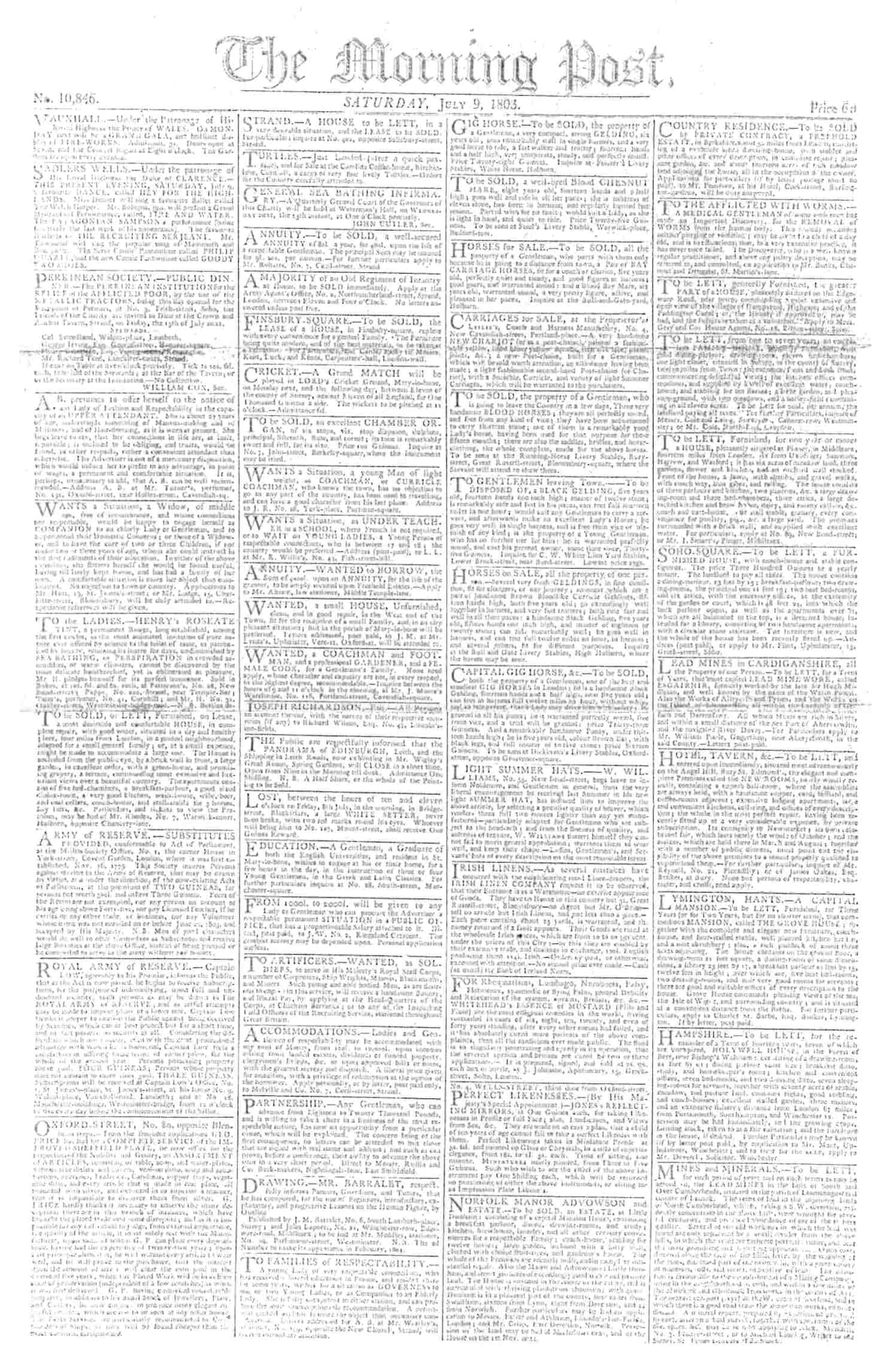
Reproduced by permission, Cambridge University Library
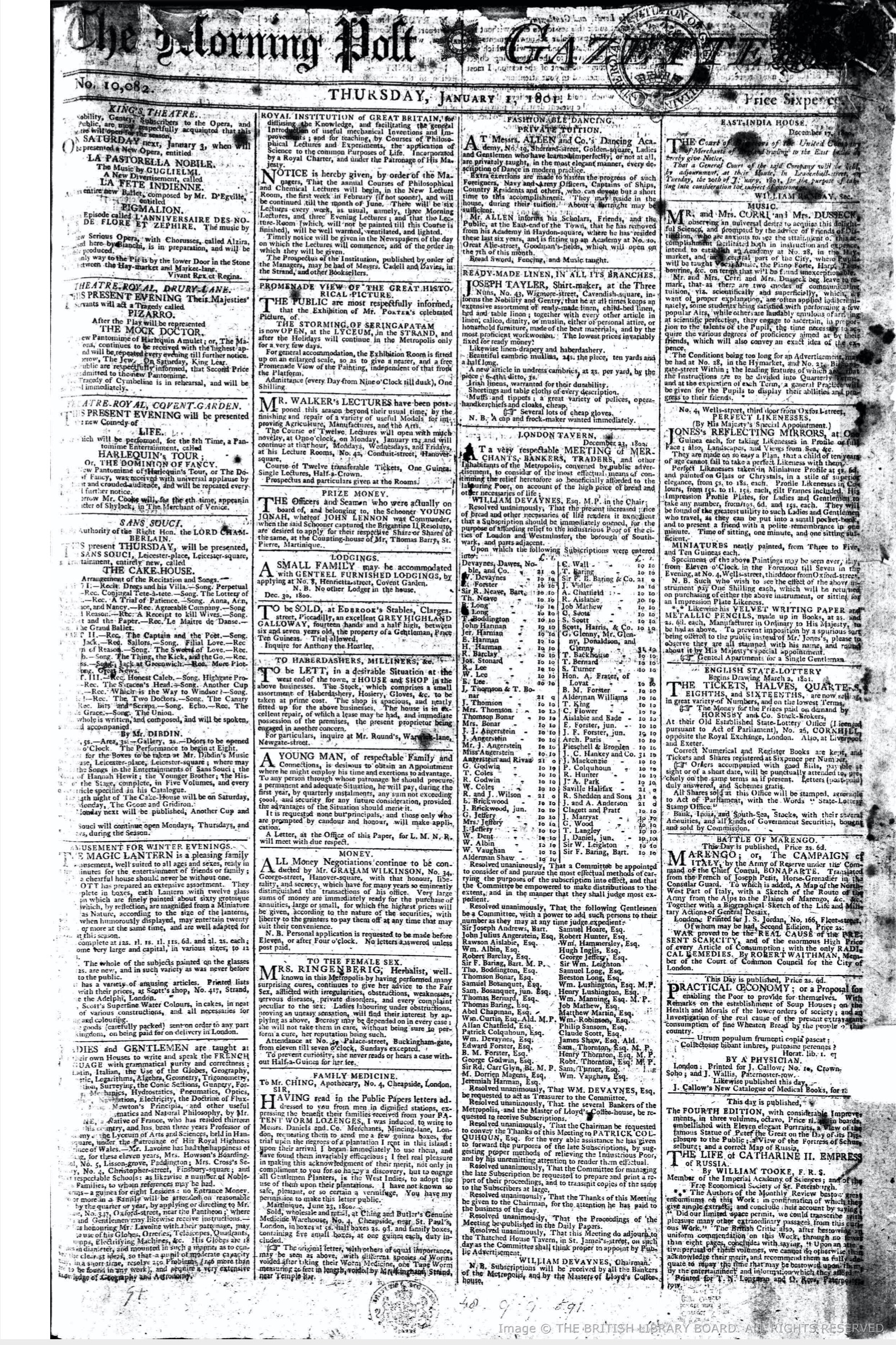
Courtesy of British Newspaper Archive