Detailed Record
Bell's Weekly Dispatch, The
vol 1 no 1, 1795 - 1801

Generic Titles:
Supplement to. (1852-1855)
then: Weekly Dispatch, The. no 1, 27 Sep 1801 - no 550, 1812
then: Bell's Weekly Dispatch. vol 3 no 551, 05 Apr 1812 - no 578, 11 Oct 1812 [1811 - 1814?]
then: Kent's Weekly Dispatch and Sporting Mercury. 09 Jan 1814; no 98, 05 Apr 1818 - no 192, 23 Jan 1820
then: Weekly Dispatch, The. 05 Jan 1823; vol 22 no 1203, 19 Sep 1824 - no 6608, 24 Jun 1928
then: Sunday Dispatch. no 6609, 01 Jul 1928 - 11 Jun 1961
then: Bell's Weekly Dispatch. vol 3 no 551, 05 Apr 1812 - no 578, 11 Oct 1812 [1811 - 1814?]
then: Kent's Weekly Dispatch and Sporting Mercury. 09 Jan 1814; no 98, 05 Apr 1818 - no 192, 23 Jan 1820
then: Weekly Dispatch, The. 05 Jan 1823; vol 22 no 1203, 19 Sep 1824 - no 6608, 24 Jun 1928
then: Sunday Dispatch. no 6609, 01 Jul 1928 - 11 Jun 1961
London,Middlesex
Editor:
Robert Bell (1796 - 1824)
Henry Richard Fox Bourne (1876 - 1887)
Ashton Wentworth Dilke (1875 - 1876)
John Jacob Löwenthal (chess editor)
Henry Richard Fox Bourne (1876 - 1887)
Ashton Wentworth Dilke (1875 - 1876)
John Jacob Löwenthal (chess editor)
Proprietor:
Associated Newspapers, Ltd
John Bell (1801)
Robert Bell (1801, 1812)
Ashton Wentworth Dilke (1875 -)
Alderman Harmer
James Harmer (1853)
Alfred Charles Harmsworth (Lord Northcliffe) 1896)
Frank Hill
George Kent (Aug 1814+)
George Newnes (Sir )
Lord. Harold Rothermere
Stiff
John Bell (1801)
Robert Bell (1801, 1812)
Ashton Wentworth Dilke (1875 -)
Alderman Harmer
James Harmer (1853)
Alfred Charles Harmsworth (Lord Northcliffe) 1896)
Frank Hill
George Kent (Aug 1814+)
George Newnes (Sir )
Lord. Harold Rothermere
Stiff
Publisher:
John Ashley (1846)
C. Barber (1802 - 1812)
Robert Bell (1813, 1824)
Timothy Bligh (1856)
Bryan (1818)
John Cassell (Cassell?)
David Deans (1812)
John P. Fuller (1876 - 1887)
R. Gray (1817 - 1819)
H. Hay (1820)
George Kent (1815 - 1818)
William Nicholson (1814)
C. Barber (1802 - 1812)
Robert Bell (1813, 1824)
Timothy Bligh (1856)
Bryan (1818)
John Cassell (Cassell?)
David Deans (1812)
John P. Fuller (1876 - 1887)
R. Gray (1817 - 1819)
H. Hay (1820)
George Kent (1815 - 1818)
William Nicholson (1814)
Printer:
C. Barker (1812)
Robert Bell (1824)
William Nicholson (? - 1814)
Robert Bell (1824)
William Nicholson (? - 1814)
Contributors:
William Cox Bennett
Eliza Cook (editor, "Facts and Scraps")
T.W.H. Crosland
Pierce Egan (1825)
Henry Fauntleroy
William Johnson Fox
George Gissing
Henry Hetherington
Francis Ludlow Holt
John Macdonald
John Stuart Mill
Nim North
Eliza Orme
Robert D. Osborn (Colonel)
George Parkins
J.W. Parkins
James Allanson Picton
Thomas Purnell
G.W.M. Reynolds
Robert Williams
Eliza Cook (editor, "Facts and Scraps")
T.W.H. Crosland
Pierce Egan (1825)
Henry Fauntleroy
William Johnson Fox
George Gissing
Henry Hetherington
Francis Ludlow Holt
John Macdonald
John Stuart Mill
Nim North
Eliza Orme
Robert D. Osborn (Colonel)
George Parkins
J.W. Parkins
James Allanson Picton
Thomas Purnell
G.W.M. Reynolds
Robert Williams
Size:
40cm, 8pp (1812); 54cm (1895?)
Price:
8d (1812); 3½d (1830); 8½d (1829-1836); 5d, 6d st (1840 - 1869); 2d (Jan 1869 -); 1d (Aug 1870, 1887, 1912); 8d/vol (1812), 8½d/vol (1824)
Circulation:
15,000 (1829); 30,000 (1830, 1836); 42,588/w (c.1838); 60,000 (1840); 66,000 (1842); 55,000/no (1843); 60,000 (1843); 61,000 (1843); 60,000 (subscribers 1847); 38,000 (1855); 34,059; 60,000 (1863); 140,000 (1870); 32,000 (1835); 55,000/w (1840s); 140,000 (c.1871)
Frequency:
weekly (Sat 1846, Sun 1912)
Illustration:
sketches
Departments:
advertisements, riddles, jokes, poems, anecdotes, local news, drama, Letters to Prominent People, editorials (c.1895); advertisements, "notices to correspondents", sports; sensationalist news (seductions, rapes, murders, etc.) (c.1795-1853), Facts and Scraps; history and politics, foreign news, naval and military intelligence, agriculture &c., the theatres, domestic occurrences, offences, London markets, advertisements, sports (boxing, racing, wrestling, pigeon-shooting, cocking, bull-baiting), crime (murders), interviews, history and politics, foreign & colonial affairs, police intelligence, the funds, weekly calendar, markets, m/b/d, sporting varieties (c.1801-1961)
Orientation:
anti-church; radical (1875); neutral (1912); anti-Poor Law, anti-Episcopal; middle-class radical; liberal independent
Merges:
incorporated with Sunday Express (1961?)
Sources:
Canney, Catalogue of Economic Literature.; Cooper, Dictionary of Contemporaries.; COPAC; Ellegard, Alvar. "The Readership of the Periodical Press in Mid-Victorian Britain". Goteborg: Goteborgs Universitets Arsskrift. 63:3 (1957). Reprinted VPN no 13 (Sep 1971): 3-22.; Grant, James. The Metropolitan Weekly and Provincial Press. Vol 3 of The History of the Newspaper Press. London: George Routledge and Sons, [1871].; Jack, Thomas C. "English Newspapers." Scottish Newspaper Directory and Guide to Advertisers. Edinburgh, 1855. 141-157.; James, Louis. Fiction for the Working Man 1830-1850. London: Oxford University Press, 1963.; Layton, Handy Newspaper List.; Law, Graham. "Serialising Fiction in the Newspaper Press." Encounters in the Victorian Press: Editors, Authors, Readers. Laurel Brake and Julie F. Codell. New York: Palgrave Macmillan, 2005. p.42.; Linton, Boston, Newspaper Press in Britain, p.325.; London: Routledge & Kegan Paul, 1986.; Mill, John Stuart. Collected Works of John Stuart Mill. Vols 22-25, Newspaper Writings. Eds. Ann P. Robson et al. Toronto: U Toronto P; Mitchell's Newspaper Press Directory 1846.; Sper, Felix. Periodical Press of London, Theatrical & Literary. Boston: F.W. Faxon Co., 1937.; Uffelman, 1992.; Young, G.M. ed. Early Victorian England. 1934.; Griffiths,; May, Frederick L. Press Guide. London: May, 1876. p.15; Sell’s Dictionary p.163, ad p.1159
Histories:
Altick, English Common Reader.; Altick, English Common Reader.; Aspinall, A. “Statistical Accounts”. pp. 222-234, 372-382.; Barker, Hannah. Newspapers, Politics, and English Society, 1695-1855. Harlow: Longman, 2000; Bourne, H. R. Fox. English Newspapers. vol 1. New York: Russell & Russell, 1966.; Brown, News and Newspapers.; Cole, Postgate, British People 1746-1946.; Cranfield, G.A. The Press and Society: From Caxton to Northcliffe. London and New York: Longman, 1978.; Dudek, Louis. Literature and the Press: a History of Printing, Printed Media and Their Relation to Literature Toronto: The Ryerson Press, 1960.; Easley, "Researching Victorian Women Journalists in the Digital Age".; Engels, Frederick. The Condition of the Working Class in English.; Graham, British Literary Periodicals, p.229.; Grant, James. The Newspaper Press: Its Origin - Progress - and Present Position. London: Tinsley Brothers, 1871.; Harrison, Brian. Drink and The Victorians: the Temperance Question in England 1815-1872. London: Faber and Faber, [1971].; Harrison, Poor Men’s Guardians.; Herd, March of Journalism.; Hobson, Harold. "The Obscure Years 1822 - 1915". The Pearl of Days: an intimate memoir of the Sunday Times 1822 - 1972. Leonard Russell. London: Hamish Hamilton Ltd., 1972.; James, Fiction for the Working Man.; Jones, Aled. Powers of the Press: Newspapers, Power and the Public in Nineteenth-Century England. England: Scolar Press, 1996.; Jones, Aled. Powers of the Press: Newspapers, Power and the Public in Nineteenth-Century England. England: Scolar Press, 1996.; Koss, Rise and Fall of the Political Press.; Lake, Guide for Collectors.; Landon, Richard G. ed. Book Selling and Book Buying: Aspects of the Nineteenth Century British and American Book Trades. Chicago: American Library Association, 1978.; Law, "Distribution" p.60.; Mussell, Capacious Double Sheets, p.13.; Rosenverg, E. "Wopsle's consecration." DSN 8 (1977): 6-11.; Schoyen, George Julian Harney.; Shattock, Joanne and Michael Wolff. eds. The Victorian Periodical Press: Soundings and Samplings. Toronto: University of Toronto Press, 1982.; Thomas, Donald. A Long Time Burning: the History of Literary Censorship in England. London: Routledge & Kegan Paul, [1969].; Timperley, C. H. Encyclopaedia of Literary and Typographical Anecdote. New York: Garland Publishing Company, 1977.; Whitehead, A. " Against the tyranny of kings and princes: radicalism in workers in the dawn." GN 22 (1986): 13-28.
Comments:
"In the course of time the bulk of the property of the Dispatch came into the hands of the late Mr. Alderman Harmer, and he lost no time in greatly enlarging its size, and adding new and attractive features to it" (Grant, James; p.41).
"The circulation of the Dispatch rose with rapidity which probably had no previous paralleled in the history of the Weekly Newspaper Press. It especially addressed itself to the masses, by whom its bold and systematic denunciation of the aristocracy and the higher classes generally, rendered it immensely popular. The habitual Atheism, and blasphemy too, which appeared in its columns, particularly under the signature of "Publicola," also tended much ... to increase its circulation. The Dispatch was then the only journal, weekly or daily, which openly advocated Atheism" (Grant, James; p.42). "The circulation of this journal had greatly diminished during the last twelve or fourteen years, owing chiefly to the opposition of the Penny Weekly Papers" (Grant, James; p.43). "For many years the Dispatch was the best-paying weekly newspaper in London, and perhaps in the world" (Grant, James; pp.45).
Bell's Weekly Dispatch, whose respectable appearance belied the content of crime reports, was at this time the most popular paper among the working classes. It inspired The Penny Weekly Dispatch (1840), Clarke's Weekly Dispatch (1841-1842) and Bell's Penny Dispatch, Sporting and Police Gazette and Newspaper of Romance (1841) (James, p.35). Other publishers that were quick to follow Edward Lloyd in providing cheap imitations of established London papers (James, Louis; p.35).
Founded c.1795 (Altick). "Bell's Weekly Dispatch, an increasingly radical weekly newspaper, at first 'catered chiefly for the lovers of the highly spiced news reports of price fights and such matters.' Its weekly circulation of 30,000 copies in 1836 was already double that of The Times daily circulation…it was then the leading weekly newspaper in London…The Weekly Dispatch, just referred to, printed powerful leading articles signed 'Publicola' which were feared and condemned by conservative Victorians" (Dudek).
"For some time after its commencement in 1801, and styled Bell's Weekly Dispatch until it passed out of its founder's hands, The Dispatch had no very pronounced politics, and catered chiefly for the lovers of highly-spiced news, reports of prize-fights and such matters" (Bourne, p.101).
"Addresses itself chiefly to the operatives and artizans, to whose feelings and comprehensions its strong, rough, unceremonious mode of dealing with principles and potentates, and 'powers that be,' seems peculiarly appropriate. In the lighter, as in the more political portions of its contents, the same tone and tendency are evinced, the books selected for extract being such as will afford quotations striking and amusing; if with a dash of the dreadful, all the better. From the copiousness of its contents, and the full 'resume' of the past week's news, it is very acceptable to country readers, and to such as have not opportunities of seeing daily papers" (Mitchell's, 1846).
Some years after its beginning in 1801, the Weekly Dispatch changed its name to Bell's Weekly Dispatch at a time when it was " 'printed, published and edited by Robert Bell' " in order to benefit from the popularity of the Bell name, since John Bell at the time was quite popular (however, no relation of Robert Bell's) (Herd, Harold; p.83).
"Bell's Weekly Dispatch, whose respectable appearance belied the content of crime reports, was at this time the most popular among the working classes. (James, Louis; p.35).
"Giving the news of the whole week, the paper originally appealed to the lower and lower middle classes; with its high price it must have lost a large part of its poorer public, readers in the 'sixties being mainly middle class of fair educational standard, politically Liberal" (Ellegard, p.7).
In the Weekly Dispatch ". . .sensationalist accounts of the wicked doings of court and nobility and wealthy ran side by side with attacks on the post-1832 government" (Harrison, p.99).
"The Sunday Weekly Dispatch was a very different proposition, with pronounce Radical sympathies, and a very large circulation...The Weekly Dispatch had its own correspondents overseas and claimed a circulation of 60,000 as early as 1843, but it tended to emphasise 'police news'; according to The Illustrated London News , 'it is essentially the organ of the crime districts of England, and its circulation will always be proportional to the existing amount of depravity in the land. It keeps its venom well set in the teeth of society' " (Cranfield, G.A. The Press and Society).
It emphasized police news, and had an anti-church bias. It "attacked religion in every form and sought to bring all the institutions of society, as at present existing, into contempt" (Jones, Aled. Powers of the Press, p.1).
Due to the overwhelming success of the Weekly Dispatch, O'Connor, of the Northern Star, wrote and said "You unmitigated ass! You sainted fool! You canonized ape! You nincompoop!" (Cole, G.D.H. and Raymond Postgate, p.263). Bennett contributed "leaders, essays, reviews, and fine arts criticism" from 1868-1870 (Cooper, Thompson; p.87). At one point, Crosland regularly contributed sonnets to the Weekly Dispatch (Herd, Harold; p.295).
"The Satirist or the Censor of the Times [q.v], and Later the Weekly Despatch, were prosecuted and convicted for imputing homosexuality to the Duke of Brunswick" (Thomas, Donald; p.222).
"For prohibitionists did not share Robert Lowe's belief that `drunkenness, and facility for being intimidated' increased with every descent in the social scale: when the Weekly Dispatch tried to identify the Alliance with Lowe's unpopular views, the Alliance News insisted that ‘in proportion to their number, the unworking classes are, at least, as guilty in this matter as the working.' The popular weeklies disagreed amongst themselves, and their criticisms reflected the traditional radical loathing for ‘class legislation’; both the Weekly Dispatch and Reynolds' Newspaper urged protests in Hyde Park (as in 1855) against Gruce's Bill" (Harrison).
In 1876, May characterizes this as "a family newspaper supported largely by the industrial classes." The paper was "Dated Sunday [with] editions on Thursday, Friday and Saturday" (15).
This was one of several weekly, liberal newspapers that superseded the Tory publications of the day. These papers were said to "have opened a new epoch in journalism" (Graham 229).
"The circulation of the Dispatch rose with rapidity which probably had no previous paralleled in the history of the Weekly Newspaper Press. It especially addressed itself to the masses, by whom its bold and systematic denunciation of the aristocracy and the higher classes generally, rendered it immensely popular. The habitual Atheism, and blasphemy too, which appeared in its columns, particularly under the signature of "Publicola," also tended much ... to increase its circulation. The Dispatch was then the only journal, weekly or daily, which openly advocated Atheism" (Grant, James; p.42). "The circulation of this journal had greatly diminished during the last twelve or fourteen years, owing chiefly to the opposition of the Penny Weekly Papers" (Grant, James; p.43). "For many years the Dispatch was the best-paying weekly newspaper in London, and perhaps in the world" (Grant, James; pp.45).
Bell's Weekly Dispatch, whose respectable appearance belied the content of crime reports, was at this time the most popular paper among the working classes. It inspired The Penny Weekly Dispatch (1840), Clarke's Weekly Dispatch (1841-1842) and Bell's Penny Dispatch, Sporting and Police Gazette and Newspaper of Romance (1841) (James, p.35). Other publishers that were quick to follow Edward Lloyd in providing cheap imitations of established London papers (James, Louis; p.35).
Founded c.1795 (Altick). "Bell's Weekly Dispatch, an increasingly radical weekly newspaper, at first 'catered chiefly for the lovers of the highly spiced news reports of price fights and such matters.' Its weekly circulation of 30,000 copies in 1836 was already double that of The Times daily circulation…it was then the leading weekly newspaper in London…The Weekly Dispatch, just referred to, printed powerful leading articles signed 'Publicola' which were feared and condemned by conservative Victorians" (Dudek).
"For some time after its commencement in 1801, and styled Bell's Weekly Dispatch until it passed out of its founder's hands, The Dispatch had no very pronounced politics, and catered chiefly for the lovers of highly-spiced news, reports of prize-fights and such matters" (Bourne, p.101).
"Addresses itself chiefly to the operatives and artizans, to whose feelings and comprehensions its strong, rough, unceremonious mode of dealing with principles and potentates, and 'powers that be,' seems peculiarly appropriate. In the lighter, as in the more political portions of its contents, the same tone and tendency are evinced, the books selected for extract being such as will afford quotations striking and amusing; if with a dash of the dreadful, all the better. From the copiousness of its contents, and the full 'resume' of the past week's news, it is very acceptable to country readers, and to such as have not opportunities of seeing daily papers" (Mitchell's, 1846).
Some years after its beginning in 1801, the Weekly Dispatch changed its name to Bell's Weekly Dispatch at a time when it was " 'printed, published and edited by Robert Bell' " in order to benefit from the popularity of the Bell name, since John Bell at the time was quite popular (however, no relation of Robert Bell's) (Herd, Harold; p.83).
"Bell's Weekly Dispatch, whose respectable appearance belied the content of crime reports, was at this time the most popular among the working classes. (James, Louis; p.35).
"Giving the news of the whole week, the paper originally appealed to the lower and lower middle classes; with its high price it must have lost a large part of its poorer public, readers in the 'sixties being mainly middle class of fair educational standard, politically Liberal" (Ellegard, p.7).
In the Weekly Dispatch ". . .sensationalist accounts of the wicked doings of court and nobility and wealthy ran side by side with attacks on the post-1832 government" (Harrison, p.99).
"The Sunday Weekly Dispatch was a very different proposition, with pronounce Radical sympathies, and a very large circulation...The Weekly Dispatch had its own correspondents overseas and claimed a circulation of 60,000 as early as 1843, but it tended to emphasise 'police news'; according to The Illustrated London News , 'it is essentially the organ of the crime districts of England, and its circulation will always be proportional to the existing amount of depravity in the land. It keeps its venom well set in the teeth of society' " (Cranfield, G.A. The Press and Society).
It emphasized police news, and had an anti-church bias. It "attacked religion in every form and sought to bring all the institutions of society, as at present existing, into contempt" (Jones, Aled. Powers of the Press, p.1).
Due to the overwhelming success of the Weekly Dispatch, O'Connor, of the Northern Star, wrote and said "You unmitigated ass! You sainted fool! You canonized ape! You nincompoop!" (Cole, G.D.H. and Raymond Postgate, p.263). Bennett contributed "leaders, essays, reviews, and fine arts criticism" from 1868-1870 (Cooper, Thompson; p.87). At one point, Crosland regularly contributed sonnets to the Weekly Dispatch (Herd, Harold; p.295).
"The Satirist or the Censor of the Times [q.v], and Later the Weekly Despatch, were prosecuted and convicted for imputing homosexuality to the Duke of Brunswick" (Thomas, Donald; p.222).
"For prohibitionists did not share Robert Lowe's belief that `drunkenness, and facility for being intimidated' increased with every descent in the social scale: when the Weekly Dispatch tried to identify the Alliance with Lowe's unpopular views, the Alliance News insisted that ‘in proportion to their number, the unworking classes are, at least, as guilty in this matter as the working.' The popular weeklies disagreed amongst themselves, and their criticisms reflected the traditional radical loathing for ‘class legislation’; both the Weekly Dispatch and Reynolds' Newspaper urged protests in Hyde Park (as in 1855) against Gruce's Bill" (Harrison).
In 1876, May characterizes this as "a family newspaper supported largely by the industrial classes." The paper was "Dated Sunday [with] editions on Thursday, Friday and Saturday" (15).
This was one of several weekly, liberal newspapers that superseded the Tory publications of the day. These papers were said to "have opened a new epoch in journalism" (Graham 229).
Location:
complete runs: LO/N38 A; partial runs: CA/U-1 A (1914-1961), LO/U-1 G (Goldsmith Collection) 22:1203, 1205, 1209, 1212, 1214 & 23:1276, 1277, LO/N-1 A, XY/N-1 (19 Sep 1852-May 1855 supp.), OX/U-1 A; N.America: see Fulton
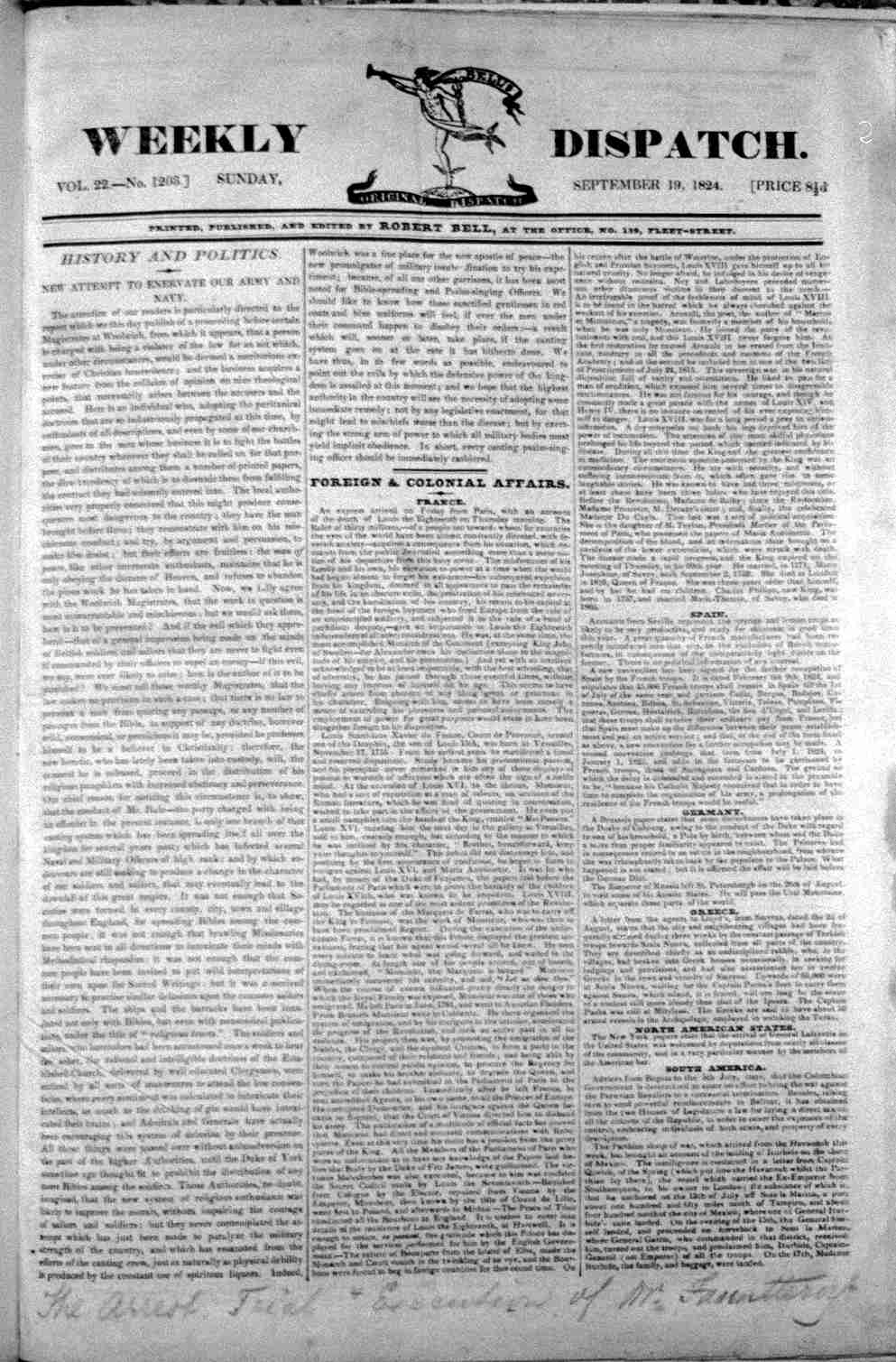
Reproduced by permission, London University Library

Reproduced by permission, the British Newspaper Library
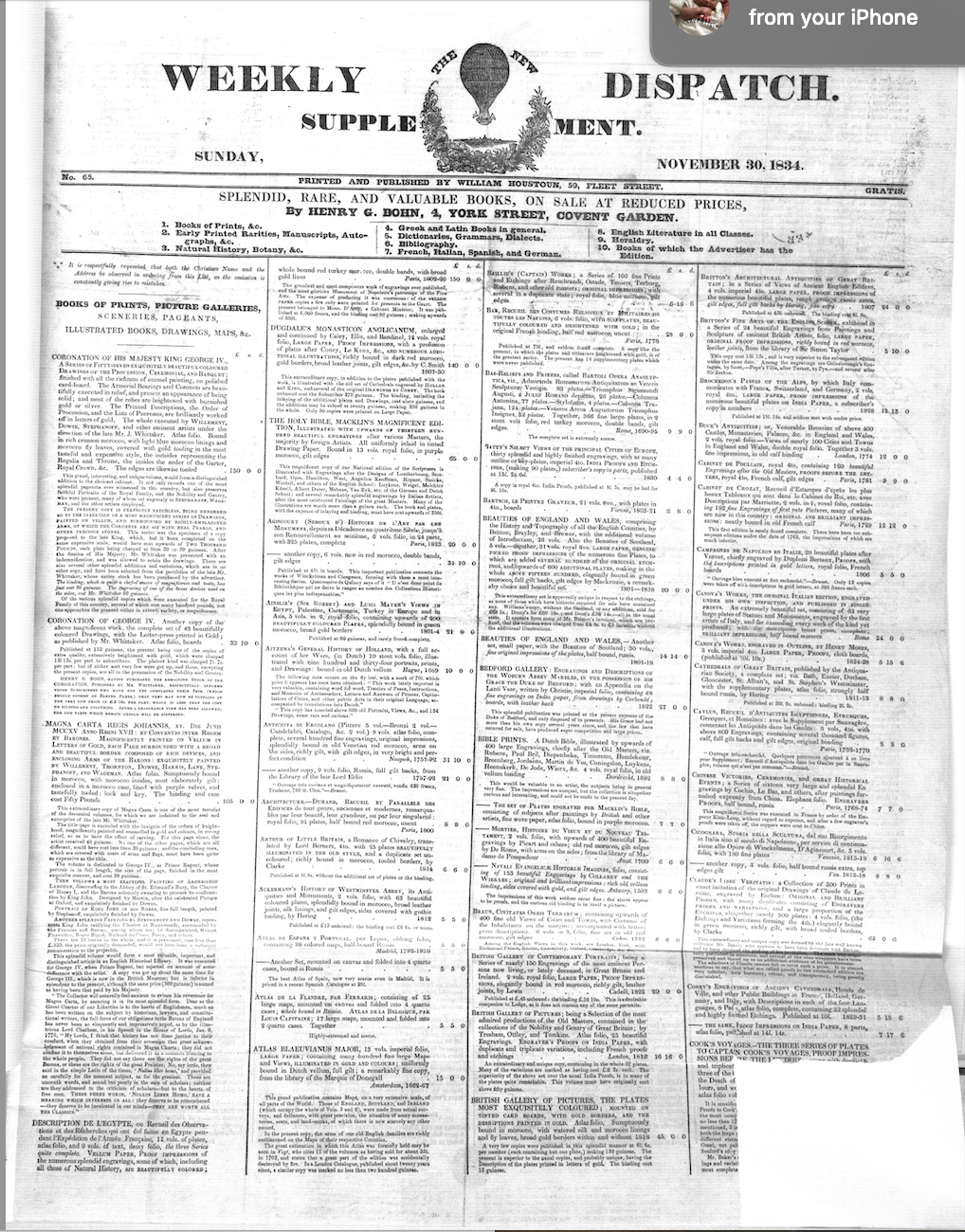
Reproduced by permission, the British Newspaper Library