Detailed Record
Lloyd's Illustrated London Newspaper
vol 1 no 1, 27 Nov 1842 - no 7, 08 Jan 1843

then: Lloyd's Weekly London Newspaper. no 8, 15 Jan 1843 - no 301, 27 Aug 1848
then: Lloyd's Weekly Newspaper. no 321, 14 Jan 1849 - no 3131, 23 Nov 1902
then: Lloyd's Weekly News. no 3132, 30 Nov 1902 - no 3940, 26 May 1918
then: Lloyd's Sunday News. no 3941, 02 Jun 1918 - no 4218, 30 Sep 1923
then: Sunday News, The. no 4219, 07 Oct 1923 - no 4552, 09 Mar 1930
then: Sunday News. no 4553, 16 Mar 1930 - no 4626, 09 Aug 1931//
then: Lloyd's Weekly Newspaper. no 321, 14 Jan 1849 - no 3131, 23 Nov 1902
then: Lloyd's Weekly News. no 3132, 30 Nov 1902 - no 3940, 26 May 1918
then: Lloyd's Sunday News. no 3941, 02 Jun 1918 - no 4218, 30 Sep 1923
then: Sunday News, The. no 4219, 07 Oct 1923 - no 4552, 09 Mar 1930
then: Sunday News. no 4553, 16 Mar 1930 - no 4626, 09 Aug 1931//
London,Middlesex
Editor:
William Carpenter
Thomas Catling (sub-editor 1857; 1884+)
Douglas Jerrold (Apr 1852 - 1857)
William Blanchard Jerrold (son of Douglas Jerrold 1857 -)
Ball Reynolds
Edgar Wallace (1931)
Thomas Catling (sub-editor 1857; 1884+)
Douglas Jerrold (Apr 1852 - 1857)
William Blanchard Jerrold (son of Douglas Jerrold 1857 -)
Ball Reynolds
Edgar Wallace (1931)
Proprietor:
Edward Lloyd (1842 - 1890?)
Publisher:
Edward Lloyd (1842, 1846, 1848 - 1849)
Sunday News Ltd (1931)
United Newspapers (1918, 1923, 1930)
Sunday News Ltd (1931)
United Newspapers (1918, 1923, 1930)
Printer:
Daily News Ltd (1931)
Hoe and Co (1855)
Edward Lloyd (1842, 1848 - 1849)
United Newspapers (1918, 1923, 1930)
Hoe and Co (1855)
Edward Lloyd (1842, 1848 - 1849)
United Newspapers (1918, 1923, 1930)
Contributors:
G.W. Appleton (1902)
C.H. Bullivant (1918)
Thomas Burke (1930)
J.W. Carter (Rev.)
Maude Crossley (1923)
James Hope Daly (1923)
Hepworth Dixon (1852)
William Early (1902)
Trevor Ellis (ill. 1923)
T.H.S. Escott
Leonora Eyles (1923)
George Gissing
A.P. Hatton (1923)
Geraldine Endsor Jewsbury
Henry T. Johnson
Charles King (1923)
John Leeming (1923)
Jonas Levy (barrister)
J. Norman Lynd (1930)
Ethil Mannin (1930)
Horace Mayhew
B. Ogey (Col.) 1923)
Roger Pocock (1902)
Clement K. Shorter (1902)
Edgar Wallis (1931)
Andrew Wilson (Dr.) 1902)
C.H. Bullivant (1918)
Thomas Burke (1930)
J.W. Carter (Rev.)
Maude Crossley (1923)
James Hope Daly (1923)
Hepworth Dixon (1852)
William Early (1902)
Trevor Ellis (ill. 1923)
T.H.S. Escott
Leonora Eyles (1923)
George Gissing
A.P. Hatton (1923)
Geraldine Endsor Jewsbury
Henry T. Johnson
Charles King (1923)
John Leeming (1923)
Jonas Levy (barrister)
J. Norman Lynd (1930)
Ethil Mannin (1930)
Horace Mayhew
B. Ogey (Col.) 1923)
Roger Pocock (1902)
Clement K. Shorter (1902)
Edgar Wallis (1931)
Andrew Wilson (Dr.) 1902)
Size:
42cm, 8pp (1842); 12pp (Sep 1843); 51cm (1849); 49cm, 24pp (1902); 55cm, 8-10pp (1918); 16-18pp (1923); 44cm, 40pp + 8pp sports supp (1930)
Price:
2d (1842); 2½d (1843); 3d (Sep 1843 - 1855); 2d, 3d st (1855 - 1861); 1d (Sep 1861, 1902); 6d (1912); 3½d (1918); 2d (1923+)
Circulation:
30,000 (1842); 21,000/no (1843); 25,000; 32,000 (1843); 500 000(1843); 100,000 (Nov 1852); 90,000 (1853); 107,000 (1855); 170,000 (Sep 1861); 340,000 (1863); 500,000 (1865); 612,000 (1881); 750,000 (1886); 900,000 (1880s); 600,000 (May 18th 1890); 1,000,000-1,250,000 (1896 - 1902); 8,000,000/w (1955)
Frequency:
weekly (Sun am)
Illustration:
engravings, woodcuts (1842); sketches; phtographs (1918+)
Indexing:
T of C/no (1902)
Departments:
law/foreign intelligence, American news, central criminal court, public amusements, advertisements, public opinion, police, coroner's inquests, general news at one view, the drama, markets (1842); the army, the royal navy, sporting, theatricals, public amusements, calendar for the week, Saturday’s police, poetry, assize intelligence, the funds, the gazettes, Lloyd's list, markets (1843); foreign telegrams, yesterday's law and police/London summary, last night's provincial news, stock markets, the United Kingdom, yesterday's inquests, the king and court, society divorce, imperial parliament, theatres, music halls, music, fashions and recipes, home pets, the poultry yard, household hints, the garden, literature, calendar of the week, to correspondents, public amusements, jokes of the day, long-lost relatives, advertisements, fires, markets, army, navy, railway, legal, trade/furnishing advertisements, situations vacant, houses and businesses for sale, racing/cycling/sporting and angling notes, yesterday's football and athletics (1902); crime reports, murder and execution coverage, interviews, war, prisoners of war, Boer War, Balkan War
Orientation:
liberal; radical; democratic, anti-Poor Law (1846); working class
Merges:
merged with The Sunday Graphic (1931)
Sources:
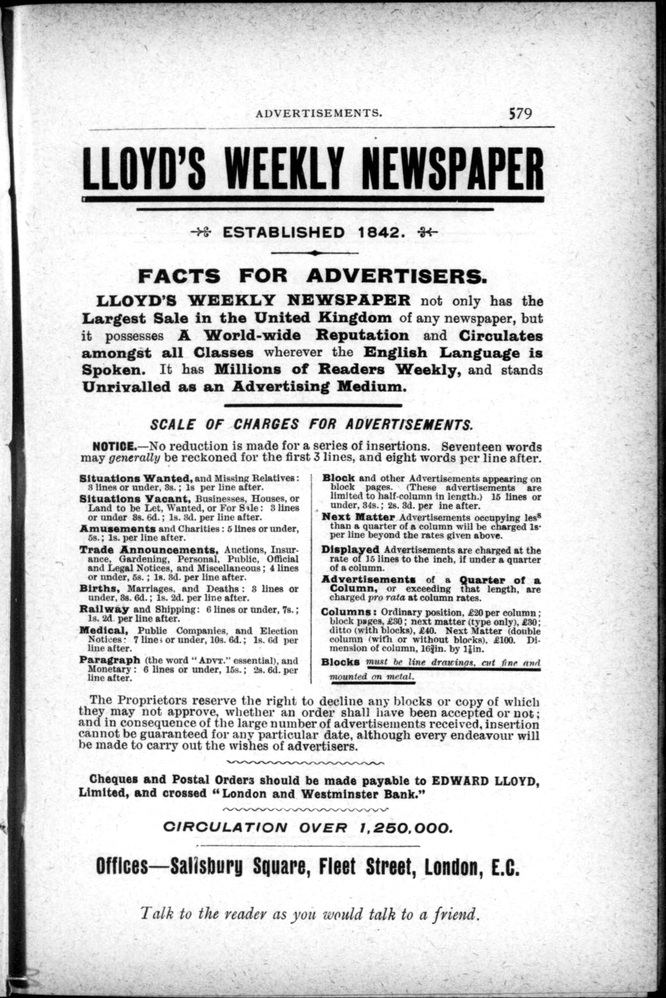
BLC Consolidated List, p.42.; COPAC; Grant, James. The Metropolitan Weekly and Provincial Press. Vol 3 of The History of the Newspaper Press. London: George Routledge and Sons, [1871].; Ellegard, Alvar. The Readership of the Periodical Press in Mid-Victorian Britain. Goteborg: Goteborgs Universitets Arsskrift, 63:3 (1957).; James, Louis. Fiction for the Working Man, 1830-1850. London: Oxford University Press, 1963.; Mitchell's Newspaper Press Directory, 1846, 1851, 1864.; Mitchell, Sally. The Fallen Angel. Chastity, Class and Women's Reading 1835-1880. Bowling Green, Ohio: Bowling Green University Popular Press, 1981.; Reprinted VPN. no 13 (Sep 1971): 3-22.; Larson, Shirley,, p.93.; Sutherland Longman Companion to Victorian Fiction.; Uffelman, 1992.; Jack, Scottish Newspaper Directory.; Sutherland Longman Companion to Victorian Fiction.; Williams, Judith Blow. A Guide to the Printed Materials for English Social and Economic History 1750-1850. vol 1. New York: Octagon Books Inc., 1966.; Cooper, Dictionary of Contemporaries.; Fulton, Richard. "The Sudan Sensation of 1898." VPR vol 42, 2009, p.37-63.; McWilliam, Rohan. The Tichborne Claimant. Hambledon Continuum, 2007, p.1-278; Successful Advertising, 1902. p.579
Histories:
Altick, English Common Reader.; Berridge, Virginia S. "Popular Journalism and Working-Class Attitudes, 1854-1886: A Study of Reynolds's Newspaper, Lloyd's Weekly Newspaper and The Weekly Times." University of London Ph.D. thesis, 1976.; Bourne, H.R. Fox, vol 2 (1887): 121-24, 227, 253-54, 347-48.; Bourne, H.R. Fox. English Newspapers. vol 2. New York: Russell & Russell, 1966.; Boyce, George, et al, eds. Newspaper History from the Seventeenth Century to the Present Day. Beverly Hills, CA: Sage Publications, 1978.; Brown, Lucy. Victorian News and Newspapers. Oxford: Clarendon Press, 1985; Coustillas, P. " The missing short stories." GN 12 no 4 (1977): 21-22.; Cranfield, G.A. The Press and Society: From Caxton to Northcliffe London and New York: Longman, 1978.; Curtis, Lewis Perry, Jr. Jack the Ripper in the London Press. New York: Yale UP, 2001.; Drotner, Children and Their Magazines.; Elwin, Victorian Wallflowers.; Engel, Tickle the Public.; Grant, Alfred. The American Civil War and the British Press. London: McFarland & Company, Inc. p.139.; Harris, Michael and Lee, Alan, Eds. The Press in English Society. London: Associated University Presses, 1986.; Harrison, Stanley. Poor Men's Guardians: A Record of the Struggles for a Democratic Newspaper Press, 1763-1973. London: Lawrence and Wishart, 1974.; Herd, March of Journalism.; Hoggart, P.R. "Edward Lloyd, 'the father of the cheap press'." Dickensian 80 (1984): 33-38.; Hughes, Linda K. and Michael Lund. The Victorian Serial. London: University Press of Virginia, 1991: 296.; James, Fiction for the Working Man.; Jones, Kennedy. Fleet Street & Downing Street. London: Hutchinson And Co.,1920.; Knelman, The Murderess and the English Press.; Koss, Stephen. The Rise and Fall of the Political Press in Britain. London: Hamish Hamilton Ltd, 1981.; Leckie, Barbara. Culture and Adultery: the novel, the newspaper, and the law, 1857-1914. Philadelphia: University of Pennsylvania Press, 1999.; Lee, Origins of Popular Press.; Mitchell, Sally. The Fallen Angel: Chastity, Class and Women’s Reading, 1835–1880. Bowling Green, Ohio: Bowling Green University Popular Press, 1981.; Mussell, "Stead and the Tabloid Campaign".; Nicholson, "Remixing the Nineteenth Century Archive".; Nevett, Terence. "Advertising." Victorian Periodicals and Victorian Society. Eds. J. Don Vann and Rosemary T. VannArsdel. Toronto: U Toronto P, 1994. 219-234.; Rose, Jonathan. "Workers' Journals." Victorian Periodicals and Victorian Society. Eds. J. Don Vann and Rosemary T. VanArsdel. Toronto: U of Toronto P, 1995: 301-310.; Stewart, W. A. C. Progressives and Radicals in English Education 1750-1970. London: Macmillan, 1972.; Totowa, N.J.: Rowman and Littlefield, c.1976.; Williams, Read All About It, p.99.; Williams, Francis. Dangerous Estate: The Anatomy of Newspapers. London: Longmans, Green and Co, 1957.; VPR 11:4, p.138; 18:1, p.9; 20:4, p.144.; Wilkinson, Images of War in Edwardian Newspapers.
Comments:
"[T]he price was nominally twopence, but so far as the proprietor was concerned it was only a penny, because there then existed a penny stamp on every newspaper. At first its title was Lloyd's Illustrated London News, and the first seven numbers, in accordance with this title, contained illustrations. The size of the paper was then about the same as the Echo, and the number of pages was eight, each page containing three columns...In the seventh number an announcement was made that on the following week the paper would be greatly enlarged, which it was. Including the additional quantity of small type which was used, and taking into consideration the great increase in the size of the sheet, the amount of additional matter given to its readers must have been little short of double what it was before. One halfpenny extra was charged for the journal in consequence of this additional amount of matter, and greatly improved quality of the paper. Practically, therefore, though the proprietor received three-halfpence for his journal-the other penny going to the Government as stamp duty-the paper was cheaper than when the price was only a penny. The general impression...[is] that Mr. Douglas Jerrold commenced his editorship...with the first number. He only commenced it with the eighth number, that being its first number in its enlarged form. An announcement to the effect the Mr. Jerrold was to be the future editor was made in the seventh number in these words:-'The editorial department will be confided to a gentleman whose pen, we doubt not, will be speedily recognized and cordially welcomed by his old friends, the masses.' Under Douglas Jerrold's editorial auspices, Lloyd's London Weekly Newspaper rose with great rapidity into circulation. Apart from the pint and pungency of his own writings, the condensation and variety of the intelligence of the day were excellent; while the reviews of books were at once able and elaborate...considering that the paper was chiefly to be devoted to the discussion of the leading question of the day, and to news at home and from abroad. One of its principal features was that of 'Answers to Correspondents,' on the same plan as had been acted on in the Weekly Dispatch for many years. These 'Notices,' ...were not such as were then common in newspapers, -- that is, stating whether particular communications sent for publication would be inserted or not. They chiefly consisted of answers to questions which were sent by correspondents, relating to every conceivable variety of subjects. Another attractive feature of Lloyd's Weekly Newspaper in its earlier days, was the space devoted to interesting and instructive extracts from literary and moral works. These paragraphs appeared under the heading, 'Pearls for Stringing' and certainly as regards the majority of their number they were worthy of the name of 'Pearls.' At first there was no small amount of prejudice in some classes of the community against the new paper, because Mr. Lloyd, the proprietor, had previously published some non-political journals which ministered to the prevalent prurient taste among the lower classes for a literature, if literature it might be called, which was essentially of the Jack Sheppard Newgate kind; but it was soon seen that Lloyd's Weekly Newspaper was not of a character to the vitiated tastes of the readers of the journals I allude to,-journals which, it is right to state, were soon after this discontinued by Mr. Lloyd. The space devoted to the 'Pearls for Stringing,'…together with the reverential reviews of religious books, did much to remove the prejudice… After the lapse of several years the original heading of the column devoted to paragraphs of this nature was changed into that of 'Our Scrap Book Column.’ ...with this altered opinion and this largely increased circulation of the paper, there came a great increase in the number if its advertisements. Under the auspices of [Blanchard Jerrold]...Lloyd's London Weekly Newspaper has continued its career of prosperity till the present time. It was several years ago enlarged to the extent of twelve pages, nearly the size of the Globe, and much more closely printed. On the abolition of the newspaper stamp duty, its price was reduced to a penny. It was, it is right to add, the first newspaper, weekly or daily, which was really sold at a penny. A novelty newspaper history made its appearance in Lloyd's Weekly Newspaper a few years ago. It had reference to what may be deemed the best means of getting access to the minds of the masses with a view to their conversion. It occurred to the Rev. J.W. Carter, Vicar of Christ church, Stratford, that if brief but searching and solemn appeals to the consciences of the unconverted, could be got into newspapers read by the masses, the spiritual good which would thereby be done might be incalculably great. As therefore Lloyd's Newspaper confessedly had then as the largest circulation of any newspaper in the world -- its circulation being above 500,000 -- he offered to the proprietor of that journal to pay for his addresses as advertisements. The only stipulation which Mr. Carter made was that his appeals to the unsaved should always appear in the same part of the paper. This was readily agreed to on the part of Mr. Lloyd, and Mr. Carter's addresses have accordingly appeared from time to time for some years past in the journal in question… The politics of Lloyd's Weekly Newspaper are thoroughly Liberal, but not so extreme in that directions as those of some others of its weekly contemporaries…. Mr. Lloyd was the first proprietor of a weekly paper to introduce into his establishment the rotary printing-machines of Hoe. By means of each of these -- they are three in number -- he is enabled to throw off his immense impression at the rate of 15,000 copies per hour, or at the rate of 45,000 copies by the three machines together per hour. The largest of them prints, when pressed for time, no less than 20,000 perfect copies -- that is, on both sides - in an hour. The largest impression of the paper ever printed and issued from Lloyd's premises, was 573,000 copies" (Grant 88-96).
Motto: "Measures not Men" (1843).
"We shall not consider our letter-press as a mere sloppy, trashy vehicle for the introduction of our illustrations, but by, we hope, a judicious distribution of literary labour, we shall make [this paper]...equally esteemed for the artistical skill...as for the literary talent that will adorn its pages... With regard to politics...we have but one creed... the happiness and welfare of our country...We present 'The Two-penny Illustrated Newspaper', a legalised vehicle of information" (Address no 1, p.1).
"This paper appeals to the million on the two great principles of quantity and cheapness. Its price is lower than that of most weekly papers...it seeks to squeeze in as liberal an allowance as possible for the threepence charged. It is peculiarly the poor man's paper, and endeavours of course to embrace as many articles of intelligence, and as much under each head...giving prominence to police reports, and similar matters of popular interest. At the same time its contents are far more creditable, and comprise far more of a light and literary character, than might be conceived...immense mass of matter for the money; with a little of everything, and a good deal of many things; so that even if its readers saw no other paper, they would not be behind the rest of the world" (Mitchell's, 1846).
Lloyd's was the "first newspaper to reach a million sales" (Williams, Read All About It 99). It did so in 1896, breaking through what Jackson calls the "mythical barrier of one million readers" (60).
"Lloyd's Weekly Newspaper contains more news than all the weekly papers combined. It includes all the news of the week, comprising parliamentary debates, law intelligence, police reports, sporting intelligence of all kinds, trials at the Old Bailey and assizes, foreign news, movements of the army and navy, literature, theatricals, and the fine arts, together with the provincial and London markets. Sixty columns of important matter include all the news of the week" (Mitchell's, 1851).
Together with The News of the World and Reynolds's Weekly Newspaper, Lloyd's Illustrated London Newspaper "became the most widely read paper of Victorian England, superseding Bell's Life, the Weekly Dispatch and the Weekly Chronicle" (Engel 28).
"Among these cheap papers Lloyd's Weekly News takes precedence, both as the first to be sold for a penny and as, partly on that account, the one with by far the largest circulation...Lloyd's only attempted to give a few columns of smart original writing as spice to a carefully prepared epitome of the week's news, with fuller reports of the latest information for Sunday reading; and when Blanchard Jerrold followed his father as editor, with Thomas Catling soon afterwards as sub-editor, yet more attention was paid to news than to political guidance...Lloyd's is pre-eminently a popular paper of news, and as such has achieved a success unparalleled in its way" (Fox Bourne 347-48).
"Readers lower to lower middle class, educational standard low, politically mainly liberal. The paper itself claimed (Jan. 26, 1862) that 'This journal has been the first in contemporary history that has entered the weaver's home and the hind's cottage" (Ellegard 6).
The working classes read mostly on Sundays (Lee 38).
When this periodical began it was unstamped. "After seven numbers the stamp office threatened prosecution over a report of an escaped lion, and Lloyd stamped his paper... The regular newsagents boycotted it on account of its low price, but Lloyd built up his own sales organization. He placed his advertisements on walls, trees, and fences throughout the country, and even stamped them on pennies paid to his workmen, until stopped by Act of Parliament..." (James 36).
Many illustrations appeared in the 1842 issues but were not as prevalent thereafter, sometimes not appearing at all. Launched on November 27, and by December 11 it had reached a circulation of 100,000 (Cranfield 171).
Edward Lloyd was "heavily committed to crime news. Shock and horror were his stock and trade" (Knelman 36).
His sensationalist paper forced other established papers (such as The Sun, The Times, and The Globe) to cover more crime to compete (Knelman 36).
This paper "became the most successful of Victorian week-end journals, reaching a sale of over a million copies" (Herd 185).
"Helped by Jack the Ripper murders, the installation of the first Hoe rotary printing press in England and the invention of the system of offering papers to newsagents on sale or return, Lloyd's Weekly, in fact, exploited this formula so successfully that it later became the first newspaper in the world to reach a sale of a million" (Williams 103).
Only five metropolitan dailies sold more than 200,000 copies a day in the mid-1880s: the Daily Chronicle, Daily Telegraph, Standard, and the ha'penny Echo and Evening News. But none of these dailies could match Lloyd's Weekly, whose circulation climbed from 97,000 in 1855 to 600,000 in 1888." (Curtis 59).
"This experience of enforced pauses inspired by serialization had gone on, of course, as long as the novel. That Dickens first readers did concentrate on the meaning of individual installments is suggested by the decision of Lloyd's Weekly London Newspaper on May 1, 1859 to recommend 'Tale', reprinting the entire third chapter for its readers. Victorian audiences thus had several places where Dickens text could be studied in the pause before the story was continued" (Hughes).
"There was a voice in the British press, however, that embraced the cause of democracy, that was anti-slavery, and represented the English worker. Lloyd's Weekly London Newspaper belonged to that small section of the press where circulation was limited, but the call was loud and clear" (Grant 139).
Motto: "Measures not Men" (1843).
"We shall not consider our letter-press as a mere sloppy, trashy vehicle for the introduction of our illustrations, but by, we hope, a judicious distribution of literary labour, we shall make [this paper]...equally esteemed for the artistical skill...as for the literary talent that will adorn its pages... With regard to politics...we have but one creed... the happiness and welfare of our country...We present 'The Two-penny Illustrated Newspaper', a legalised vehicle of information" (Address no 1, p.1).
"This paper appeals to the million on the two great principles of quantity and cheapness. Its price is lower than that of most weekly papers...it seeks to squeeze in as liberal an allowance as possible for the threepence charged. It is peculiarly the poor man's paper, and endeavours of course to embrace as many articles of intelligence, and as much under each head...giving prominence to police reports, and similar matters of popular interest. At the same time its contents are far more creditable, and comprise far more of a light and literary character, than might be conceived...immense mass of matter for the money; with a little of everything, and a good deal of many things; so that even if its readers saw no other paper, they would not be behind the rest of the world" (Mitchell's, 1846).
Lloyd's was the "first newspaper to reach a million sales" (Williams, Read All About It 99). It did so in 1896, breaking through what Jackson calls the "mythical barrier of one million readers" (60).
"Lloyd's Weekly Newspaper contains more news than all the weekly papers combined. It includes all the news of the week, comprising parliamentary debates, law intelligence, police reports, sporting intelligence of all kinds, trials at the Old Bailey and assizes, foreign news, movements of the army and navy, literature, theatricals, and the fine arts, together with the provincial and London markets. Sixty columns of important matter include all the news of the week" (Mitchell's, 1851).
Together with The News of the World and Reynolds's Weekly Newspaper, Lloyd's Illustrated London Newspaper "became the most widely read paper of Victorian England, superseding Bell's Life, the Weekly Dispatch and the Weekly Chronicle" (Engel 28).
"Among these cheap papers Lloyd's Weekly News takes precedence, both as the first to be sold for a penny and as, partly on that account, the one with by far the largest circulation...Lloyd's only attempted to give a few columns of smart original writing as spice to a carefully prepared epitome of the week's news, with fuller reports of the latest information for Sunday reading; and when Blanchard Jerrold followed his father as editor, with Thomas Catling soon afterwards as sub-editor, yet more attention was paid to news than to political guidance...Lloyd's is pre-eminently a popular paper of news, and as such has achieved a success unparalleled in its way" (Fox Bourne 347-48).
"Readers lower to lower middle class, educational standard low, politically mainly liberal. The paper itself claimed (Jan. 26, 1862) that 'This journal has been the first in contemporary history that has entered the weaver's home and the hind's cottage" (Ellegard 6).
The working classes read mostly on Sundays (Lee 38).
When this periodical began it was unstamped. "After seven numbers the stamp office threatened prosecution over a report of an escaped lion, and Lloyd stamped his paper... The regular newsagents boycotted it on account of its low price, but Lloyd built up his own sales organization. He placed his advertisements on walls, trees, and fences throughout the country, and even stamped them on pennies paid to his workmen, until stopped by Act of Parliament..." (James 36).
Many illustrations appeared in the 1842 issues but were not as prevalent thereafter, sometimes not appearing at all. Launched on November 27, and by December 11 it had reached a circulation of 100,000 (Cranfield 171).
Edward Lloyd was "heavily committed to crime news. Shock and horror were his stock and trade" (Knelman 36).
His sensationalist paper forced other established papers (such as The Sun, The Times, and The Globe) to cover more crime to compete (Knelman 36).
This paper "became the most successful of Victorian week-end journals, reaching a sale of over a million copies" (Herd 185).
"Helped by Jack the Ripper murders, the installation of the first Hoe rotary printing press in England and the invention of the system of offering papers to newsagents on sale or return, Lloyd's Weekly, in fact, exploited this formula so successfully that it later became the first newspaper in the world to reach a sale of a million" (Williams 103).
Only five metropolitan dailies sold more than 200,000 copies a day in the mid-1880s: the Daily Chronicle, Daily Telegraph, Standard, and the ha'penny Echo and Evening News. But none of these dailies could match Lloyd's Weekly, whose circulation climbed from 97,000 in 1855 to 600,000 in 1888." (Curtis 59).
"This experience of enforced pauses inspired by serialization had gone on, of course, as long as the novel. That Dickens first readers did concentrate on the meaning of individual installments is suggested by the decision of Lloyd's Weekly London Newspaper on May 1, 1859 to recommend 'Tale', reprinting the entire third chapter for its readers. Victorian audiences thus had several places where Dickens text could be studied in the pause before the story was continued" (Hughes).
"There was a voice in the British press, however, that embraced the cause of democracy, that was anti-slavery, and represented the English worker. Lloyd's Weekly London Newspaper belonged to that small section of the press where circulation was limited, but the call was loud and clear" (Grant 139).
Location:
partial runs: LO/N38 A nos 1-4626 (27 Nov 1842-09 Aug 1931, wanting nos 302-320), CA/U-1 A nos 1-4218 (27 Nov 1842-30 Sep 1923, wanting nos 302-320); see Fulton; see EEN units 57-59 (microfilm); The full text is available on CENGAGE from Gale.; Full text at BNA (1842-1900)
Courtesy of British Newspaper Archive
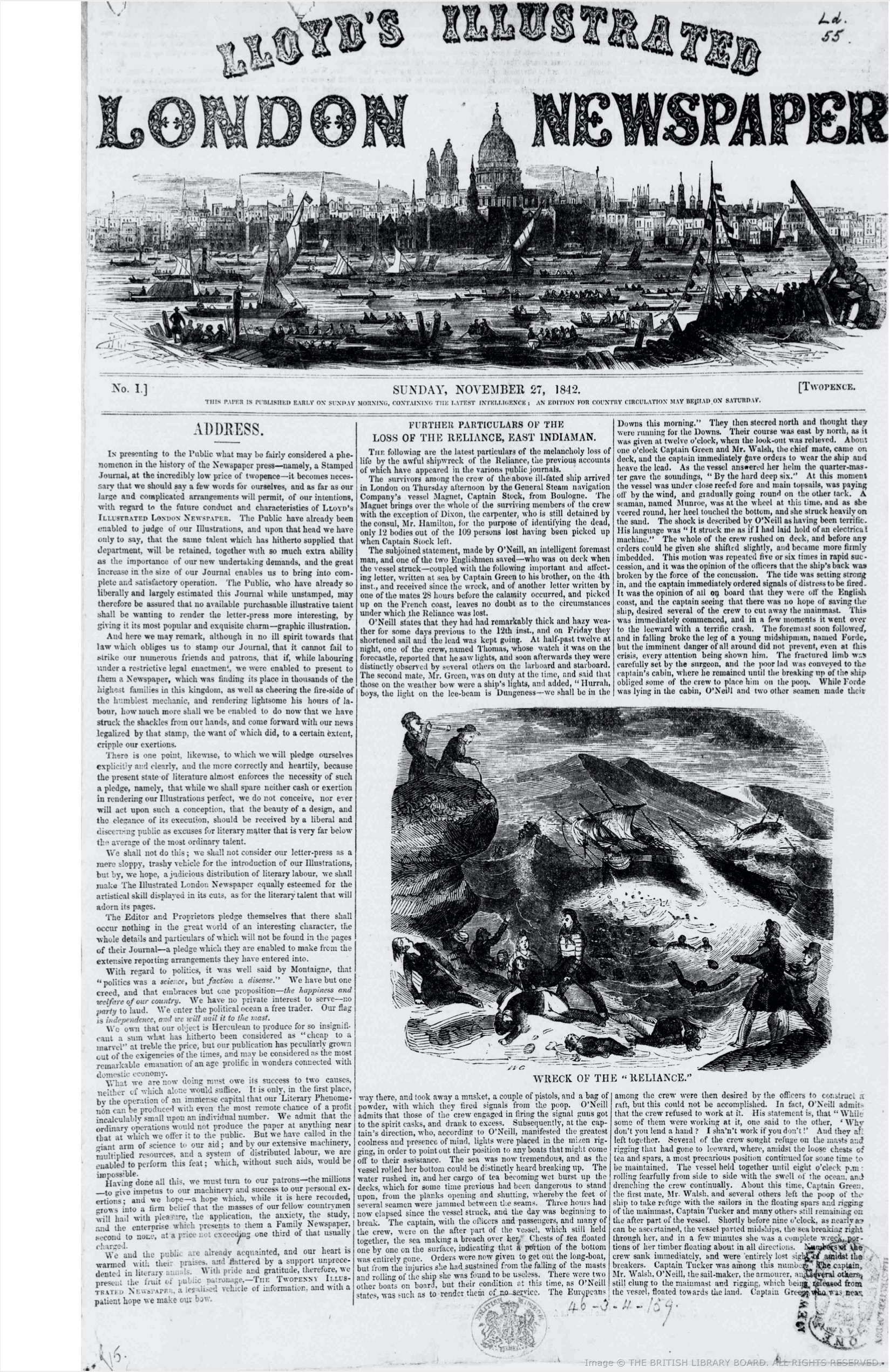
Courtesy of British Newspaper Archive

Successful Advertising (1902)
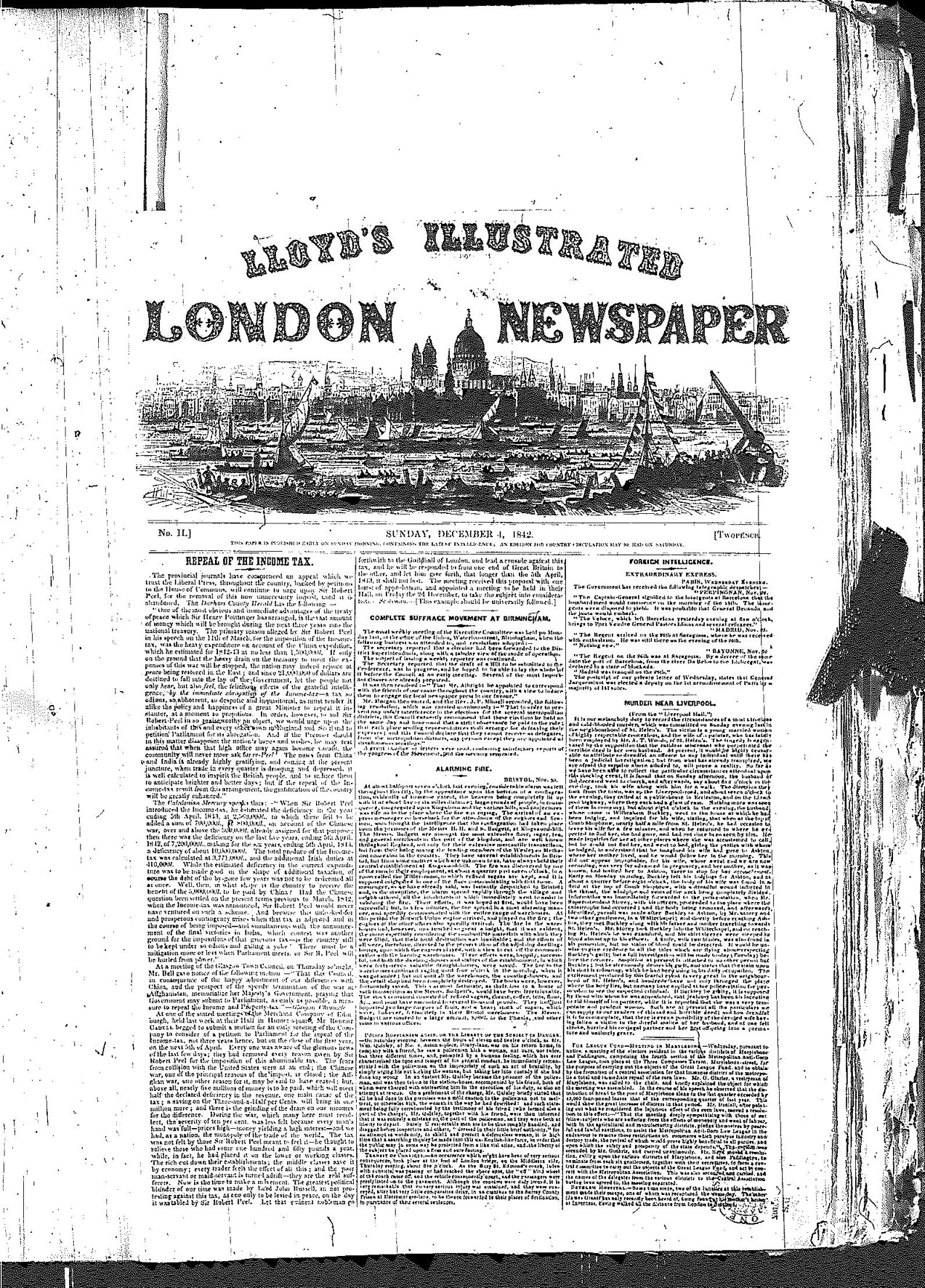
Reproduced by permission, the British Library