Detailed Record
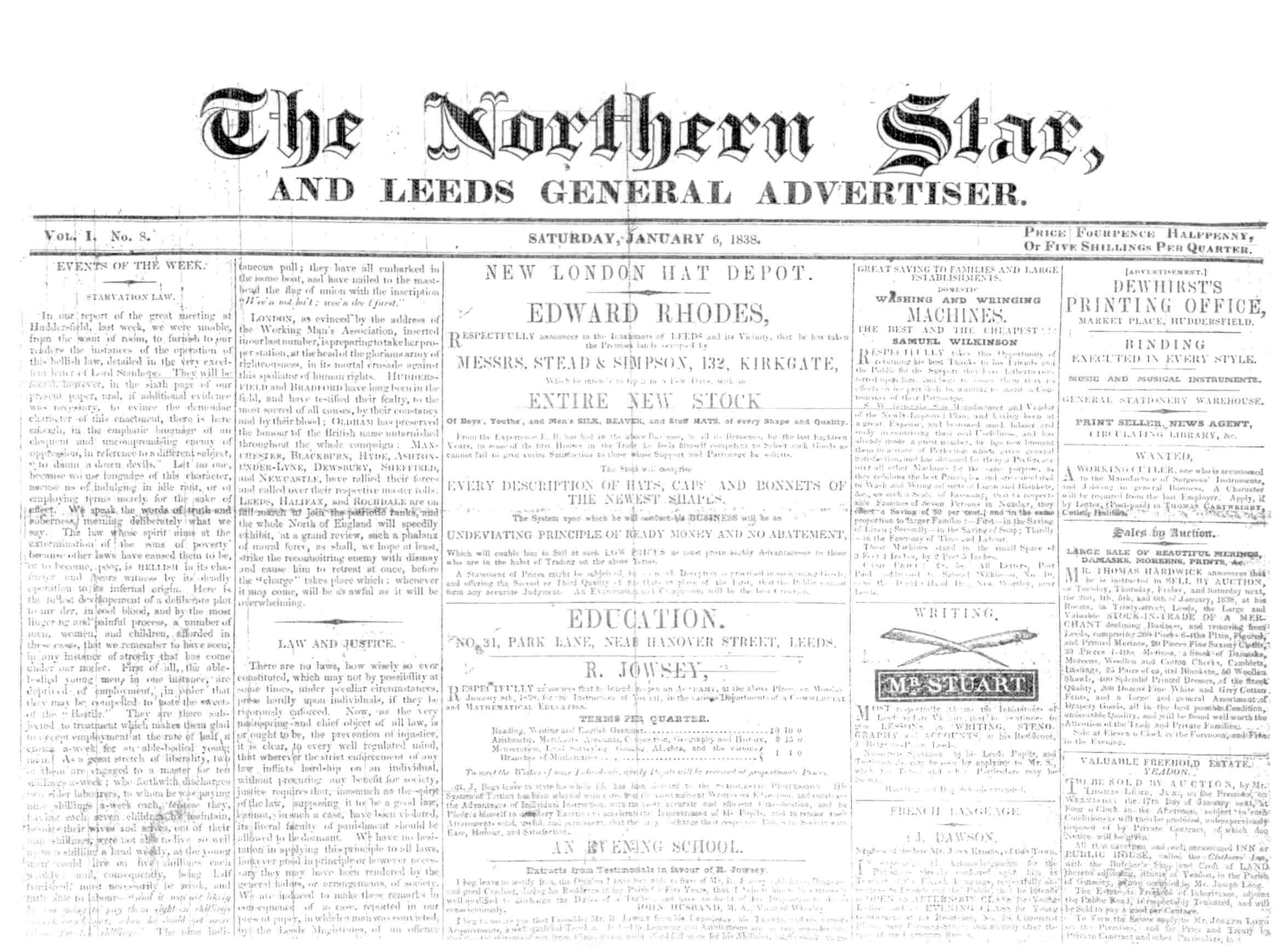
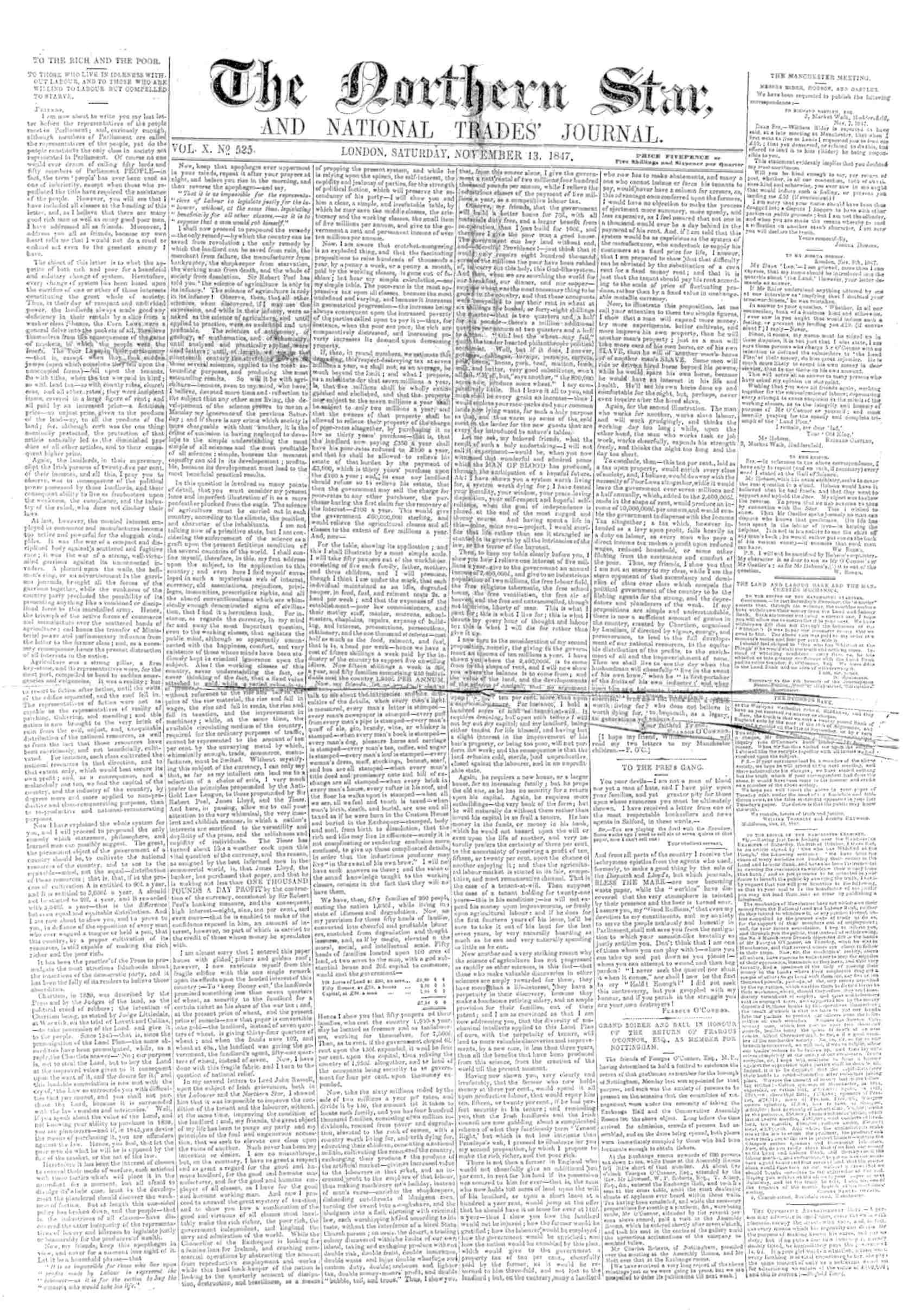
Northern Star, and Leeds General Advertiser, The
vol 1 no 1, 22 Nov 1837; vol 1 no 8 [ns], 06 Jan 1838 - no 367, 23 Nov 1844

then: Northern Star and National Trades' Journal, The. no 368, 30 Nov 1844 - vol 15 no 749, 13 Mar 1852
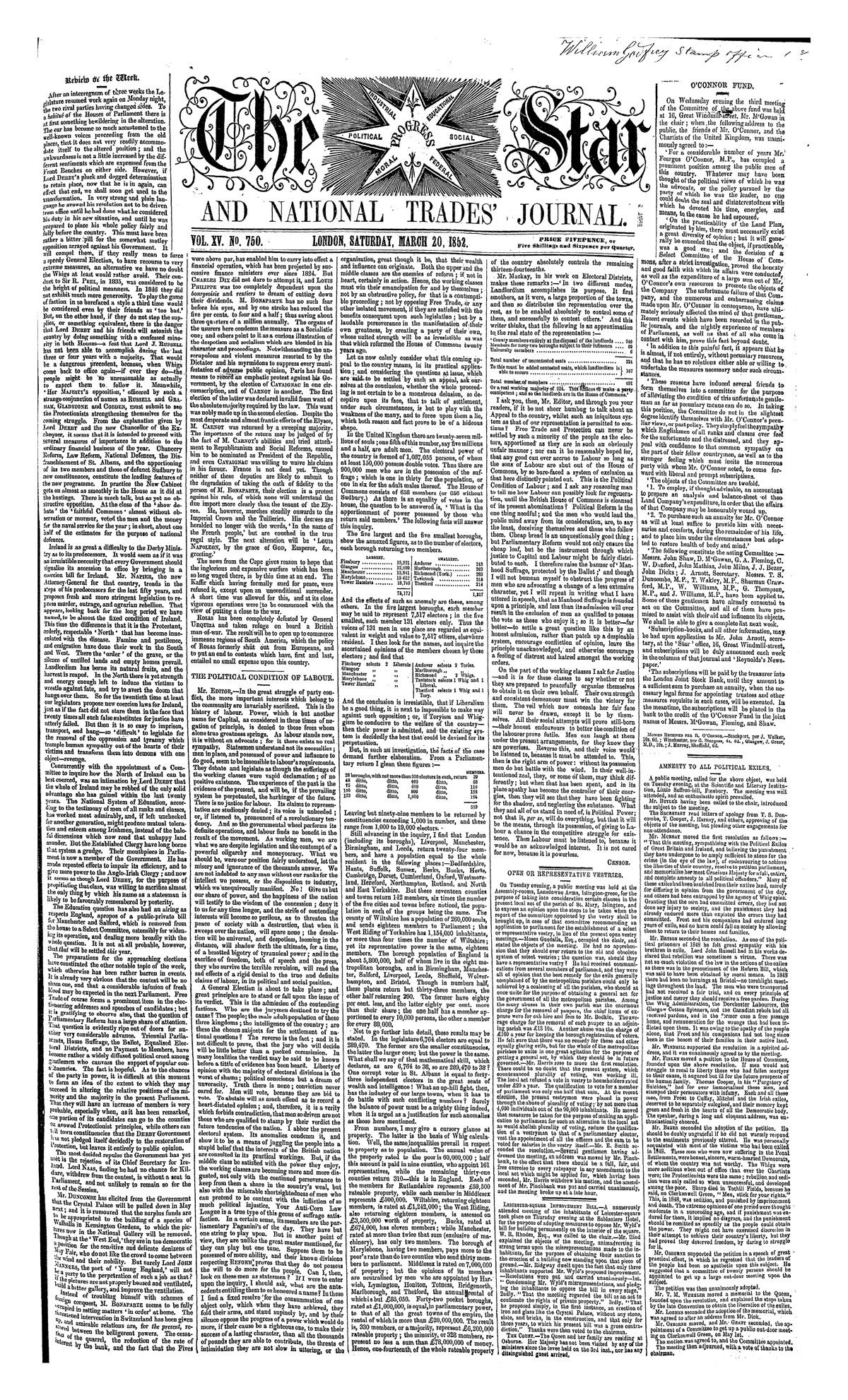
then: Star and National Trades' Journal, The. no 750, 20 Mar 1852 - no 755, 01 May 1852
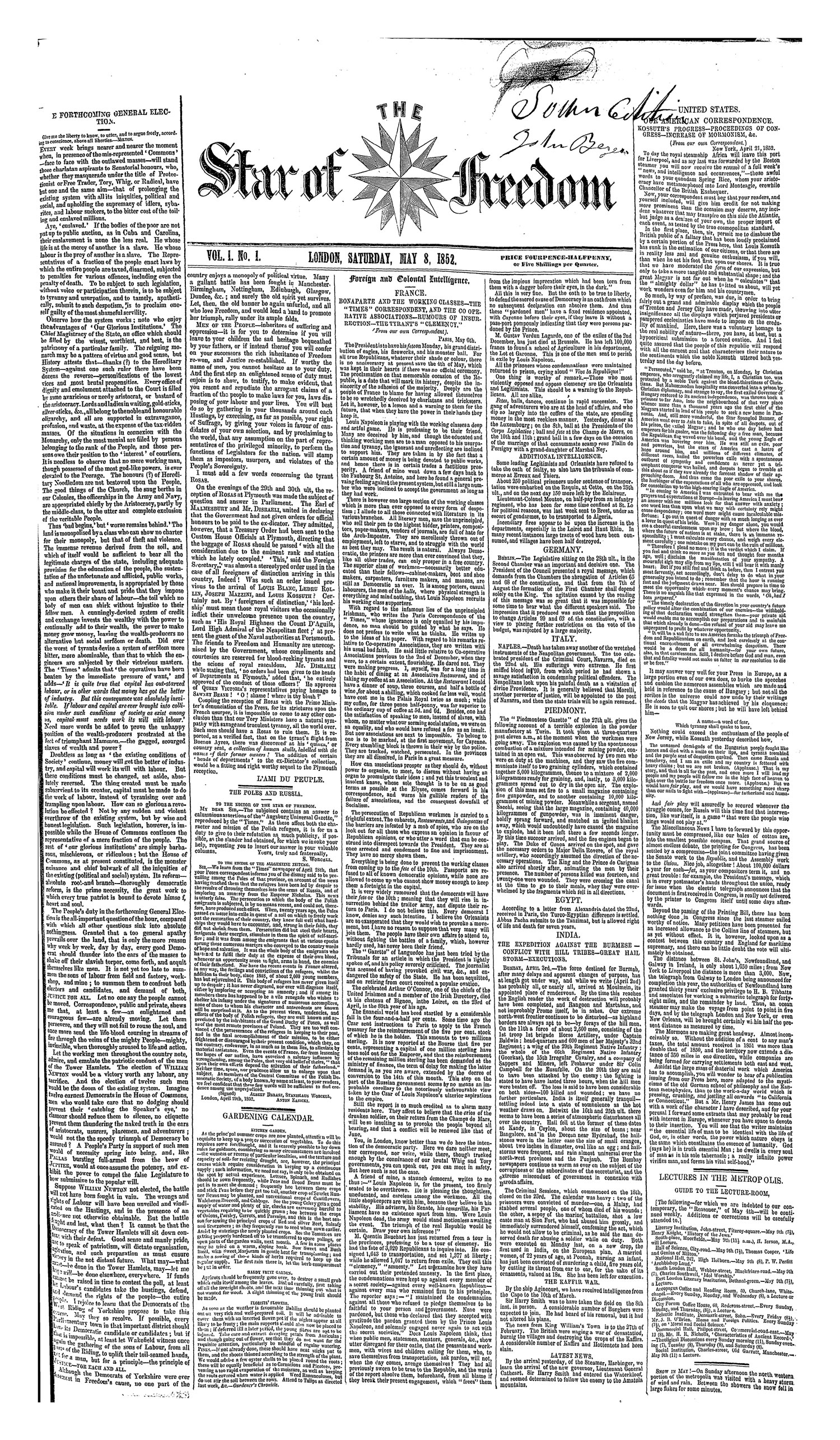
then: Star of Freedom, The; journal of political progress, trades' record, and co-operation chronicle. vol 1 no 1, 08 May 1852 - vol 1 no 14, 07 Aug 1852; no 1 [ns], 14 Aug 1852 - no 16 [ns], 27 Nov 1852//
then: Star and National Trades' Journal, The. no 750, 20 Mar 1852 - no 755, 01 May 1852
then: Star of Freedom, The; journal of political progress, trades' record, and co-operation chronicle. vol 1 no 1, 08 May 1852 - vol 1 no 14, 07 Aug 1852; no 1 [ns], 14 Aug 1852 - no 16 [ns], 27 Nov 1852//
Leeds,Yorkshire, West Riding (1837 - 1844)
London,Middlesex (30 Nov 1844 - 1850)
Editor:
G.A. Fleming (1850 - 1820)
George Julian Harney (c. 1834 - c. 1855, assistant editor, then editor from Oct 1845 - May 1850; editor again 1852 - 1855)
William Hill (Rev.) 1837 - 1843)
Josiah Hobson (1843 - 1845)
Ernest Jones (assistant editor, 1847)
Gerald Massay (literary editor 1852+)
George Julian Harney (c. 1834 - c. 1855, assistant editor, then editor from Oct 1845 - May 1850; editor again 1852 - 1855)
William Hill (Rev.) 1837 - 1843)
Josiah Hobson (1843 - 1845)
Ernest Jones (assistant editor, 1847)
Gerald Massay (literary editor 1852+)
Proprietor:
George Julian Harney (April 1852-Nov 1852)
Feargus O'Connor (founder 1837 - 1852)
Feargus O'Connor (founder 1837 - 1852)
Publisher:
George Julian Harney (1852)
William Hewitt (1846)
Abel Heywood
William Hill (Rev.)
Josiah Hobson
McGowan Hobson
William Hewitt (1846)
Abel Heywood
William Hill (Rev.)
Josiah Hobson
McGowan Hobson
Printer:
George Julian Harney
Josiah Hobson (1837 - 1845?)
J. McGowan (1845)
Josiah Hobson (1837 - 1845?)
J. McGowan (1845)
Contributors:
William Aitken (1839)
J. Monk Ambrose
John Arnott
William Ashton (May 1845)
Thomas Attwood (Jan 1838)
Alexander Bell (1852)
Louis Blanc
Engels Brown (1840s)
Henry Candy
William Carpenter
John Cleave
W.H. Clifton
John Collins (Mar 1839)
William Courtenay (Sir) see John Thom Jun 1838)
Hugh Craig
Henry Cullingham
Robert Kellie Douglas
Christopher Doyle (Aug 1839)
Ebenezer Elliot
Friedrich Engels
Timothy Falvey
John Fergusson
Micheal Forester
John Fraser
T. Frost
Ph. Gigot
W.H. Gradner
Charles Jameson Grant
Mary Howitt
Ernest Jones
Samuel M. Kydd (1852)
Richard Lee (London correspondent, 1839 - 1841)
W.J. Linton (1852)
John Lowery (Emma Miles May 1843)
Karl Marx
Mazzini Marx
Giuseppe Mazzini
Edward P. Mead
Charles Hodgson Neesom (Dec 1839)
Elizabeth Neesom (May 1839)
Richard Oastler (1842)
James Bronterre O'Brien
Feargus O'Connor
Thomas Price
W. Rider
George Ross
Henry Ross
Arnold Ruge
D. Schofield
Percy Bysshe Shelley
T.B. Smith
John Smithson
Joseph Stephens (Rev.) Jun 1838)
James Syme
John Taylor
John Thom (pseud. Sir William Courtenay Jun 1838)
George Twedel
Keats Twedel
T. Watson Twedel
Henry Vincent
J.B. Walker
W.L. Warren
Wemyss (Col.) 1839)
John West (Nov 1842)
Thomas Martin Wheeler (1840 - 1850)
George White
James Whittle
M. Wilkinson
J.F. Woods
J. Monk Ambrose
John Arnott
William Ashton (May 1845)
Thomas Attwood (Jan 1838)
Alexander Bell (1852)
Louis Blanc
Engels Brown (1840s)
Henry Candy
William Carpenter
John Cleave
W.H. Clifton
John Collins (Mar 1839)
William Courtenay (Sir) see John Thom Jun 1838)
Hugh Craig
Henry Cullingham
Robert Kellie Douglas
Christopher Doyle (Aug 1839)
Ebenezer Elliot
Friedrich Engels
Timothy Falvey
John Fergusson
Micheal Forester
John Fraser
T. Frost
Ph. Gigot
W.H. Gradner
Charles Jameson Grant
Mary Howitt
Ernest Jones
Samuel M. Kydd (1852)
Richard Lee (London correspondent, 1839 - 1841)
W.J. Linton (1852)
John Lowery (Emma Miles May 1843)
Karl Marx
Mazzini Marx
Giuseppe Mazzini
Edward P. Mead
Charles Hodgson Neesom (Dec 1839)
Elizabeth Neesom (May 1839)
Richard Oastler (1842)
James Bronterre O'Brien
Feargus O'Connor
Thomas Price
W. Rider
George Ross
Henry Ross
Arnold Ruge
D. Schofield
Percy Bysshe Shelley
T.B. Smith
John Smithson
Joseph Stephens (Rev.) Jun 1838)
James Syme
John Taylor
John Thom (pseud. Sir William Courtenay Jun 1838)
George Twedel
Keats Twedel
T. Watson Twedel
Henry Vincent
J.B. Walker
W.L. Warren
Wemyss (Col.) 1839)
John West (Nov 1842)
Thomas Martin Wheeler (1840 - 1850)
George White
James Whittle
M. Wilkinson
J.F. Woods
Names:
Titus Brooke
John Cleave (London agent)
James Guest (Birmingham agent)
Abel Heywood (Manchester agent)
William Hill
James Ibbotson
Arthur O'Connor
Feargus O'Connor (owner)
Christopher Tinker
John Cleave (London agent)
James Guest (Birmingham agent)
Abel Heywood (Manchester agent)
William Hill
James Ibbotson
Arthur O'Connor
Feargus O'Connor (owner)
Christopher Tinker
Size:
59cm, 8pp (1839); 256pp (1852)
Price:
3 1/2d (1839); 4½d st (1839, 1852); 5s/q (Jan 1838); 5s6d/q; price increased to 6½d; 6d (1846); 5d (1847, Mar 1852); 4½d (May 1852)
Circulation:
10,450/w (1837); 35,000-60,000/no (1838 - 1839); 80,000/w (1839); 10,000/w (1838); 60,000 (a two week period in 1839); 42,000 (Apr 1839 - Jun 1839); 30,000?-50,000+ (1839); 18,000 (paid subscribers 1841); 13,580 (1841); 12,500 (1842); 9,350 (1843); 7,000 (1844); 6,000 (paid subscribers 1846); 12,500 (1847); 7,000, 21,000 (1848); 5,000/w (1848-1850); 1,200 (1852)
Frequency:
weekly (Sat 1839-1846+; 1852)
Issued by:
Chartist Organisation of Fergus O'Connor, The
Departments:
review of the week, United States, Italy, Switzerland, China, India, questions and answers, notices to correspondents, democratic movements, co-operation, our pen and ink portrait gallery, news from the gold diggings, public amusements, science and art, statistics of the week, markets, letters for working men, industrial association, the political aspect (1852); editorials, articles, and letters condemning the New Poor Law (1830s); reports of anti-Poor Law meetings, chartist/local and general intelligence, local markets, to readers and correspondents, medical advise, reviews, poetry, bankrupts, astrology, correspondence, news, advertisements, parliament report, national association of united trades, forthcoming meetings, law and the land, national land company, crime, court cases
Orientation:
Chartist (1837, 1847); Radical; radical reform; pro-universal suffrage, pro-free trade, voluntary (1846); working-class radical
Merges:
superseded The Northern Star and The Friend of the People (q.v.); merged with Friend of the People (q.v.) under new name Star of Freedom
Sources:
Berridge, Virginia. "Content Analysis and Historical Research on Newspapers." The Press in English Society from the Seventeenth to Nineteenth Centuries. Eds. Michael Harris and Alan Lee. London, Toronto: Associated University Presses, 1986. 201-218.; Canney, Catalogue of Economic Literature.; COPAC; James, Louis. Fiction for the Working Man 1830-1850. London: Oxford University Press, 1963.; Haywood, Ian. "Memory and Tradition in the Radical Press." Encounters in the Victorian Press: Editors, Authors, Readers. Laurel Brake and Julie F. Codell. New York: Palgrave Macmillan, 2005. p.70.; Mitchell's Newspaper Press Directory, 1846, 1847.; Sutherland Longman Companion to Victorian Fiction.; Uffelman, 1992.; Williams, Judith Blow. A Guide to the Printed Materials for English Social and Economic History 1750-1850. 2 vols. New York: Octagon Books, 1966.; Prince, Kathryn. Shakespeare in the Victorian Periodicals. Routledge, 2008, p.1-149;
Histories:
Altick, English Common Reader.; Barker, Hannah. Newspapers, Politics, and English Society, 1695-1855. Harlow: Longman, 2000.; Black, Frank Gees. The Harney Papers. Frank Gees. Netherlands: Royal Vangorcum Ltd, 1969.; Black, Jeremy. The English Press 1621-1861. Stroud: Sutton Publishing, 2001: 191, 200.; Blair, "Making of the Working-Class Poet".; Bourne, H.R. Fox. English Newspapers. vol 2. New York: Russell & Russell, 1966.; Breton, Oppositional Aesthetics of Chartist Fiction.; Breton, "Portraits of the Poor".; Brown, Kenneth D. The English Labour Movement 1700-1951. Dublin: Gill and Macmillan, 1982.; Browne, "The Northern Star, English Chartism and Irish politics, 1845—48." Saothar, 29 (2004), pp. 67-76.; Burnett, John, ed. Useful Toil. London: Allen Lane, 1974.; Clarke, Grub Street to Fleet Street, p.127.; Clemm, Mapping the World in Household Words.; Cole, Chartist Portraits5.; Cranfield, The Press and Society.; Deering, D. "The 1978 conference." VPR 12 (1979): 34-5.; Drew, "Dickens in Context Newspaper and Periodical Market".; Epstein, J.A. "Feargus O'Connor and the Northern Star." IRSH 21 (1976): 51-97.; Epstein, Feargus O’Connor and the Chartist Movement.; Flick, Carlos. The Birmingham Political Union and the Movements for Reform in Britain 1830-1839. Hamden, CT: Archon, 1978.; Glasgow, Eric. "The Establishment of the Northern Star Newspaper." History 39: 54-67.; Harmondsworth: Penguin, 1977.; Harrison, “World of No Conception”.; Harrison, Brian. Drink and The Victorians: the Temperance Question in England 1815-1872. London: Faber and Faber, [1971].; Harrison, Stanley. Poor Men's Guardians: A Record of the Struggles for a Democratic Newspaper Press, 1763-1973. London: Lawrence and Wishart, 1974.; Harrison, "Press and Pressure Group in Modern Britain".; Haywood, Ian. Chartist Fiction. Aldershot: Ashgate, 1999.; Herd, March of Journalism.; Hollis, P. ed. "Class and conflict in nineteenth-century England, 1815-1850." 1973.; Hollis, Patricia. "Anti-Slavery and British Working-Class Radicalism in the Years of Reform." Anti-Slavery, Religion, and Reform. Eds. Christine Bolt and Seymour Drescher. Folkestone: Wm Dawson & Sons Ltd., 1980: 294-315.; Hovell, The Chartist Movement.; Jones, Aled. "Chartist Journalism and Print Culture in Britain, 1830-1855". in Allen and Ashton (eds.). Papers for the People: A Study of the Chartist Press. London: Merlin Press, 2005. pp.1-24.; Jones, Aled. Powers of the Press: Newspapers, Power and the Public in Nineteenth-Century England. England: Scolar Press, 1996.; Kemnitz, “Chartist convention of 1839”.; Kinealy, Repeal and Revolution, pp.44, 164.; Koss, Rise and Fall of the Political Press.; Law, "Distribution" p.60.; Leary, Manchester Periodicals ms p.212.; Machin, Politics and the Churches.; Maidment, "The Poorhouse Fugitives".; Mussell, Jim. "Northern Star (1837-1852)." ncse.ac.uk.; Mussell, Press in the Digital Age.; Mutch, "Social Purpose Periodicals".; Olsen, "Men and the Periodical Press" p.251.; Read, Donald and Eric Glasgow. Feargus O'Connor: Irishman and Chartist. London: Edward Arnold, Ltd, 1961.; Rodrick, "Melodrama and Natural Science".; Rodrick, Anne. "'Only a Newspaper Metaphor': Crime Reports, Class Conflict, and Social Criticism in Two Victorian Newspapers." VPR 29.1 (1996): 1-18.; Sander, Mike. "'A Jackass Load of Poetry'; the Northern Star's Poetry Column 1838-1852" In VPR 39:1 (Spring 2006): 46-66.; Schoyen, A. R. The Chartist Challenge: A Portrait of George Julian Harney. London: Heinemann, 1958.; Schoyen, A.R. The Chartist Challenge: A Portrait of George Julian Harney. New York: Macmillan, 1958.; Score, "Child Slavery in England".; Shaaban, “Chartist Press.”.; Simon, Brian. Studies in the History of Education 1780-1870. London: Lawrence & Wishart, [1969, c1960].; Shannon, Dickens, Reynolds, and Mayhew.; Thomas, Donald. A Long Time Burning: the History of Literary Censorship in England. London: Routledge & Kegan Paul, [1969].; Thompson, Popular Politics in the Industrial Revolution.; Thompson, The Chartists.; Thompson, Dorothy. Outsiders: Class, Gender, and Nation. London: Verso: 1993.; Walvin, James. "The Rise of British Popular Sentiment for Abolition." Anti-Slavery, Religion, and Reform: 149-162.; Webb, R. K. The British Working Class Reader. London: George Allen & Unwin Ltd., 1955.; Williams, Read All About It.; Wilson, The Chartist Movement in Scotland (1970).; Yeo, E. "Christianity in the Chartist Struggle, 1838-1842." PP 140 (1981): 109-39.
Comments:
"O'Connor's Northern Star was at its apogee in 1839 selling 48,000 copies per weeks, its demands for the democratisation of politics were read by a much wider audience" (Harrison, Brian. "'A World of Which We Had No Conception.'").
"'Reader', said Feargus O'Connor, in the first number of The Northern Star...'behold that little red spot in the corner of my newspaper. That is the stamp; the Whig 'beauty' spot; your 'plague' spot. Look at it: I am entitled to it upon the performance of certain conditions. I was ready to comply, and yet, will you believe that the little spot you see has cost me nearly eighty pounds in money, together with much anxiety, and nearly one thousand miles of night and day travelling? Of this they shall hear more, but for the present suffice it to say there it is; my licence to teach'" (Bourne).
Established November 22, 1837.
"In 1837 the Chartist weekly Northern Star had been floated for less than £700" (Drew 109).
With this paper, "Feargus O'Connor was quite explicit about founding the paper to overcome press silence on Chartism" (276).
The Northern Star eclipsed all other reformist, radical papers almost immediately after it was published (Clarke 127).
"Feargus O’Connor used his weekly Northern Star to present the Chartist vision of a fair and just society through editorials, national and international news coverage, and advocacy for specific political goals such as the Chartist Land Plan. However, he and his editor, George Julian Harney, also devoted some 25 percent of the paper to crime and accident reports, focusing on items that helped present a comprehensive picture of class-based injustice" (Rodrick, "Melodrama", 68).
Williams calls this the "mouthpiece of Chartism" and the "world's best-selling newspaper in the middle of the nineteenth century" (Read 85). It highlighted the "local and sectional struggles across Britain into a political movement of national significance. It provided Chartism with an identity and national platform. The newspaper did this by encouraging differing views to be expressed in its pages, and complementing political commentary with news" (92).
"This is a weekly newspaper, projected in the Chartist interest, and strongly imbued with the principles of Ultra-Radicalism. It had at one time a great extent of popularity in the district which may be designated its birth-place the north of England; whence it has recently removed to the metropolis, with no proportionate increase of circulation; for its prosperity was mainly dependent on the growth of Chartism, the decline of which it has somewhat shared. Its circulation, however, is not inconsiderable; but of course, chiefly, if not entirely, among the working classes, operatives, and small tradesmen" (Mitchell's, 1846).
"It was originally published at Leeds, where it obtained, in a short time, a larger circulation than any other country newspaper ever realised. The party to which it is attached [ie. Chartist], however, losing its popularity, the sale fell off, and the publication of the paper was transferred to London. Its articles are written in a bold uncompromising spirit...." (Mitchell's, 1847).
Cox and Mowatt explain this shift more extensively: "Despite the Northern Star’s strong roots in the north of England, the paper moved its offices to London following a change of editorship in 1844; an example of the enduring pull on periodical publishing exerted by the metropolis" (44).
"The Chartist paper, The Northern Star, continued to be an organ for Feargus O'Connor's ranting, and the agitation of 1848 produced a crop of radical papers to replace those that had died around 1840..." (James, Louis; p.42).
"...[R]arely seen as a vehicle for sensationalized accounts of murder and mayhem. Yet nearly one quarter of each weekly issue was devoted to reports of crimes, accidents, and police proceedings, using the sensational to underscore a political program....the state, constructing itself upon an inherently unstable of class division and inequity, caused the acts of suicide, murder, and abuse that filled the columns of the Northern Star….an expression of working class protest against the Poor Law and demands for factory reform…. Its circulation rivaled that of The Times in 1839…Circulation subsequently dropped off…before peaking a second time in 1848…then dropped precipitously, to less than 5000 per week by 1850. When Harney purchased the paper in 1852, circulation was down to 1200 and he was forced to end publication that same year” (VPR).
This paper began as a Factory and Anti-Poor Law journal. When O'Conner purchased the paper, he turned it into "a national vehicle for his brand of Chartism" but published other Chartist viewpoints, including those of his critics within the movement. The Northern Star was the [self-proclaimed] definitive and comprehensive voice of the Chartist movement; it succeeded in uniting Chartism by publishing local and regional initiatives and according them national significance (Barker, Hannah; p.215, 216). "Feargus O'Conner, editor of the Northern Star, insisted that the paper was a 'mirror' of the people's mind...written with public readings very much in mind...readings of radical papers were not met with reverential silence but formed the basis of listeners subsequent discussions...(Barker, Hannah; p.25, 55).
The paper also "claimed to serve a largely working-class readership, which had previously found 'no single provincial organ through which their wants and wishes could be adequately expressed, and by which their rights could be duly asserted and their interests maintained'" (Barker, Hannah; p.49).
Founded as a legal, stamped publication with the intention of surviving the rigours of commercial competition (Jones, Aled. Powers of the Press, p.147).
At first, the Northern Star was a working-class paper. It is fairly obvious that Feargus intended to use the Northern Star to advance his personal career. His role in the paper was publicized, and his public speeches reprinted therein in full. Accepted as the national organ of the Chartist movement (Cranfield, p.194).
In 1839 the paper achieved its full glory. It had six columns on each of its eight pages. It was out-of-date in appearance, and its advertisement were reminiscent of 18th century newspapers (Cranfield, p.195). Published the prospectus for the Nottingham Chronicle in 1839 (Cranfield, p.195). The Northern Star claimed on 2 February 1839 that it had sold 17 640 papers the previous week, and that it had 27 000 orders for the next. It was able to substantiate its claims with a record of stamp purchases. A similar record in 1839 gave the Northern Star a weekly average of 42 077 (Cranfield, p.197). "Its maximum sale at this time [1839] was probably over 50 000 a week" (Cranfield, p.198). 1842 was the key year for the Northern Star. When the middle classes finally began to realise the needs of the working classes, the great days of the Northern Star were over (Cranfield, p.198).
Cox and Mowatt: "By February 1838 it was selling over 10,000 copies a week – more than both the Manchester Guardian and the Leeds Mercury. Having been won over to the Chartist cause, the Northern Star appointed correspondents in every town and village where the movement had found support." (40).
The sales figures of 50,000 per week do not reflect the total readership. Williams in Read All About It estimates that there may have been up to twenty readers per copy, which pushes circulation numbers above one million weekly (91).
Jim Mussell, in the NCSE, writes that "in March 1839 the Star was purchasing over 40,000 stamps per issue and, claiming it was read by seven people for every purchaser, proposed a readership of almost 300,000."
"The Reporter, like the Chartists' Northern Star at a later date, provided an important organizational framework and a focal point for a diffuse political movement" (Walvin, p.157).
"Bronterre O'Brien, the 'school master of Chartism', whose journalism in the Unstamped Poor Man's Guardian and then in the Northern Star taught a generation of working men to 'read' capitalism as the systematic theft of their labour" (Hollis, p.296).
The Northern Star "regularly portrayed female activism with accounts of fund-raising and petitioning activities" (Score 71).
"The early editions concentrated on the anti-poor law campaign and the Glasgow cotton spinners..." (Brown, Lucy).
Part of the Northern Star's apparent editorial agenda was to establish links between crimes and social conditions (Rodrick).
"In politics it was the extreme of Radicalism, or Chartism as it was then called, from advocating the People's Charter. It advocated six distinct changes which were deemed constitutional departures from the law and customs of the realm" (Wood 308).
"O'Connor's role was as a major contributor - most weeks he wrote a front-page Letter, he occasionally wrote other columns, and he always ensured that his speeches were reported in full. But for the rest - the greater part of the paper - he allowed his editors and other staff considerable freedom" (Thompson, The Chartists, 47).
"O'Connor, whose Northern Star was rapidly gaining readers, used physical force as a threat ("peaceably if we may, forcibly if we must") but never came to the point of countenancing it in fact" (Cole, G.D.H. Chartist Portraits; P.238). O'Connor was also quoted as writing and saying of his rival Weekly Dispatch, "You unmitigated ass! You sainted fool! You canonized ape! You nincompoop!" (Cole, G.D.H. Chartist Portraits; P.263).
Poems and extracts of poems by Byron, Shelley and Keats appear in the publication (Shaaban, p.38-9).
"During the years 1845-46 the Northern Star regularly and consistently printed on its literary page extracts from Byron's poetry" (Shaaban, p.41). A number of issues have a feature in a continuing series entitled "The Beauties of Byron". The focus on Byron includes features on "To a Lady" and Childe Harold among others (Shaaban, p.39). Poems by Byron are published in full, including "Ode to Napoleon Bonaparte" "From the French" and "Prometheus" (Shaaban, p.42). No 336 contains a poem by John Fergusson called "To the Memory of Shelley" (Shaaban, p.38). An article in 10 Jan, 1846 compares and contrasts the work of Byron and Shelley (Shaaban, p.40). The subject of Byron's poem "The Prisoner of Chillon" is argued to be "deeply interesting to all haters of tyranny" (2 May, 1846, p.3). Frost compares Scott, Byron and Shelley in the 2 Jan, 1847 publication. Twedell "acclaims Shelley as the prophet and patriot of liberty" (Shaaban, p.42).
Read weekly by a Primitive Methodist preacher at a miner's meeting (Webb, p.34).
Jones and Harney became leading members of "the international socialist group of Fraternal Democrats and friends of Marx and Engels" (Epstein, 76).
"O'Conner's rise to popular leadership was rapid in the extreme. Within fifteen months from the foundation of the Northern Star, he was the universally acknowledged leader in those parts...The paper could make or unmake reputations, and local leaders went in terror of its censure. Place declared that the Northern Star had degraded the whole Radical Press. It was truly the worst and most successful of the radical papers, a melancholy tribute to the low level of intelligence of its readers...In the palmy days between 1839 and 1842 the Star had been not only the oracle of northern industrial discontent, but a veritable gold mine to its proprietor, and the source of the lavish subventions with which he sustained the tottering finances of the cause. But the greatest prosperity of the Star had been in its early days of identification with Chartism. Founded in 1837 before the Charter had been devised, it was not before 1839 that it had grown into the position of the leading Chartist organ. It was in the great year 1839 that the Star had attained the highest point of its prosperity. But after the great year 1839 the sales of the Star had steadily declined. Even in 1840 it had only half the circulation of the previous year: each succeeding year was marked by a further drop, and by the summer of 1843 the state of affairs was becoming critical...Accordingly in 1844 the office of the paper was transferred from Leeds to London...But if the step had been undertaken in hope of reviving its sales, the result finally was the completion of its ruin...It was now called the Northern Star and the National Trades Journal, and a desperate effort was made to win new readers by appeals to the Trades Union element which in early days had seemed of little account. Before long it almost ceased to be a Chartist paper at all...Early in 1852 he sold the Northern Star to new proprietors, who forthwith dissociated it from the Chartist cause" (Hovell).
Read states that the Northern Star was the "first great British popular newspaper" (p.56).
This publication gets its name from an Irish publication of the same title that was closely associated with Feargus O'Connor's uncle, Arthur O'Connor (Read, Donald; p.56).
There are conflicting reports for 1839 prices. Law claim that the price was 3 1/2d (p.60) while other reports explain that the 1839 price was 4 1/2d.
No 688 is incorrectly numbered 687 (Canney).
Superceded by The Star of Freedom (q.v.).
Harney purchased the Northern Star in 1852.
"Very popular Chartist paper" (Williams, Judith; vol 2, p.519).
After its inception, The Northern Star ". . . speedily out-passed all other Radical journals not only in violence of language but also in the extent of its circulation" (Cole, G.D.H. Chartist Portraits; p.47).
The Northern Star ". . .began not as a Chartist organ, but much more as the expression of working-class protests against the Poor Law and demands for factory reform. It advocated Universal Suffrage and the rest of the Chartist demands, primarily as means to these ends. Only when the London Working Men's Association had published the Charter, and began to secure for it the support of Radical working men's associations in many other places, did The Northern Star take up the Charter. . ." (Cole, G.D.H. Chartist Portraits; p.312).
The Northern Star "provided readers with models of proud, working-class masculinity that were distinct from definitions of middle-class manhood" (Olsen 251).
John Cleave was the London "agent" for this periodical. Other agents for the Star: James Ibbotson of Bradford, Titus Brooke of Dewsbury, Christopher Tinker of Huddersfield. Richard Lee was the London correspondent from 1839-1840. Abel Heywood had the Manchester agency for the new series. Of total 3,000 issues, 1,220 copies were ordered in Ashton-under-Lyne (Flick, p.38).
"Sunshine and Shadow appeared in weekly installments in the Northern Star between 31 March 1849 and 5 January 1850. Its author was the Chartist administrator and schoolteacher Thomas Martin Wheeler (1811-62)... He became the London correspondent of the Northern Star in 1840" (Haywood, "Memory" p.65).
It was seriously diminished after the Chartist movement failed in 1844. At this time, it's sales diminished to 7,000 (Clarke 127).
This periodical is available online at the Nineteenth-Century Serials Edition website, http://nsce-stg.cch.kcl.ac.uk
"'Reader', said Feargus O'Connor, in the first number of The Northern Star...'behold that little red spot in the corner of my newspaper. That is the stamp; the Whig 'beauty' spot; your 'plague' spot. Look at it: I am entitled to it upon the performance of certain conditions. I was ready to comply, and yet, will you believe that the little spot you see has cost me nearly eighty pounds in money, together with much anxiety, and nearly one thousand miles of night and day travelling? Of this they shall hear more, but for the present suffice it to say there it is; my licence to teach'" (Bourne).
Established November 22, 1837.
"In 1837 the Chartist weekly Northern Star had been floated for less than £700" (Drew 109).
With this paper, "Feargus O'Connor was quite explicit about founding the paper to overcome press silence on Chartism" (276).
The Northern Star eclipsed all other reformist, radical papers almost immediately after it was published (Clarke 127).
"Feargus O’Connor used his weekly Northern Star to present the Chartist vision of a fair and just society through editorials, national and international news coverage, and advocacy for specific political goals such as the Chartist Land Plan. However, he and his editor, George Julian Harney, also devoted some 25 percent of the paper to crime and accident reports, focusing on items that helped present a comprehensive picture of class-based injustice" (Rodrick, "Melodrama", 68).
Williams calls this the "mouthpiece of Chartism" and the "world's best-selling newspaper in the middle of the nineteenth century" (Read 85). It highlighted the "local and sectional struggles across Britain into a political movement of national significance. It provided Chartism with an identity and national platform. The newspaper did this by encouraging differing views to be expressed in its pages, and complementing political commentary with news" (92).
"This is a weekly newspaper, projected in the Chartist interest, and strongly imbued with the principles of Ultra-Radicalism. It had at one time a great extent of popularity in the district which may be designated its birth-place the north of England; whence it has recently removed to the metropolis, with no proportionate increase of circulation; for its prosperity was mainly dependent on the growth of Chartism, the decline of which it has somewhat shared. Its circulation, however, is not inconsiderable; but of course, chiefly, if not entirely, among the working classes, operatives, and small tradesmen" (Mitchell's, 1846).
"It was originally published at Leeds, where it obtained, in a short time, a larger circulation than any other country newspaper ever realised. The party to which it is attached [ie. Chartist], however, losing its popularity, the sale fell off, and the publication of the paper was transferred to London. Its articles are written in a bold uncompromising spirit...." (Mitchell's, 1847).
Cox and Mowatt explain this shift more extensively: "Despite the Northern Star’s strong roots in the north of England, the paper moved its offices to London following a change of editorship in 1844; an example of the enduring pull on periodical publishing exerted by the metropolis" (44).
"The Chartist paper, The Northern Star, continued to be an organ for Feargus O'Connor's ranting, and the agitation of 1848 produced a crop of radical papers to replace those that had died around 1840..." (James, Louis; p.42).
"...[R]arely seen as a vehicle for sensationalized accounts of murder and mayhem. Yet nearly one quarter of each weekly issue was devoted to reports of crimes, accidents, and police proceedings, using the sensational to underscore a political program....the state, constructing itself upon an inherently unstable of class division and inequity, caused the acts of suicide, murder, and abuse that filled the columns of the Northern Star….an expression of working class protest against the Poor Law and demands for factory reform…. Its circulation rivaled that of The Times in 1839…Circulation subsequently dropped off…before peaking a second time in 1848…then dropped precipitously, to less than 5000 per week by 1850. When Harney purchased the paper in 1852, circulation was down to 1200 and he was forced to end publication that same year” (VPR).
This paper began as a Factory and Anti-Poor Law journal. When O'Conner purchased the paper, he turned it into "a national vehicle for his brand of Chartism" but published other Chartist viewpoints, including those of his critics within the movement. The Northern Star was the [self-proclaimed] definitive and comprehensive voice of the Chartist movement; it succeeded in uniting Chartism by publishing local and regional initiatives and according them national significance (Barker, Hannah; p.215, 216). "Feargus O'Conner, editor of the Northern Star, insisted that the paper was a 'mirror' of the people's mind...written with public readings very much in mind...readings of radical papers were not met with reverential silence but formed the basis of listeners subsequent discussions...(Barker, Hannah; p.25, 55).
The paper also "claimed to serve a largely working-class readership, which had previously found 'no single provincial organ through which their wants and wishes could be adequately expressed, and by which their rights could be duly asserted and their interests maintained'" (Barker, Hannah; p.49).
Founded as a legal, stamped publication with the intention of surviving the rigours of commercial competition (Jones, Aled. Powers of the Press, p.147).
At first, the Northern Star was a working-class paper. It is fairly obvious that Feargus intended to use the Northern Star to advance his personal career. His role in the paper was publicized, and his public speeches reprinted therein in full. Accepted as the national organ of the Chartist movement (Cranfield, p.194).
In 1839 the paper achieved its full glory. It had six columns on each of its eight pages. It was out-of-date in appearance, and its advertisement were reminiscent of 18th century newspapers (Cranfield, p.195). Published the prospectus for the Nottingham Chronicle in 1839 (Cranfield, p.195). The Northern Star claimed on 2 February 1839 that it had sold 17 640 papers the previous week, and that it had 27 000 orders for the next. It was able to substantiate its claims with a record of stamp purchases. A similar record in 1839 gave the Northern Star a weekly average of 42 077 (Cranfield, p.197). "Its maximum sale at this time [1839] was probably over 50 000 a week" (Cranfield, p.198). 1842 was the key year for the Northern Star. When the middle classes finally began to realise the needs of the working classes, the great days of the Northern Star were over (Cranfield, p.198).
Cox and Mowatt: "By February 1838 it was selling over 10,000 copies a week – more than both the Manchester Guardian and the Leeds Mercury. Having been won over to the Chartist cause, the Northern Star appointed correspondents in every town and village where the movement had found support." (40).
The sales figures of 50,000 per week do not reflect the total readership. Williams in Read All About It estimates that there may have been up to twenty readers per copy, which pushes circulation numbers above one million weekly (91).
Jim Mussell, in the NCSE, writes that "in March 1839 the Star was purchasing over 40,000 stamps per issue and, claiming it was read by seven people for every purchaser, proposed a readership of almost 300,000."
"The Reporter, like the Chartists' Northern Star at a later date, provided an important organizational framework and a focal point for a diffuse political movement" (Walvin, p.157).
"Bronterre O'Brien, the 'school master of Chartism', whose journalism in the Unstamped Poor Man's Guardian and then in the Northern Star taught a generation of working men to 'read' capitalism as the systematic theft of their labour" (Hollis, p.296).
The Northern Star "regularly portrayed female activism with accounts of fund-raising and petitioning activities" (Score 71).
"The early editions concentrated on the anti-poor law campaign and the Glasgow cotton spinners..." (Brown, Lucy).
Part of the Northern Star's apparent editorial agenda was to establish links between crimes and social conditions (Rodrick).
"In politics it was the extreme of Radicalism, or Chartism as it was then called, from advocating the People's Charter. It advocated six distinct changes which were deemed constitutional departures from the law and customs of the realm" (Wood 308).
"O'Connor's role was as a major contributor - most weeks he wrote a front-page Letter, he occasionally wrote other columns, and he always ensured that his speeches were reported in full. But for the rest - the greater part of the paper - he allowed his editors and other staff considerable freedom" (Thompson, The Chartists, 47).
"O'Connor, whose Northern Star was rapidly gaining readers, used physical force as a threat ("peaceably if we may, forcibly if we must") but never came to the point of countenancing it in fact" (Cole, G.D.H. Chartist Portraits; P.238). O'Connor was also quoted as writing and saying of his rival Weekly Dispatch, "You unmitigated ass! You sainted fool! You canonized ape! You nincompoop!" (Cole, G.D.H. Chartist Portraits; P.263).
Poems and extracts of poems by Byron, Shelley and Keats appear in the publication (Shaaban, p.38-9).
"During the years 1845-46 the Northern Star regularly and consistently printed on its literary page extracts from Byron's poetry" (Shaaban, p.41). A number of issues have a feature in a continuing series entitled "The Beauties of Byron". The focus on Byron includes features on "To a Lady" and Childe Harold among others (Shaaban, p.39). Poems by Byron are published in full, including "Ode to Napoleon Bonaparte" "From the French" and "Prometheus" (Shaaban, p.42). No 336 contains a poem by John Fergusson called "To the Memory of Shelley" (Shaaban, p.38). An article in 10 Jan, 1846 compares and contrasts the work of Byron and Shelley (Shaaban, p.40). The subject of Byron's poem "The Prisoner of Chillon" is argued to be "deeply interesting to all haters of tyranny" (2 May, 1846, p.3). Frost compares Scott, Byron and Shelley in the 2 Jan, 1847 publication. Twedell "acclaims Shelley as the prophet and patriot of liberty" (Shaaban, p.42).
Read weekly by a Primitive Methodist preacher at a miner's meeting (Webb, p.34).
Jones and Harney became leading members of "the international socialist group of Fraternal Democrats and friends of Marx and Engels" (Epstein, 76).
"O'Conner's rise to popular leadership was rapid in the extreme. Within fifteen months from the foundation of the Northern Star, he was the universally acknowledged leader in those parts...The paper could make or unmake reputations, and local leaders went in terror of its censure. Place declared that the Northern Star had degraded the whole Radical Press. It was truly the worst and most successful of the radical papers, a melancholy tribute to the low level of intelligence of its readers...In the palmy days between 1839 and 1842 the Star had been not only the oracle of northern industrial discontent, but a veritable gold mine to its proprietor, and the source of the lavish subventions with which he sustained the tottering finances of the cause. But the greatest prosperity of the Star had been in its early days of identification with Chartism. Founded in 1837 before the Charter had been devised, it was not before 1839 that it had grown into the position of the leading Chartist organ. It was in the great year 1839 that the Star had attained the highest point of its prosperity. But after the great year 1839 the sales of the Star had steadily declined. Even in 1840 it had only half the circulation of the previous year: each succeeding year was marked by a further drop, and by the summer of 1843 the state of affairs was becoming critical...Accordingly in 1844 the office of the paper was transferred from Leeds to London...But if the step had been undertaken in hope of reviving its sales, the result finally was the completion of its ruin...It was now called the Northern Star and the National Trades Journal, and a desperate effort was made to win new readers by appeals to the Trades Union element which in early days had seemed of little account. Before long it almost ceased to be a Chartist paper at all...Early in 1852 he sold the Northern Star to new proprietors, who forthwith dissociated it from the Chartist cause" (Hovell).
Read states that the Northern Star was the "first great British popular newspaper" (p.56).
This publication gets its name from an Irish publication of the same title that was closely associated with Feargus O'Connor's uncle, Arthur O'Connor (Read, Donald; p.56).
There are conflicting reports for 1839 prices. Law claim that the price was 3 1/2d (p.60) while other reports explain that the 1839 price was 4 1/2d.
No 688 is incorrectly numbered 687 (Canney).
Superceded by The Star of Freedom (q.v.).
Harney purchased the Northern Star in 1852.
"Very popular Chartist paper" (Williams, Judith; vol 2, p.519).
After its inception, The Northern Star ". . . speedily out-passed all other Radical journals not only in violence of language but also in the extent of its circulation" (Cole, G.D.H. Chartist Portraits; p.47).
The Northern Star ". . .began not as a Chartist organ, but much more as the expression of working-class protests against the Poor Law and demands for factory reform. It advocated Universal Suffrage and the rest of the Chartist demands, primarily as means to these ends. Only when the London Working Men's Association had published the Charter, and began to secure for it the support of Radical working men's associations in many other places, did The Northern Star take up the Charter. . ." (Cole, G.D.H. Chartist Portraits; p.312).
The Northern Star "provided readers with models of proud, working-class masculinity that were distinct from definitions of middle-class manhood" (Olsen 251).
John Cleave was the London "agent" for this periodical. Other agents for the Star: James Ibbotson of Bradford, Titus Brooke of Dewsbury, Christopher Tinker of Huddersfield. Richard Lee was the London correspondent from 1839-1840. Abel Heywood had the Manchester agency for the new series. Of total 3,000 issues, 1,220 copies were ordered in Ashton-under-Lyne (Flick, p.38).
"Sunshine and Shadow appeared in weekly installments in the Northern Star between 31 March 1849 and 5 January 1850. Its author was the Chartist administrator and schoolteacher Thomas Martin Wheeler (1811-62)... He became the London correspondent of the Northern Star in 1840" (Haywood, "Memory" p.65).
It was seriously diminished after the Chartist movement failed in 1844. At this time, it's sales diminished to 7,000 (Clarke 127).
This periodical is available online at the Nineteenth-Century Serials Edition website, http://nsce-stg.cch.kcl.ac.uk
Location:
complete runs: CA/U-1 A; partial runs: LO/N38 A nos 8-16 [ns] (06 Jan 1838-27 Nov 1852), LO/U-1 G (Goldsmith Collection) 5:212-6:313, nos 1-16 (Dec 1841-Nov 1843, 1852 mic); N.America: see Fulton. The full text is available from CENGAGE, from BNA and from NCSE
Reproduced by permission, London University Library
Reproduced by permission, Cambridge University Library

downloaded from ncse.ac.uk; Public Domain

downloaded from ncse.ac.uk; Public Domain
downloaded from ncse.ac.uk; Public Domain
downloaded from ncse.ac.uk; Public Domain